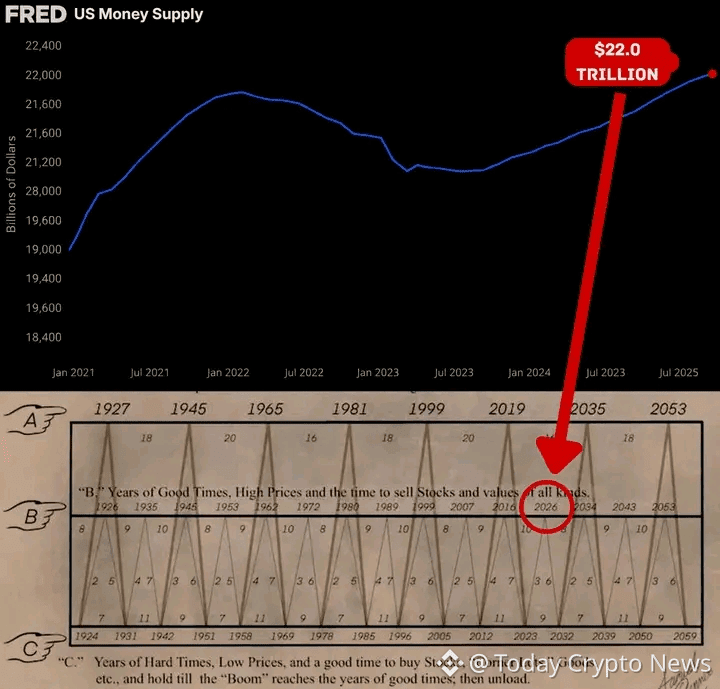
I’ve spent the last several hours reviewing recent liquidity data, and one thing is clear:
The U.S. financial system is entering a rare liquidity expansion phase.
Roughly $4.7 trillion is expected to circulate through the U.S. economy over the next 12 months.
This does not arrive all at once. It enters the system gradually, in distinct waves.
Understanding the sequence matters more than reacting late.
HOW THE LIQUIDITY FLOWS⚠️
This capital enters the economy in stages, each influencing markets differently.
Wave 1 | Early Year
Tax-related refunds and adjustments
Increased household cash flow
Initial boost to consumption, savings, and balance sheet repair
Markets often begin pricing this in before it shows up clearly in official data.
Wave 2 | Mid-Year
Corporate cash repatriation
Capital allocation toward buybacks, dividends, and strategic investments
This phase typically supports equity markets through improved corporate financial optics and shareholder returns.
Wave 3 | Late Year
→ Accelerated depreciation incentives
→ Front-loaded corporate spending and capital expenditure
Historically, this has acted as a short-term growth accelerator, particularly for cyclical and industrial segments.
WHY THIS MATTERS
Liquidity expansions do not create stability.
They create movement.
Markets tend to respond first, while economic data follows later.
That disconnect is where volatility — and opportunity — usually forms.
In the short term, increased liquidity often supports risk assets.
Over time, secondary effects such as inflation pressure and asset valuation risk begin to matter more.
THE KEY TAKEAWAY
This is not about emotion or headlines.
It is about understanding timing, sequencing, and positioning.
Liquidity can lift markets before fundamentals fully adjust.
The challenge is recognizing when momentum is being driven by flow rather than long-term value