

XRP reserves on two of the market’s most closely watched exchanges have declined to multi-month lows.
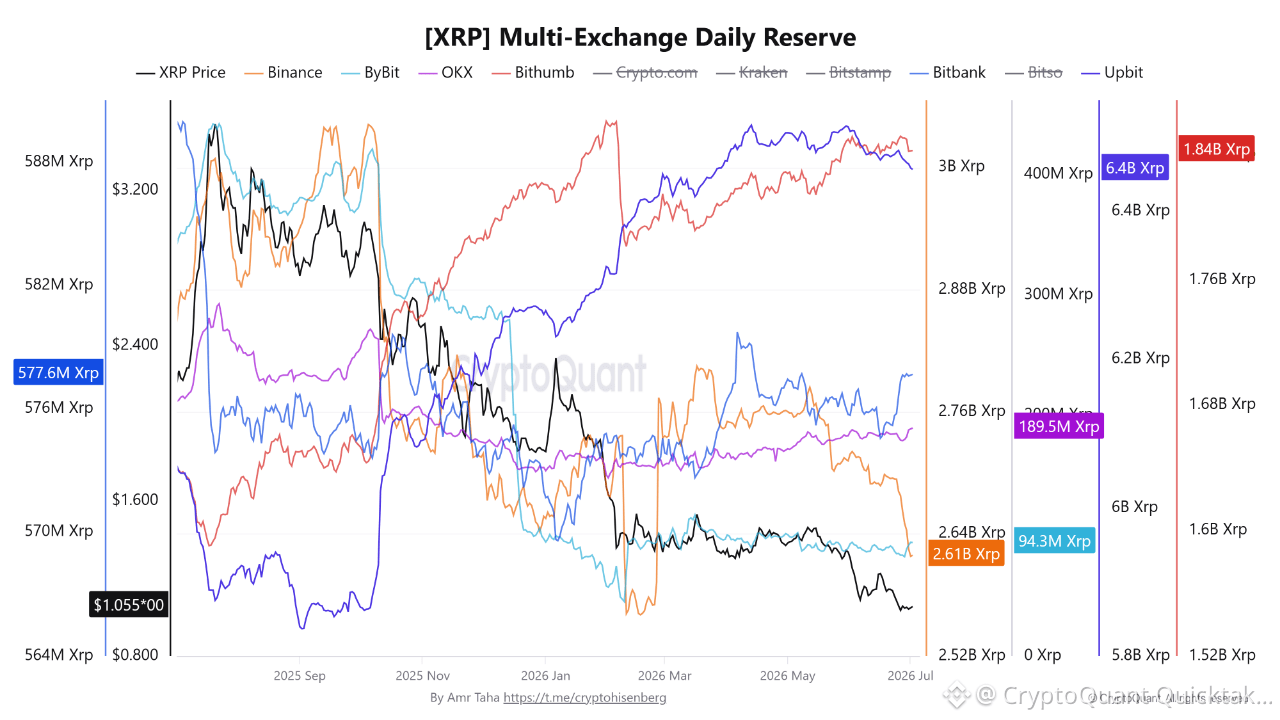
On Binance, XRP reserves fell from roughly 2.78 billion XRP on May 12 to 2.61 billion XRP on July 2—a decline of around 170 million XRP, or more than 6%.
The latest reading marks Binance’s lowest XRP reserve level since March 2026.
Upbit, which holds the largest XRP reserve among the exchanges tracked on the chart, also moved lower.
Its balance declined from approximately 6.515 billion XRP on May 30 to 6.457 billion XRP on July 2, a reduction of about 58 million XRP. That puts Upbit’s XRP reserve at its lowest level since April 2026.
Together, Binance and Upbit have seen roughly 228 million XRP removed from their tracked balances during the recent drawdown. While Upbit’s percentage decline is smaller, its reserve remains large enough that even modest changes can matter for XRP’s broader exchange-liquidity picture.
The move is particularly notable because the decline was not uniform across all Korean trading venues.
Bithumb’s XRP reserve remained broadly stable near 1.84 billion XRP, suggesting that the reduction is concentrated in specific exchanges rather than representing a broad withdrawal trend across every platform.
Binance appears to be the stronger signal in relative terms, with its reserve dropping more than 6% since mid-May.
Upbit adds a second important layer to the story: the largest tracked XRP reserve is also now sitting at a multi-month low.
Lower exchange-held balances can indicate that tokens are being moved into private custody, transferred between venues, or removed from immediately tradable supply. However, reserve declines alone do not confirm accumulation or guarantee a bullish price outcome. The key question is whether the reduced balances are followed by sustained demand and tighter spot-market liquidity.
Written by Amr Taha