
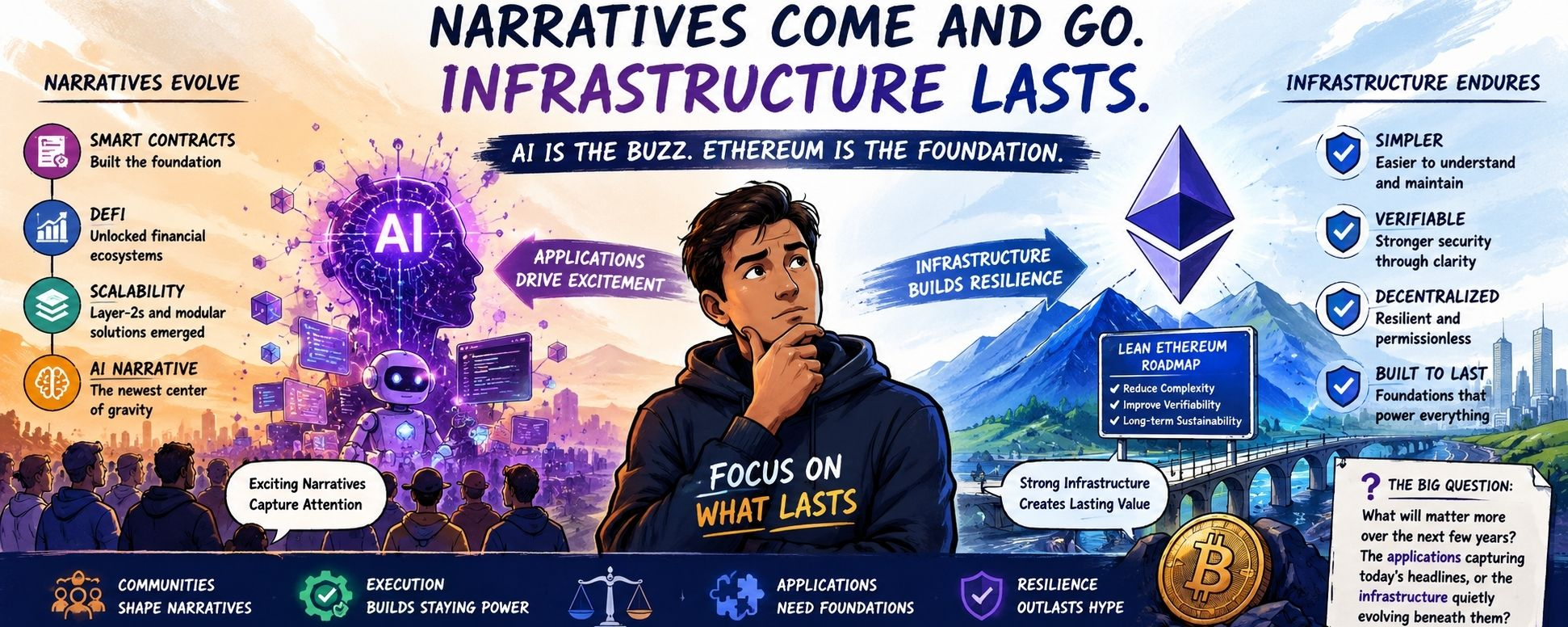
Over the past few market cycles, I've noticed that the biggest shifts in crypto rarely begin with price. They usually begin with a change in what the industry believes is worth building.
That difference matters.
Prices can move because of liquidity, speculation, or macro events. Narratives, on the other hand, tend to emerge when developers, researchers, and long-term participants begin focusing on solving a different class of problems. Looking back, every major cycle has had a defining theme.
The early years were dominated by the question of whether smart contracts could actually become useful infrastructure.
Then attention shifted toward decentralized finance, where protocols transformed blockchains from simple settlement layers into financial ecosystems.
As activity increased, scalability became the next challenge. Layer-2 networks, rollups, and modular architectures entered the conversation because adoption exposed the limits of existing infrastructure.
Now, it feels like AI has become the newest center of gravity.
Almost every week another AI-related protocol, infrastructure project, or autonomous agent appears. Some will disappear as quickly as they arrived. Others may end up defining the next phase of crypto.
Whenever a new narrative becomes dominant, I try to ask a different question.
Instead of asking which token might benefit the most, I ask what underlying problem everyone suddenly agrees needs solving.
That question usually reveals far more than short-term market excitement.
While watching the AI conversation grow, another discussion quietly caught my attention.
It wasn't about AI at all.
It was about Ethereum itself.
The recent conversation surrounding #VitalikOutlinesLeanEthereumRoadmap feels different from the usual roadmap discussions that appear every few months. Rather than introducing another massive redesign, the focus seems to be moving toward making Ethereum simpler, easier to verify, and easier to maintain over the long run.
That idea sounds surprisingly ordinary.
Yet historically, infrastructure improvements that appear "boring" often become some of the most important developments years later.
Crypto has a habit of celebrating visible innovation while overlooking invisible reliability.
Everyone notices new applications.
Far fewer people notice improvements that reduce technical debt, simplify validation, or make decentralized systems easier to secure.
But those improvements often determine whether an ecosystem can continue growing.
From my perspective, this creates an interesting contrast with the current AI narrative.
AI projects compete by promising new capabilities.
Ethereum's ongoing discussions increasingly focus on improving foundations.
Those aren't competing stories.
They're complementary.
Powerful applications eventually depend on dependable infrastructure.
One observation I've made across multiple market cycles is that narratives usually arrive before execution.
That's normal.
People become excited about an idea long before the ecosystem has fully built it.
DeFi experienced this.
Layer-2 networks experienced this.
Real-world asset tokenization experienced this.
Even Bitcoin experienced years where the narrative developed much faster than the supporting infrastructure.
The same pattern may be unfolding today.
AI has captured attention.
Infrastructure is quietly trying to catch up.
This is where execution becomes more important than storytelling.
Narratives create visibility.
Execution creates staying power.
The projects that survive are rarely the ones generating the loudest headlines.
They're usually the ones consistently reducing friction behind the scenes.
Another factor I've been paying closer attention to is how exchange ecosystems influence these conversations.
Communities across major exchanges, especially Binance Square, don't simply react to narratives anymore.
They actively shape them.
Thousands of analysts, developers, traders, and researchers contribute observations every day.
Certain themes begin appearing repeatedly.
Discussions evolve.
Ideas mature.
Eventually, the broader market starts recognizing patterns that community participants noticed much earlier.
That makes timing especially interesting.
By the time a narrative reaches mainstream attention, many of the deeper conversations have already been happening for weeks or months inside these communities.
Watching those discussions has become almost as valuable as watching price charts.
Sentiment leaves footprints before capital fully follows.
Of course, visibility alone doesn't guarantee success.
Crypto history is filled with projects that attracted enormous attention but struggled to deliver meaningful adoption.
Execution remains the difficult part.
That's why I find infrastructure conversations particularly valuable.
Infrastructure isn't designed to generate excitement every day.
Its purpose is to make future innovation possible.
When I think about Ethereum's long-term positioning, I don't immediately think about the next market rally.
I think about durability.
Can the network remain decentralized while becoming easier to maintain?
Can it improve efficiency without sacrificing security?
Can developers continue building increasingly complex applications on top of simpler core architecture?
Those questions may ultimately matter more than temporary market momentum.
Bitcoin often reminds the market that simplicity can become a strength.
Ethereum now appears to be exploring whether a similar philosophy can coexist with programmability and flexibility.
If that balance can be achieved, the implications extend beyond Ethereum itself.
Every ecosystem connected to Ethereum could benefit from stronger foundations.
That includes DeFi protocols, Layer-2 networks, tokenized assets, decentralized identity systems, gaming applications, and perhaps even future AI infrastructure.
One lesson I've learned from following crypto over the years is that technological progress rarely moves in straight lines.
Narratives rise.
Expectations become unrealistic.
Corrections follow.
Then the strongest ideas quietly continue developing while attention shifts elsewhere.
Months later, those same ideas suddenly look obvious.
Looking at today's market, I don't think the most interesting question is whether AI will remain the dominant narrative.
The more interesting question is whether the infrastructure supporting tomorrow's applications is improving at the same pace.
Because eventually every exciting application depends on reliable foundations.
The market often rewards innovation first.
History tends to reward resilience later.
That's why discussions like #VitalikOutlinesLeanEthereumRoadmap stand out to me.
Not because they promise immediate excitement.
But because they suggest that some of the industry's attention is returning to the fundamentals that make long-term innovation possible.
Sometimes the biggest signals aren't the loudest announcements.
They're the quiet architectural decisions that most people overlook until years later.
I'm curious whether we're entering another one of those moments—where infrastructure becomes the real story behind the next wave of crypto growth, even if the spotlight remains fixed on AI for now.
What do you think will matter more over the next few years: the applications capturing today's headlines, or the infrastructure quietly evolving beneath them?
#VitalikOutlinesLeanEthereumRoadmap $BTC #Write2Earn #ZakiWeb3Media