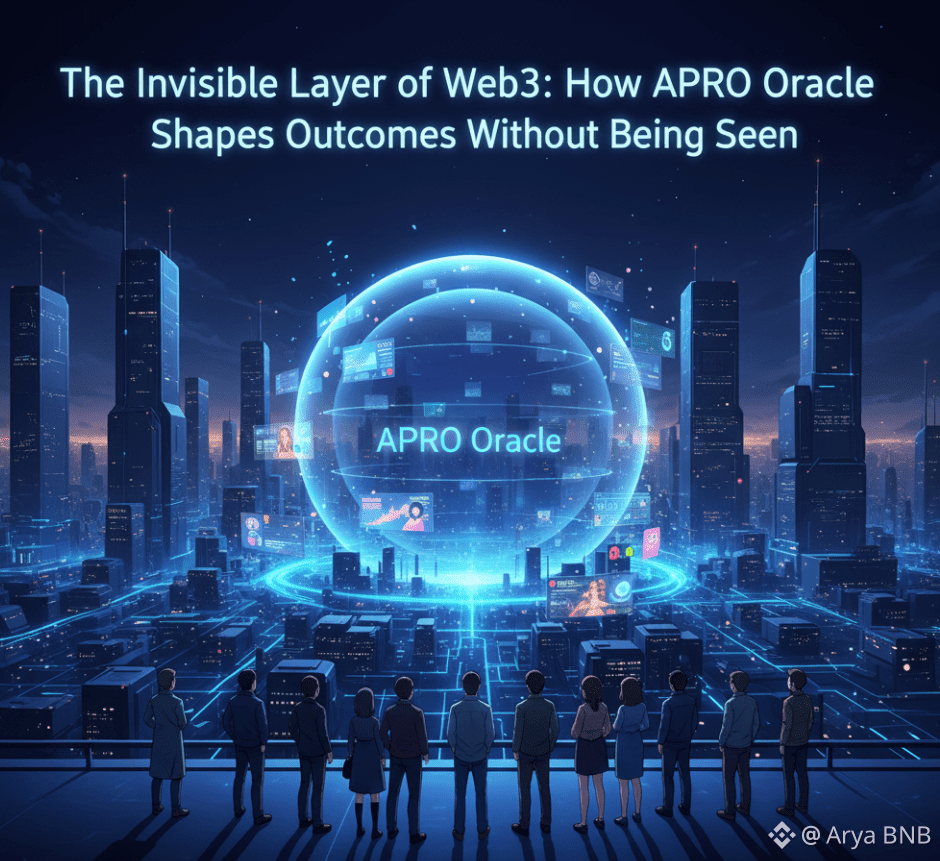
The most influential technologies are often the least visible. Users interact with applications, interfaces and tokens rarely considering the infrastructure beneath them. Oracles occupy this hidden layer quietly shaping outcomes by determining which version of reality smart contracts accept as truth. APRO Oracle operates deliberately within this invisibility focusing on influence through reliability rather than prominence.
In Web3, visibility often correlates with speculation rather than utility. APRO resists this dynamic by prioritizing integration depth over surface level adoption metrics. Its goal is not to be noticed but to be depended upon. This orientation influences everything from its technical architecture to its governance philosophy. APRO is built to endure not to trend.
The consequences of oracle design choices ripple outward in subtle but profound ways. A slightly delayed price feed can trigger liquidations. An unverified data source can undermine an entire protocol. APRO approaches these risks by embedding verification at multiple levels creating a layered defense against error and manipulation. This redundancy may appear inefficient on paper but it mirrors the design principles of critical infrastructure in other industries.
As decentralized systems grow more autonomous the role of oracles becomes even more consequential. Smart contracts increasingly execute complex logic without human intervention. In such environments the oracle is not merely an input provider it is a decision catalyst. APRO recognizes this responsibility and designs its systems to minimize single points of failure both technical and economic.
APRO’s influence also extends into developer culture. By offering flexible yet rigorous data validation models it encourages developers to think more carefully about their assumptions. Rather than treating oracle data as infallible APRO’s framework invites scrutiny and customization. This fosters a more mature development ecosystem where reliability is engineered rather than assumed.
The network’s governance model reinforces this ethos. Decisions are informed by empirical performance data rather than abstract ideology. Participants are incentivized to prioritize long term network health over short term gains. This creates a feedback loop where the system improves through use adapting to new threats and requirements without losing coherence.
From a broader perspective APRO reflects a shift in how Web3 infrastructure is valued. Early narratives emphasized disruption and replacement. APRO focuses instead on integration and augmentation. It does not seek to overthrow existing systems but to provide a trustworthy interface between decentralized logic and external reality.
This positioning may limit immediate recognition but it enhances longevity. Infrastructure that works quietly tends to persist becoming indispensable over time. APRO’s ambition lies in becoming one of those invisible constants rarely discussed deeply relied upon.
In the end APRO Oracle’s greatest achievement may be its refusal to center itself. By prioritizing outcomes over attention it shapes the trajectory of Web3 from behind the scenes proving that the most powerful layer is often the one you never see.