

The world is entering one of the most uncertain economic periods in modern history.
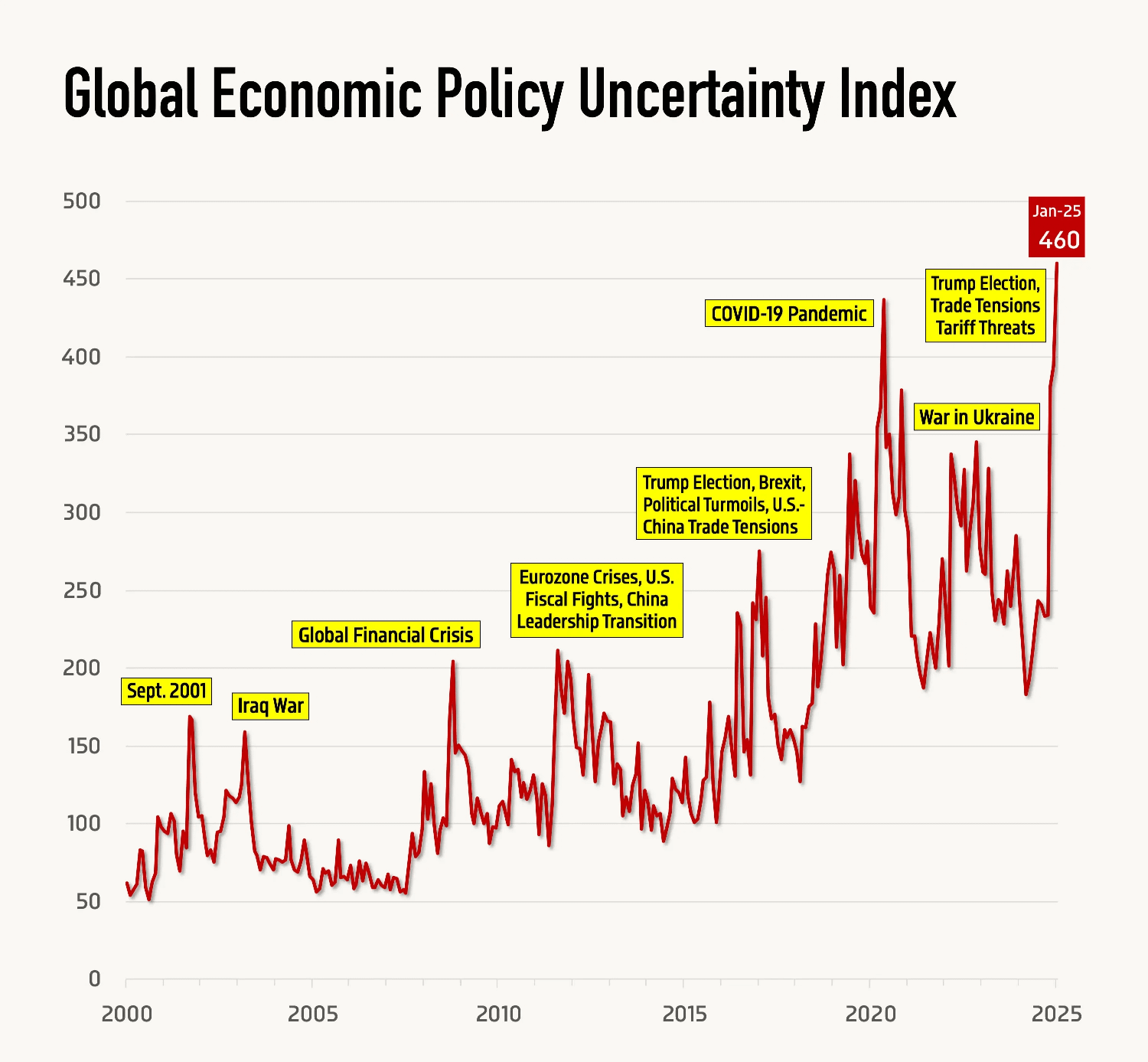
According to the Global Economic Policy Uncertainty (EPU) Index, policy-related uncertainty has surged to extreme levels, reaching 460 in January 2025, the highest reading in the chart’s history. For context, this is significantly above previous crisis peaks, including the Global Financial Crisis and the COVID-19 pandemic.
The message is clear: global stability is fragile.
And markets, especially crypto, are paying attention.
A History of Shockwaves
The chart tells a powerful story.
Since 2000, spikes in the Global Economic Policy Uncertainty Index have aligned with major geopolitical and financial disruptions:
September 2001 attacks
Iraq War
Global Financial Crisis (2008)
Eurozone debt crisis
Brexit & U.S.–China trade tensions
COVID-19 pandemic
War in Ukraine
Election cycles and tariff threats
Each of these events triggered fear, policy shifts, and market volatility.
But what stands out today is not just another spike; it’s the magnitude and persistence of uncertainty. Unlike short-term shock events, recent readings suggest prolonged instability.
January 2025: A Historic High
The index hitting 460 in January 2025 marks a structural shift rather than a temporary panic.
This surge reflects a combination of:
Intensifying geopolitical tensions
Election-related policy uncertainty
Trade friction and tariff rhetoric
Ongoing war-driven economic disruptions
Fragile global supply chains
Markets thrive on predictability. When policy direction becomes unclear, capital hesitates.
Why This Matters for Financial Markets
Historically, high policy uncertainty leads to:
Lower business investment
Delayed capital allocation decisions
Increased market volatility
Flight to perceived safe-haven assets
During the 2008 crisis and the 2020 pandemic, traditional assets experienced violent swings. Central banks responded with liquidity injections.
Today’s environment is different. Inflation pressures, debt levels, and geopolitical fragmentation limit how aggressively policymakers can react.
That constraint increases risk.
The Crypto Angle: Risk Asset or Safe Haven?
Crypto’s role during periods of uncertainty is evolving.
In earlier years, Bitcoin behaved largely as a high-beta risk asset, falling alongside equities during global stress.
But the structural backdrop is changing.
When:
Trust in monetary policy weakens
Sovereign debt rises
Currency debasement fears grow
Investors begin reassessing alternative stores of value.
Bitcoin was born during the 2008 financial crisis — a direct response to systemic instability. In a world where policy uncertainty is reaching record levels, that origin story becomes relevant again.
Volatility Is the New Normal
The chart shows that spikes in uncertainty are becoming more frequent and more intense over time.
What does that mean?
Markets may no longer experience clean, multi-year stability cycles. Instead, we could see:
Faster rotations between risk-on and risk-off
Sharp liquidity shifts
Shorter macro cycles
Heightened geopolitical sensitivity
For crypto traders, this means:
Volatility is not an anomaly, it’s structural.
A Structural Transition in the Global System
The steady upward trend in the uncertainty index suggests something deeper than isolated crises.
We are likely witnessing:
A transition from globalization to fragmentation
Multipolar economic power dynamics
Persistent trade conflicts
Political polarization in major economies
This is not just a cycle, it may be a systemic reset.
And systemic resets historically create both risk and opportunity.
What Investors Should Watch
If the uncertainty index remains elevated, expect:
Continued volatility in equities and bonds
Increased demand for non-sovereign assets
Heightened importance of liquidity conditions
Faster reaction to geopolitical headlines
For crypto specifically, monitoring macro uncertainty alongside ETF flows, liquidity data, and central bank positioning will be critical.
Final Thoughts
The Global Economic Policy Uncertainty Index reaching 460 is more than a statistic — it’s a warning sign.
The world is navigating overlapping crises: political, economic, and geopolitical.
In such an environment, capital seeks clarity.
And when clarity is scarce, markets move sharply.
The coming years may not be defined by steady growth, but by adaptation to persistent uncertainty.
For investors, that means preparation, discipline, and understanding the macro forces shaping the next move.
Because when uncertainty becomes the norm, strategy matters more than ever.