
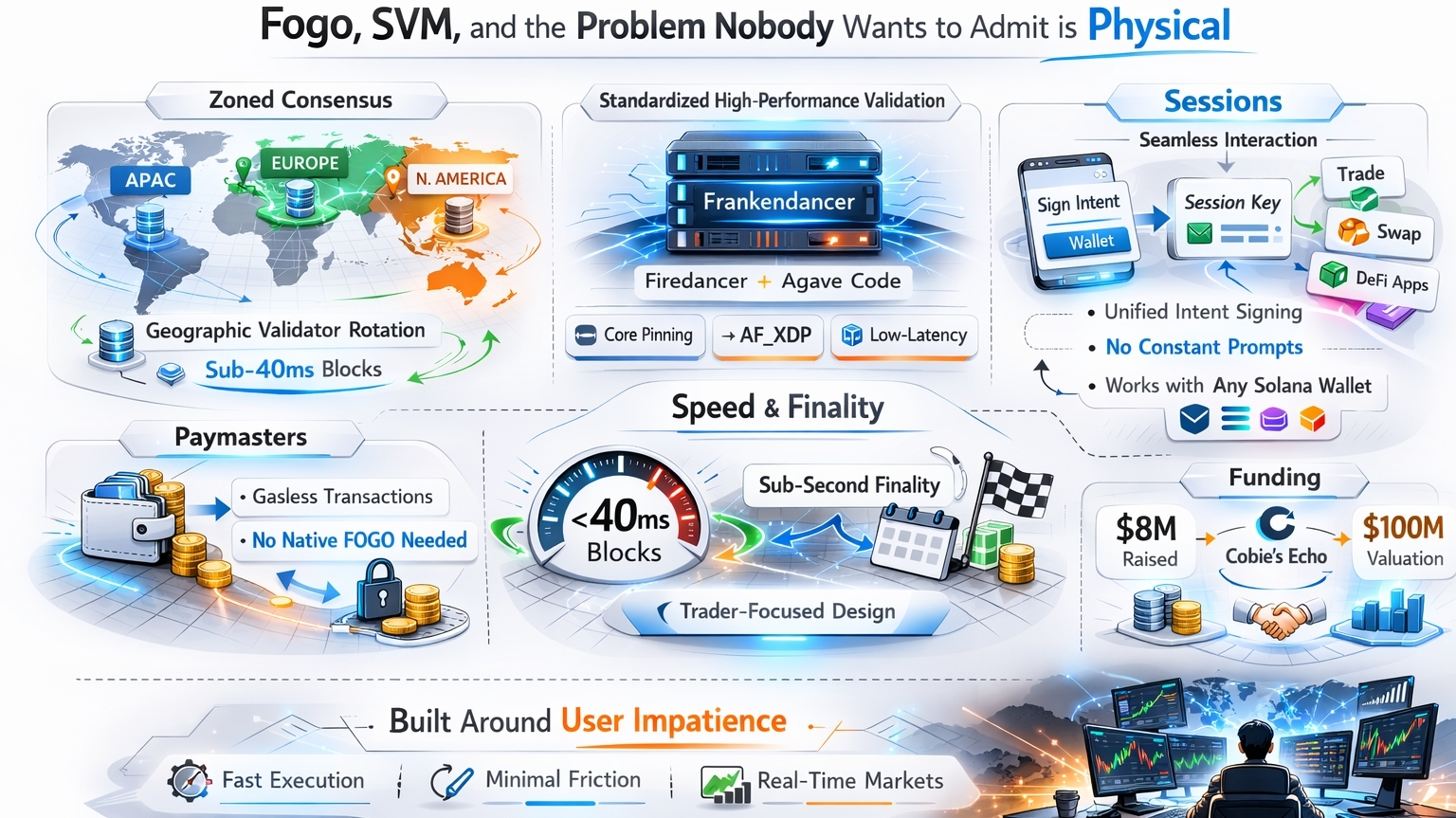
The first time I saw Fogo described as “an SVM L1,” my instinct was to shrug and move on. I’ve watched that phrase get stapled onto a dozen projects across a couple cycles—usually as shorthand for “we want Solana’s speed without Solana’s baggage,” which is fine, until you realize most of them are really just chasing a vibe. Fogo pulled me back in because it didn’t start where most chains start. It started with the uncomfortable stuff: the physics and the tail latency and the reality that your user experience is governed by the slowest and furthest parts of the network, not the average. That framing is all over their litepaper, and it’s the kind of thing you only lead with if you’ve actually felt the pain you’re trying to solve.
I’ve been around long enough to stop caring about “throughput” as a flex. In practice, the chains that feel good under pressure are the ones that keep confirmation times from getting weird when everyone shows up at once. The moment you’re trying to move quickly—trading, unwinding, rolling positions, saving yourself from a liquidation—you don’t think in TPS. You think in seconds that feel like an insult. Fogo’s entire posture is basically: stop pretending the network is uniform, and stop pretending geography doesn’t matter.
Their big architectural swing is zoned consensus—validators grouped into geographic zones, with only one zone active in consensus at a time, rotating over epochs. It’s a blunt trade. Instead of trying to make a globally scattered quorum behave like a low-latency system, they localize the critical path so confirmations aren’t constantly hostage to the slowest routes across the planet. The docs talk about “multi-local consensus” in plain terms, and if you’ve ever built or run distributed systems, you can feel the logic: lower variance beats higher idealism when your goal is a chain that behaves like a venue.
I noticed the details because the details are where this stuff either becomes real or turns into a pretty diagram. Their testnet docs lay out the zones (APAC, Europe, North America), and they’re explicit about target timings like ~40ms blocks and an epoch cadence defined in blocks. That’s not a promise that everything will always be perfect—nothing is—but it’s an honest blueprint of how they’re thinking about time.
The other thing that made Fogo feel less like a narrative play and more like a systems play is how hard they lean into standardizing validator performance. Most chains are allergic to the idea of telling validators what to run, because decentralization culture tends to treat any kind of enforced baseline like heresy. Fogo is more like: if you want consistently low latency, you cannot let the validator set be a zoo. Their litepaper talks about “standardized high-performance validation,” and it’s clear they’re building around Firedancer, with their mainnet client described as “Frankendancer,” a hybrid that uses Firedancer components with Solana’s Agave code.
That choice reads to me like someone with a latency problem, not someone with a marketing problem. The litepaper goes into the weeds—process isolation, core pinning, shared-memory queues, and kernel-bypass networking via AF_XDP. It’s the sort of engineering detail you don’t include unless you’re trying to compress variance, because variance is what makes “fast” feel fake the minute real users arrive.
On the “SVM compatibility” side, they’re not trying to reinvent the whole developer experience. The docs make it straightforward: Solana tools, Solana patterns, and an environment meant to feel familiar to anyone who already ships on Solana. That part matters more than people admit, because ecosystems don’t move when you ask builders to become new people. They move when it’s close enough that teams can reuse their instincts.
But the part that sticks with me—because it’s the part that touches actual daily usage—is Sessions.
I’ve watched “gasless” get turned into a cheap word. Half the time it means “someone else pays but now you’re boxed into their rails,” and the other half it means “you’ll still pay, just later, somewhere you didn’t notice.” Fogo Sessions is different in a subtle way: it’s trying to turn smooth interaction into a standard instead of a fragile app-specific hack. The docs describe a user signing a single intent message, then interacting through a scoped session key so they aren’t constantly interrupted by wallet prompts. The intent includes protections—domains that restrict which on-chain programs the session can touch, and optional limits on tokens and amounts. It’s not “trust us.” It’s “here are the guardrails.”
The bit I keep coming back to is that Sessions is explicitly designed to work with any Solana wallet—even ones that don’t support Fogo natively—because the user signs an intent message using familiar wallet flows. That’s not a small UX detail. Wallet fragmentation is one of those slow leaks that kills onchain apps quietly. You can have the best protocol and still lose users because they don’t want to install yet another thing just to try an app for five minutes.
Then there’s the paymaster angle. Sessions includes paymasters so users can transact without holding native gas, which is the kind of feature that sounds like “onboarding” until you’ve actually dealt with the reality of stranded accounts and “send me dust so I can do the next action.” The docs talk about paymasters directly, and the Sessions repo frames it in the same practical tone—less signing, fewer rescue transactions, fewer weird edge cases that turn a normal user into a support ticket. There’s even public package documentation floating around for a “fogo-paymaster” crate that describes funding user transactions so they don’t need native FOGO, which tells you this isn’t just a concept—there’s code orbiting it.
When people ask me what a chain is “for,” I usually answer by looking at what it obsessively removes. Fogo is obsessed with removing latency and interruption. Even their own site copy is blunt about that culture—built for traders, minimal friction, loud tone. You don’t have to like the vibe, but it does make the positioning honest: they’re not pretending to be everything to everyone.
Outside sources describe the same emphasis—sub-40ms blocks, a trading-first end-user experience, and the idea that colocation/locality is part of how they chase consistent performance. CoinGecko’s overview, for example, explicitly frames it around fast blocks and sub-second-ish finality targets through architecture choices like validator colocation, while noting the SVM compatibility angle for migration. I treat “finality” claims carefully because the market eventually punishes hand-waving, but it’s useful as a snapshot of how the project is being understood publicly.
The funding story also fits the profile of something that’s trying to be a serious venue. The Block reported that Fogo raised $8M via Cobie’s Echo platform at a $100M token valuation, and that the co-founder had Jump Crypto ties—again, not a guarantee of anything, but consistent with the engineering emphasis on Firedancer and performance.
Where I get more cautious—because I’ve learned to—is the token and disclosure layer. Fogo has a MiCA-style token white paper published that includes regulatory warnings and structured disclosures. That alone tells you they’re operating with an expectation of scrutiny, not just vibes. But it also means you’ll sometimes see economic details stated in slightly different ways across documents and venues, which is why I always read primary docs twice before treating anything as settled truth.
And then there’s the whole “who actually stays” question—the one nobody can answer with architecture. Explorers and dashboards can show block times and activity, but they don’t show whether liquidity is loyal, whether builders are shipping, whether apps feel inevitable or forced. The first real test for a chain like this isn’t whether it can hit 40ms blocks on a good day. It’s whether it still feels clean when the market is doing that thing where everyone panics at once and your hands start moving faster than your brain.
That’s the window I’m watching for with Fogo. Not the polished moments. The ugly ones. The days when something breaks elsewhere and users stampede looking for a venue that doesn’t stutter. If Fogo’s choices—localized consensus rotation, standardized high-performance validation, session-based UX that doesn’t make you sign your life away—hold their shape under that kind of stress, you’ll see it in how people talk. Less theory. More “I used it and it didn’t get in my way.” And if it doesn’t hold up, you’ll see that too, because crypto is ruthless about performance when money is on the line.
For now, Fogo feels like a project that’s betting the next phase of onchain activity looks more like real-time markets than like slow, ceremonial blockspace. Maybe that’s exactly what the cycle wants. Maybe it isn’t. I just know I’ve learned to pay attention to protocols that are built around a specific kind of user impatience—the kind that shows up not in tweets, but in the milliseconds between intention and execution.
