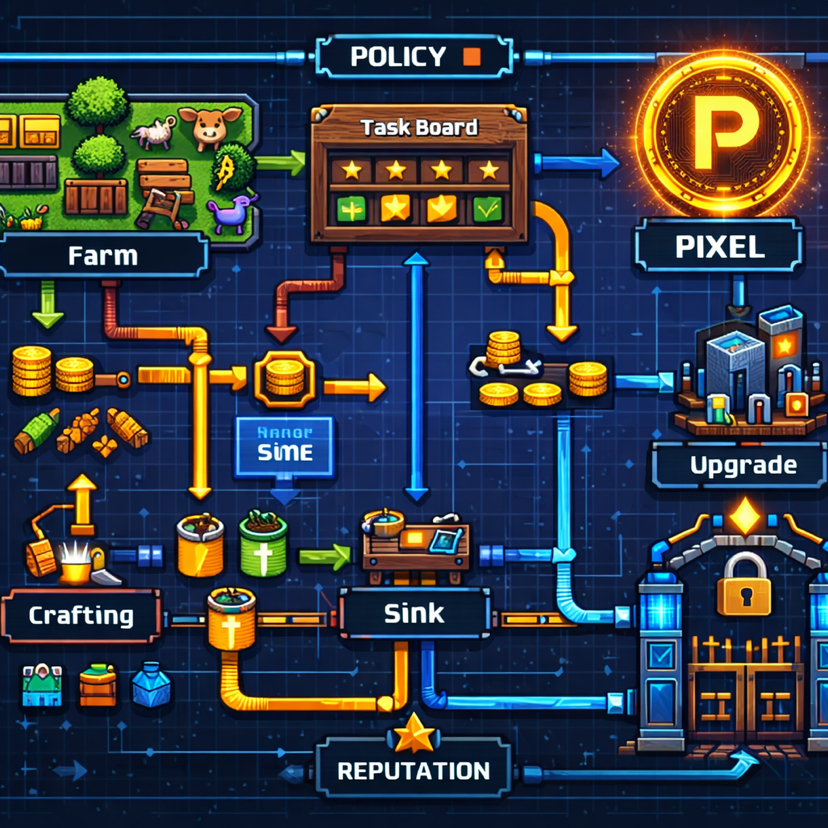
That is the thesis I keep returning to. Most people follow the price. I follow the rules. Because in a game economy, the token matters less as a chart and more as a steering wheel. The real question is not “Will PIXEL pump?” It is: How does Pixels control flow, access, and extraction inside the game?
30-Second Alpha Box
PIXEL now sits inside a tighter Chapter 2 economy. The new Coin vs. PIXEL split matters. Coins handle more of the day-to-day play loop, while PIXEL stays closer to the higher-value economic layer. At the same time, the Task Board has been tightened into the main route for earning, which makes rewards more structured and less open-ended. That usually means one thing: the project is trying to make emissions cleaner, sinks more meaningful, and bot farming less profitable. That is where the alpha is.
1) The Policy Token Thesis
Here is my contrarian take. Most people still frame PIXEL as a “GameFi reward token.” I think that is too shallow. PIXEL is better understood as a policy token. It does not merely reward activity. It helps decide what kind of activity is worth rewarding.
Chapter 2 makes this clearer. The game is shifting resource generation, task structure, and progression pressure. When a project does that, it is not just changing gameplay. It is re-pricing behavior. The distinction between Coin and PIXEL reinforces that separation. Coin can support daily utility. PIXEL sits closer to strategic value, economic gating, and system design. That is important because tokens with policy function usually survive better than tokens with only narrative function.
2) Hybrid Infrastructure & Ronin
My second contrarian moment: many people talk about Ronin only as a cheap chain for gaming. That misses the point. Ronin matters because Pixels needs high-frequency gameplay with on-chain credibility. Games require fast actions. Economies require auditability. Those two things usually fight each other.
Pixels’ hybrid model solves that tension. The game can keep the loop smooth, responsive, and familiar to players. But the meaningful economic events still need a settlement layer that can be tracked. That is what makes Ronin strategic. It lets Pixels preserve speed without giving up the ability to measure ownership, rewards, and resource flows. In other words: off-chain for play, on-chain for truth.
3) The Reputation Firewall
Here is where the real GameFi lesson lives. Previous GameFi cycles were often killed by bot inflation. Not because the games were always bad. But because the reward loops were too easy to industrialize. Once farm behavior becomes more profitable than play behavior, the economy starts eating itself.
Pixels’ answer is reputation. And I think that is more important than most people realize. A reputation firewall does not try to ban every bad actor. It tries to make extraction harder than participation. That is smarter. If access to tasks, yields, progression, or special activity gets tied to behavior quality, then the system can defend itself without freezing the game. The tightening of the Task Board fits this logic. Less loose access. More controlled distribution. More pressure on real engagement.
That is not just anti-bot design. It is economic defense.
4) Alpha Indicators for the Next 3 Months
This is the part I would watch closely.
First: Emission vs. sinks.
If Coins increase daily activity but do not create enough pressure to spend, the economy gets noisy. If PIXEL remains the hard-to-earn layer while sinks stay real, the token keeps policy value.
Second: Task Board calibration.
If the board gets tighter again, that signals the team is still controlling output. If it loosens too fast, the economy may be chasing engagement at the expense of balance.
Third: Coin-to-PIXEL conversion behavior.
I want to see whether players treat Coin as disposable utility and PIXEL as strategic accumulation. That split would validate the new design.
Fourth: Chapter 2 resource flow.
If resource generation keeps being rebalanced, then the project is actively managing inflation instead of just reacting to it. That is a good sign.
Watchlist
Daily task board structure
Coin utility vs. PIXEL utility
Emission pace after Chapter 2
Sink strength in crafting, upgrades, and progression
Signs of bot pressure vs. real player retention
My view is simple. PIXEL should be judged as a control system, not a hype token. If the team keeps tightening emissions, preserving meaningful sinks, and forcing the economy toward real play rather than farm loops, then PIXEL has something stronger than narrative. It has structure.