
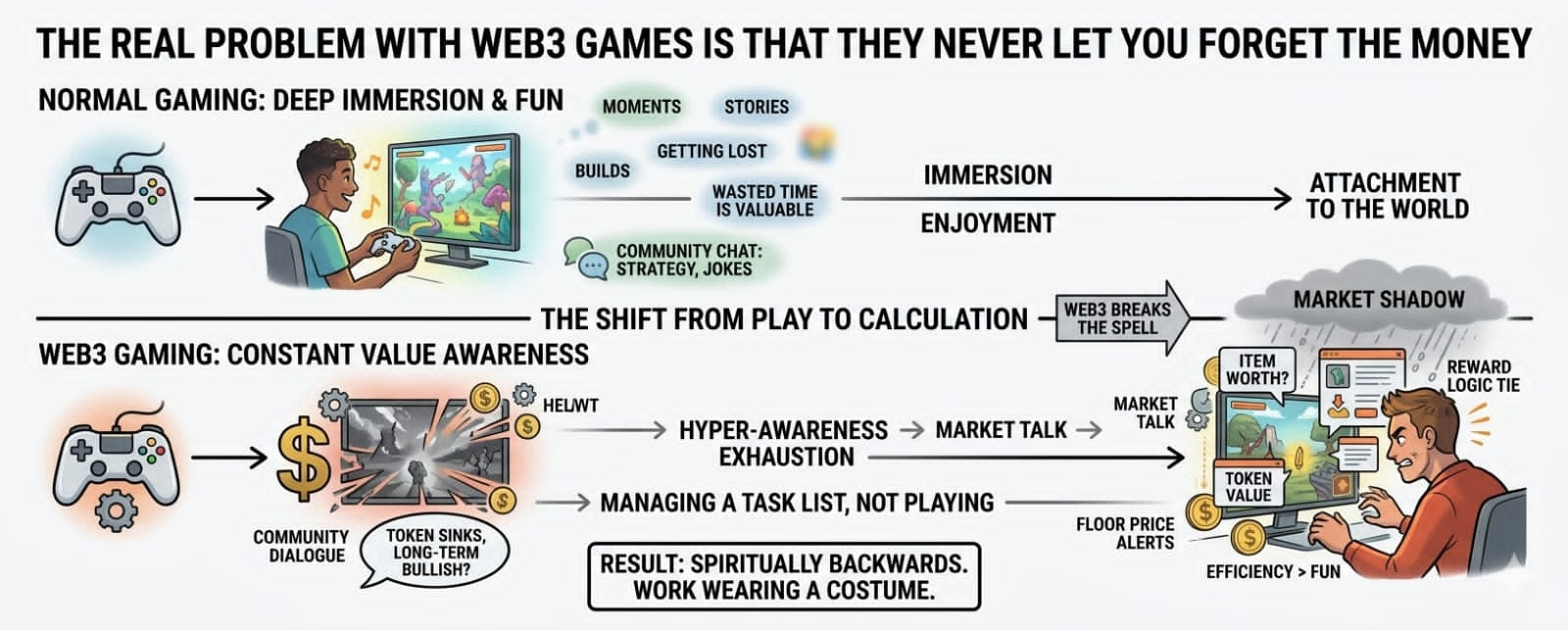
The thing that wears me out with Web3 games is not even the bad graphics anymore. I can live with rough art. I can live with janky menus. I can even live with some bugs if the game has a pulse. What I cannot stand is when a game keeps reminding me that there is money sitting behind every part of it. That kills the mood faster than anything.
A normal game lets you sink into it. That is the whole deal. You stop thinking about the outside world for a bit. You get into the loop. You care about the world, the timing, the progress, the stupid little things that should not matter but somehow do. That is what games are good at. They hold your attention in a way that feels natural. Not forced. Not explained. It just happens.
Web3 games keep breaking that spell.
You log in and there is always some extra weight hanging over everything. Every item feels like it is supposed to be worth something. Every action feels tied to some reward logic. Every community discussion turns into market talk sooner or later. It is never just about whether something is fun. It is whether it is valuable. Whether it is efficient. Whether it is sustainable. Whether the token helps. Whether the economy supports it. Whether the update is bullish. It is exhausting.
And I think that is why so many of these games feel hollow even when the basic design is fine.
Because the minute a player starts thinking like a calculator, part of the magic is gone.
That sounds dramatic, but it is true. A game needs room for wasted time. That is one of the things people forget. Good games are full of time that is technically useless but emotionally important. Wandering around. Messing up. Trying dumb stuff. Getting distracted. Chasing something for no good reason. That kind of wasted time is not actually wasted. It is where attachment comes from. It is where a world starts feeling like a world instead of a task list.
Web3 games hate wasted time. They want everything measured. Every loop justified. Every player action tied to value somehow. That is the poison. Once you train people to see the world through output, they stop playing naturally. They start managing themselves. Optimizing themselves. And that makes the whole thing feel smaller.
You can see it in the communities too. In a normal game, people talk about moments. Stories. Builds. Fights. Weird bugs. Stuff they found. Stuff that annoyed them. Stuff that made them laugh. In a Web3 game, so much of the conversation gets dragged into economics. People start sounding like part-time analysts trapped in a game lobby. It is all reward balance, supply pressure, floor price, token sinks, long-term emissions, value accrual. Even when the points are valid, the mood is dead. Completely dead.
And the worst part is, the industry acts like this is maturity. Like this is what smarter gaming looks like.
I do not buy that at all.
It is not more advanced. It is just more self-conscious. More tense. More crowded with incentives. There is a difference. A lot of these systems do not deepen the experience. They shrink it. They make players hyper-aware of outcomes in a way that stops them from enjoying the game on its own terms.
That is why so many Web3 games feel like they are asking for the wrong kind of attention. They do not want you to get lost in the world. They want you to stay alert. Track value. Watch the system. Stay aware of what things mean outside the game. But once I am doing that, I am not really immersed anymore. I am half inside the game and half outside it, thinking about price, rewards, scarcity, demand. That split ruins a lot.
And no, this does not mean every game with an economy is doomed. Games have always had economies in some form. Trade, rarity, status, grinding, all that stuff is old. The issue is not that value exists. The issue is that Web3 games push value so close to the surface that it starts leaking into every emotion. Winning feels different. Grinding feels different. Even relaxing feels different when your brain knows there is a market shadow hanging over the whole thing.
That market shadow changes player behavior in ugly ways too. It pulls in people who are not there for the world at all. They are there for extraction. Quick gains. Arbitrage with better branding. And once enough of that energy enters a game, everybody else feels it. The social space changes. The vibe gets thinner. Less trust. Less play. More calculation. More suspicion. More eyes on what can be taken out instead of what can be built inside.
That is why I think the best Web3 games, if they ever really figure it out, will need to hide the money better. Not remove it completely. Just stop putting it in the center of every conversation and system. Let the game breathe. Let players be stupid for a while. Let them get attached before the economy starts yelling in their ear. Build a place first. Then maybe build the market around it, quietly, carefully, like it knows it is supposed to serve the experience instead of replacing it.
Because right now it is the other way around too often. The game exists to justify the economy. The world exists to support the token. The fun exists to make the system more acceptable. Players can feel that. They always can. Even if they do not explain it in those words, they feel it. That is why so many people bounce off these games so fast. It is not always because the mechanics are awful. Sometimes it is because the whole thing feels spiritually backwards.
A game should make you forget yourself a little. Forget the clock. Forget the money. Forget the fact that everything outside the screen is measured and priced and tracked. If your game cannot give people that, then all the ownership talk in the world is not helping. It is just making the escape worse.
That is the mess Web3 gaming still has not solved. Not onboarding. Not scaling. Not user education. Mood. It keeps building games that refuse to let players relax into them. And until that changes, a lot of this stuff is going to keep feeling like work wearing a costume.
