
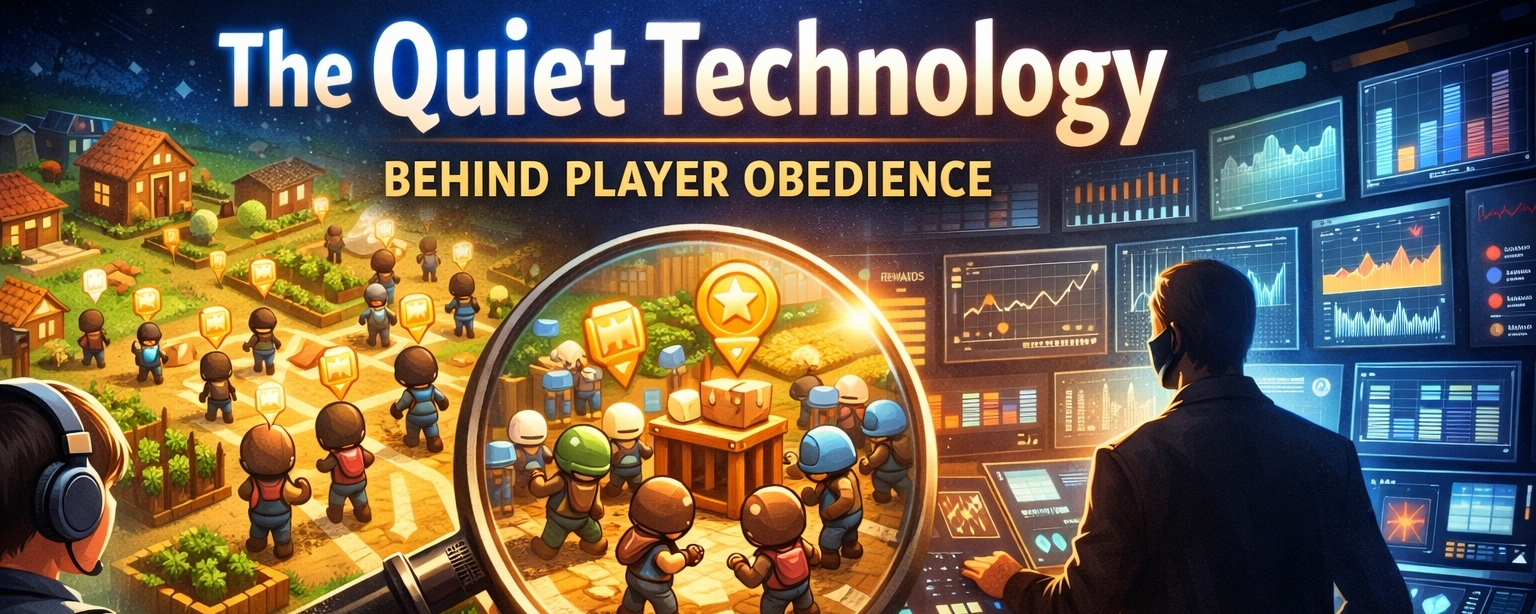
People still talk about live-service games as if the hardest part is technical. Graphics. Servers. Scale. Stability. Those things matter, obviously. But they are the problems everyone can see. They are easy to point at, easy to measure, easy to blame when something goes wrong.
The more difficult problem is usually harder to notice. It lives inside the loop that tells players what matters, what is worth doing, and what is worth coming back for. Once you start paying attention to that part, a lot of modern games stop looking like simple entertainment and start looking more like systems that are quietly shaping behavior in real time.
That is what makes Pixels worth watching.
At first glance, it looks familiar enough. A social economy, a daily routine, a list of tasks, a gentle cycle of return and repetition. None of that feels unusual anymore. What becomes interesting is what happens when the rewards change. All at once, large groups of players begin doing the same thing. They gather around the same objective. The world starts to feel less like a place people move through naturally and more like a place where movement is being guided.
Then the incentives shift again, and the crowd shifts with them.
That pattern reveals something slightly uncomfortable. In many online games, player choice is not as independent as it seems. What looks like preference is often just reaction. Players follow value signals very quickly, especially in systems where time, progress, and profit are closely tied together. The reward structure is not just paying people for play. In a very real sense, it is telling them how to play.
Once you notice that, the usual conversation about game balance starts to feel a little too narrow. This is not just about adjusting numbers so one activity does not become too strong or one strategy does not take over everything. It is closer to behavioral steering. Rewards influence where attention gathers, which habits become normal, what kinds of play grow, and which kinds of players end up with the advantage. When that system is badly designed, the damage is not theoretical. Economies bend out of shape. Repetition becomes dull and dominant. Bots find room to thrive. Real players begin to feel that they are not really living in a world anymore. They are just responding to instructions.
And that is where the real cost shows up.
A weak reward system can damage a healthy game faster than mediocre visuals ever will. Graphics do not usually break trust. Rewards do. The moment players feel that effort no longer leads to something meaningful, or that the system is rewarding the wrong kind of behavior, the game begins to wear down from within. It becomes louder, emptier, more mechanical. People may still log in, but something important has already started to disappear.
What Pixels seems to have understood is that rewards are not just a layer sitting on top of gameplay. They are part of the core machinery. They shape movement, motivation, retention, and economic pressure all at once. Once a studio sees that clearly, it stops treating rewards like a minor design feature. It starts treating them like live infrastructure.
That seems to be the deeper significance of Stacked.
What appears to have started as a response to one game’s internal problems now looks more like a system that can stand on its own: something built to observe behavior, read patterns, and deliver rewards with a level of timing and precision that hand-tuned design cannot easily match. That matters because it suggests a shift in where the real value lies. Not only in the game itself, but in the machinery that keeps the game from sliding into exploitation, boredom, or collapse.
And that points to a larger issue beyond Pixels.
The industry often assumes that when a game fails to keep players, the reason must be content, art direction, or weak mechanics. Sometimes that is true. But sometimes the problem is different. Sometimes a game does not fail because it lacks fun. Sometimes it fails because it rewarded the wrong behavior, at the wrong time, in the wrong way. It trained players to optimize instead of explore, to farm instead of inhabit, to extract instead of care. And once those habits settle in, the world starts to feel strangely hollow, even if it is hard to explain exactly why.
That possibility should probably concern more studios than it does.
Because if reward systems really are this powerful, then they matter far more than the market has usually admitted. They are not just retention tools. They help shape the culture inside a game. They influence whether a world feels alive or merely efficient. They affect whether a player feels understood or simply processed.
There is also something a little unsettling about how smooth this can become. The most effective reward systems do not feel manipulative in any obvious way. They feel natural. Timely. Relevant. So well placed that the player experiences them as if they simply fit. But often that feeling of “fit” is exactly what happens when a system becomes very good at prediction.
That is where the conversation becomes more serious.
If one game can build a strong engine for shaping behavior through rewards, then that engine is no longer just about one game. It becomes something other studios can adopt. Other economies can be built on top of it. Entire ecosystems can begin using the same logic to decide what players do, when they do it, and what keeps them coming back. At that point, the breakthrough is not just a successful title. It is a repeatable framework for managing participation.
That changes the way tokens, platforms, and network effects might be understood as well. The value is no longer tied only to whether a single game stays popular. It starts to depend on whether the underlying reward logic spreads across many games. If that happens, then what once looked like a narrow in-game system starts to look more like shared infrastructure.
That is a much bigger story than most people seem to notice.
On the surface, the conversation is still about farming loops, quests, progression systems, and digital economies. Underneath that, the real question may be simpler and more important: who is learning to direct player behavior most effectively at scale? And once that becomes the real subject, the issue is no longer just whether Pixels managed to solve its own problems.
It is whether the future winners in games will be the studios that build the most interesting worlds, or the ones that become best at quietly guiding how people move inside them.