
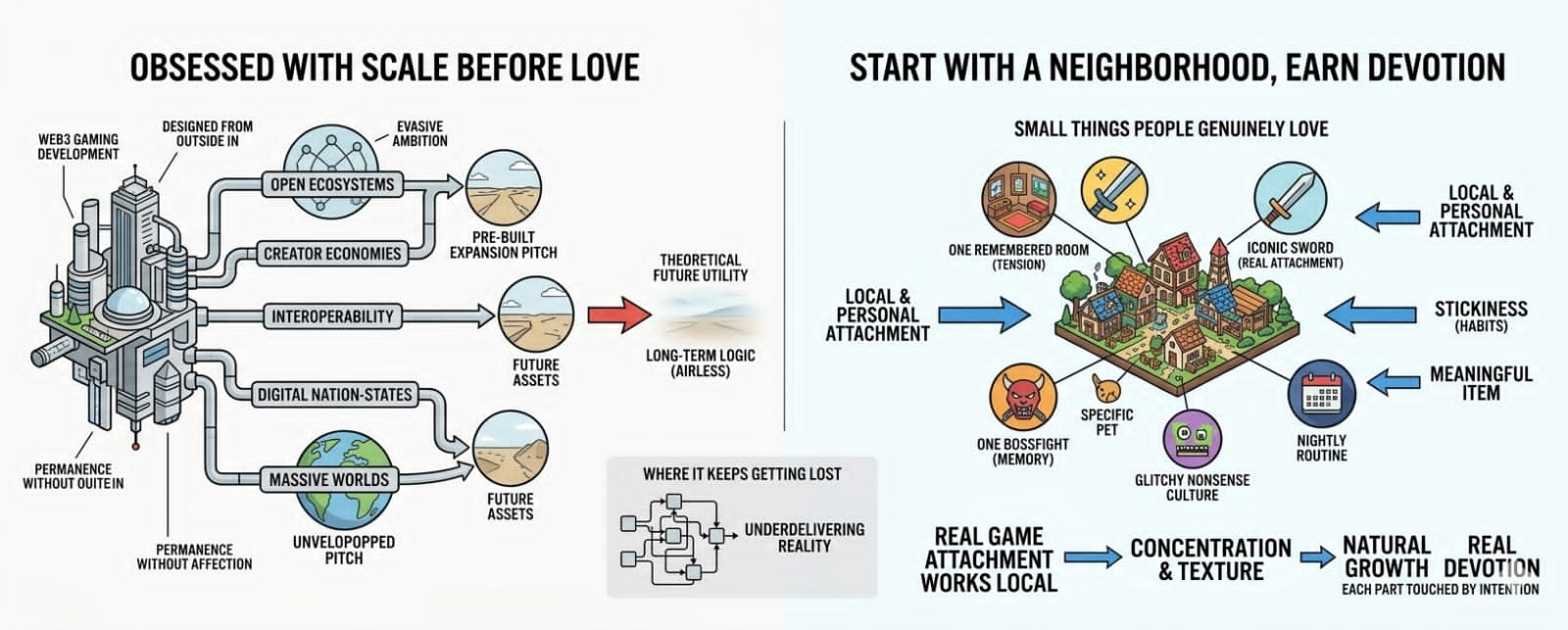
There is a certain kind of failure that only happens when an industry gets too excited about its own future. It stops building things for human beings and starts building presentations for other builders. That is where Web3 gaming keeps getting lost. It is forever talking about scale, infrastructure, interoperability, creator economies, digital nation-states, open ecosystems, and whatever the next giant phrase is supposed to be. Meanwhile it still struggles to make one small thing that people genuinely love without needing a manifesto attached to it.
That imbalance says everything.
The space is addicted to the horizon. Every pitch reaches outward. Massive worlds. Endless economies. Cross-game assets. Player-owned universes. Expanding platforms. Entire civilizations of value. It all sounds enormous, and that is exactly the problem. The ambition is always miles ahead of the evidence. Before a project has made a town people care about, it is promising a continent. Before it has made a good item loop, it is talking about an open metaverse. Before players love one weapon, one pet, one corner of one map, the studio is already explaining how those things might travel across a dozen future experiences.
That kind of thinking is not visionary. Most of the time it is evasive.
Because small love is harder than big language.
It is easy to talk about ecosystems. It is hard to make a place players remember. It is easy to sell the dream of portability and permanence. It is much harder to create one sword that feels iconic in a way no spreadsheet can explain. Real attachment usually starts at a ridiculous scale. A sound effect. A lane on a map. A funny animation. A corner of a menu. A boss fight people keep talking about years later. The best games earn devotion through detail, not through expansion plans.
Web3 gaming keeps trying to reverse that process. It wants the grand theory to arrive before the affection does.
That is why so much of it feels airless.
There is a huge difference between a world that expands because people love being in it and a world that launches with expansion already built into the sales pitch. One grows naturally. The other feels pre-explained. You can feel when a game has left room for obsession to form on its own, and you can also feel when a project is trying to force significance too early. A lot of Web3 games do the second one. They talk about longevity, permanence, and digital legacy before players even know whether moving around the world feels good.
And that is backward in such a basic way.
Nobody falls in love with a framework.
Players fall in love with specific things. A class. A route. A faction. A rhythm. A glitchy bit of nonsense that somehow becomes part of the culture. That is how real game attachment works. It starts local. Personal. A little irrational. People do not commit because the architecture is impressive. They commit because something small got under their skin and stayed there.
But Web3 gaming often seems almost embarrassed by the small. It rushes past intimacy and heads straight for scale, as if tiny moments are not ambitious enough. As if making one good village is less exciting than sketching a future where ten thousand interoperable assets move freely across partner worlds. The result is that many of these projects feel designed from the outside in. The shell arrives first. The mythology of future importance arrives second. The actual lived texture of the game arrives, maybe, if there is still time and money left.
That is why the promises always feel bigger than the reality. The reality has to be smaller. It has to be. Games become meaningful through repetition, friction, memory, and weird emotional accumulation. There is no shortcut around that. You cannot declare depth into existence with enough diagrams. You cannot talk players into loving a system because it has good long-term logic. They need a reason to care now, in a concrete way, at human scale.
And that is exactly where this whole sector keeps underdelivering.
The strange part is that the best proof of durability in games has never been size. It has been stickiness. A game survives because people form habits around little things. They log in for one mode, one friend group, one nightly routine, one competitive itch, one aesthetic they cannot quite quit. That is the foundation. Not abstract future utility. Not theoretical composability. Not the dream that your inventory might someday matter somewhere else. Most people barely care about that. They care about whether tonight’s session is worth starting.
There is also something revealing about the way Web3 projects talk about “owning your assets forever,” as if permanence automatically creates attachment. But permanence without affection is just storage. Keeping a thing forever does not make it meaningful. Meaning comes first. Then people want the thing to last. The industry keeps acting like the order can be flipped, but it cannot. Nobody treasures an item because it is on-chain. They treasure it because the game made it matter.
That is a design achievement, not a technology feature.
And until this space understands that at a gut level, it will keep mistaking expandability for depth.
Honestly, a lot of Web3 gaming would improve overnight if it got less grand and more particular. Stop promising open worlds and build one room with real tension in it. Stop talking about cross-platform identities and make one social system players actually enjoy using. Stop trying to convince everyone your economy will stretch across years and prove that your game can own twenty minutes of someone’s attention without leaning on financial hope.
That would be a real step forward.
Because love in games is usually born from concentration, not sprawl. A strong game is not strong because it can theoretically connect to everything. It is strong because it knows what it is, what it wants the player to feel, and which details deserve obsessive care. It narrows before it expands. It earns depth before it claims scale. It gives players something vivid enough to carry around in their heads when they are not playing. That is the level Web3 gaming keeps trying to skip.
And you can only skip it if you are building for investors, not players.
Players do not reward ambition by itself. They reward texture. They reward confidence. They reward games that know where to put their energy. Sometimes the most ambitious thing a studio can do is make something small enough to be excellent. Small enough to become beloved. Small enough that every part of it feels touched by intention instead of padded out for future monetization and ecosystem rhetoric.
That is the lesson this space still refuses to learn. Bigger is not more convincing. Broader is not more alive. A game does not become meaningful because it can grow forever. It becomes meaningful because, somewhere along the way, it got specific enough for people to care.
Web3 gaming keeps dreaming about empires.
It would be smarter to start with a neighborhood.
