
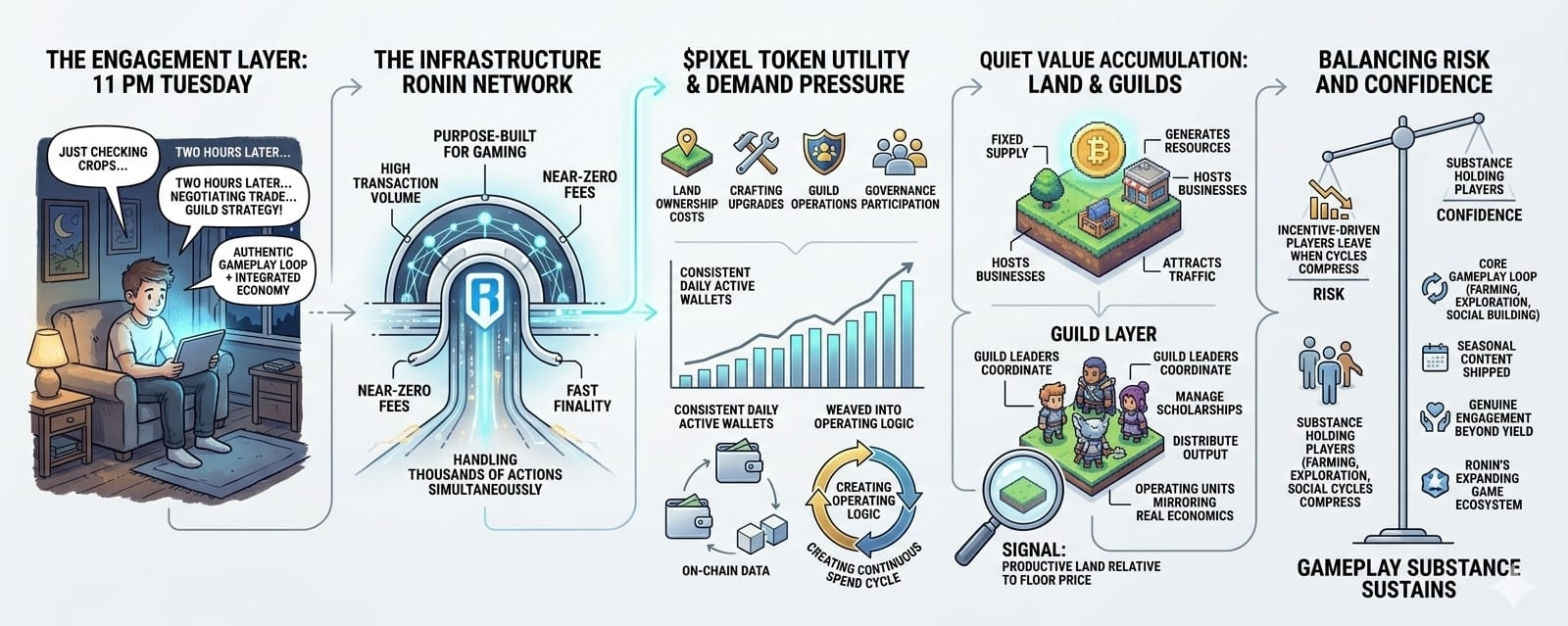
@Pixels I logged into Pixels at 11pm on a Tuesday because I told myself I'd just check my crops. Two hours later I was negotiating resource trades with someone in a guild I'd joined three weeks ago and genuinely had no interest in stopping. That moment stuck with me, not because the game is flashy or technically impressive, but because it pulled me in the same way a good mobile game does, except this one has an economy underneath it that I keep finding new layers inside of.
Pixels runs on Ronin Network, and I think that detail gets skipped over too fast in most conversations about this project. Ronin wasn't built for general crypto activity. Sky Mavis built it specifically for gaming, optimized for high transaction volume, near-zero fees, and the kind of fast finality you need when thousands of players are farming, crafting, and trading simultaneously. Pixels sitting on Ronin isn't a partnership announcement you read once and forget. It shapes how the entire economy breathes. Every action inside the game that touches $PIXEL happens on infrastructure designed to handle exactly that load without friction. That matters more than most people realize when they're evaluating whether a Web3 game economy can actually sustain itself long term.
What convinced me to take $PIXEL seriously as a token wasn't the price chart. It was spending time inside the game and watching how the token actually moves. Land ownership costs PIXEL. Crafting upgrades cost PIXEL. Running a guild operation costs PIXEL. Participating in governance costs PIXEL. None of that is theoretical. It happens every day across thousands of active wallets, and Ronin's on-chain data backs that up. Pixels consistently ranks among the top dApps on the network by daily active wallets, not monthly, daily. From my experience watching Web3 game tokens, that kind of consistent daily pressure on token demand is genuinely rare. Most projects have a token that exists adjacent to the game. In Pixels, the token is woven into the game's operating logic in a way that creates real spend cycles.
The part of this project I find myself thinking about most is the land and guild layer, because I think it's where value is accumulating quietly while most of the market stares at the spot price. Land parcels in Pixels aren't cosmetic. They generate resources, host player-run businesses, and attract traffic from other users looking to trade or complete tasks. Supply is fixed. As the active player base grows, productive land becomes more valuable in direct proportion to that growth. I've started paying more attention to what an active land parcel generates relative to its floor price than anything else in this ecosystem, because in my view that's the cleaner signal. Guilds add another dimension on top of that. Guild leaders in Pixels are coordinating farming strategies, managing scholarship players, and distributing resource output in ways that mirror real organizational economics. These aren't communities. They're operating units running inside a game world, and the players who've recognized that are positioning in ways the broader market hasn't caught up with yet.
I won't pretend the risks aren't real. A portion of Pixels' player base is there because the incentives make it worth their time, and when reward cycles compress, some of those players leave. That's not a Pixels-specific problem; it's the defining challenge of every Web3 game ever built. What keeps me more confident here than in most projects I've followed through a full cycle is that the core gameplay loop has enough actual substance to hold people who aren't purely chasing yield. The farming mechanics, the exploration, the social building, the seasonal content the team keeps shipping, these things create genuine engagement that pure token farms never had. And Ronin's expanding game ecosystem means Pixels players are increasingly part of a broader network that gives them reasons to stay active even between major updates.
So the question I keep returning to is this: if a Web3 game is posting consistent daily active wallet numbers, has token utility that creates real spend pressure, sits on purpose-built infrastructure, and still trades at valuations that don't reflect any of that, are you looking at a project with broken fundamentals, or are you looking at one of the last moments before the market figures out what's already been built?
