
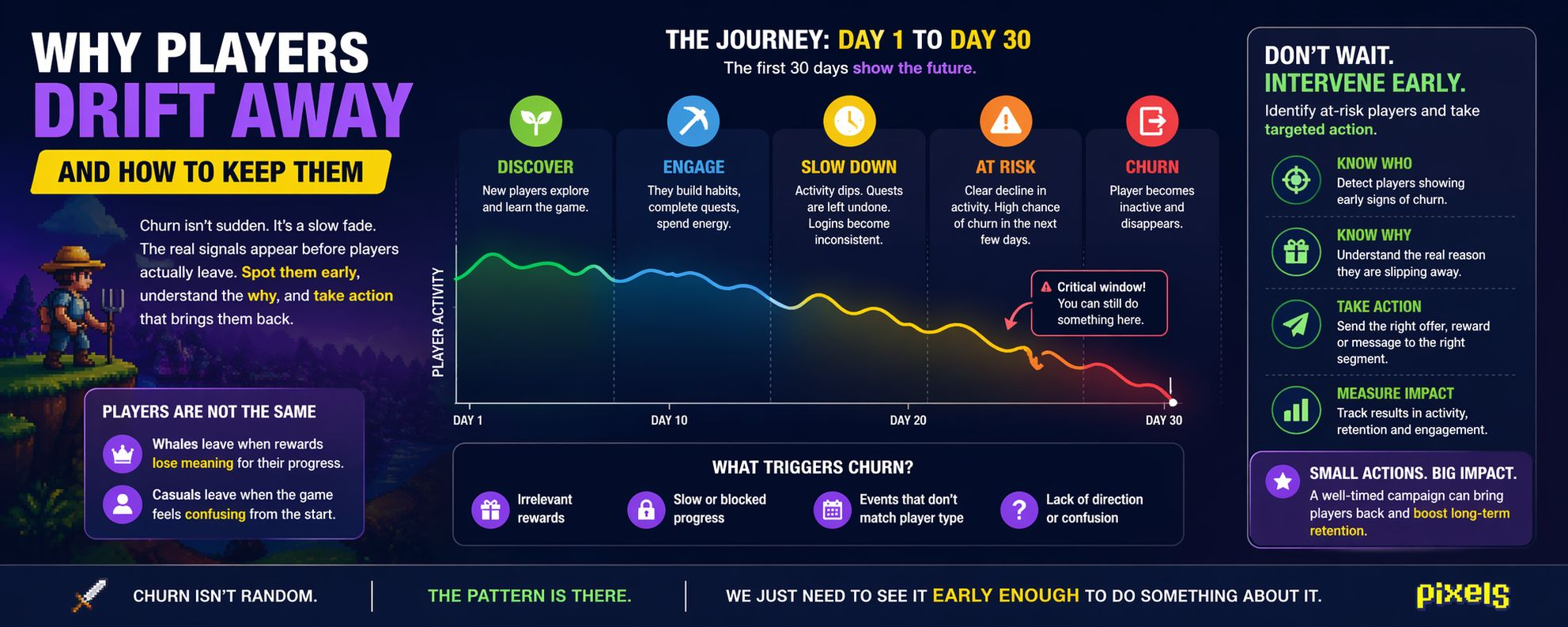
From the outside, player churn in Pixels can look very straightforward. Someone stops logging in, and that seems to explain everything. But the closer you look, the less simple it feels. Most players do not disappear in one clean break. They fade out little by little.
A player may still open the game, but something has already changed. A quest is left sitting there unfinished. Energy gets spent, but the habit does not hold for the rest of the day. They are technically still present, but the connection is getting weaker. By the time they are counted as gone, the real process has usually been happening for a while.
That is why looking only at the final login misses the more important story. What really matters is the stretch between Day 1 and Day 30. Those first weeks say a lot. They often show who is settling into the game, who is only testing it out, and who seems interested but slowly runs into enough friction to stop trying.
What becomes clear is that not every player leaves for the same reason. A whale might lose interest because the rewards no longer feel meaningful for their progress. A casual player might step away much earlier because the game never became clear or comfortable enough. But many studios still respond to both in almost the same way: another event, another bonus, another attempt to bring everyone back at once. That sounds active, but it often misses the real issue.
There are usually warning signs before a player fully leaves. Activity does not suddenly collapse. It starts to thin out. A little less consistency. A little less intent. A little less reason to return. These shifts can show up days before the player is actually gone, which makes them far more useful than a churn label that arrives after the fact.
So the real question is hard to ignore: if you can see the drop coming three days early, why wait until the player has already left?
What makes this more interesting is that the trigger is not always something dramatic. Sometimes the game itself is not “bad” in any obvious way. The problem is smaller and more specific. A reward does not match what that player needs. Progress begins to feel slow. An event appears, but it has nothing to do with the way that person plays. From a distance, those things can look minor. Up close, they are often enough to break momentum.
That is why the smarter approach is not just identifying the problem, but responding to it in a targeted way. Instead of throwing the same solution at everyone, the system looks at who is drifting, what may be causing it, and what kind of intervention actually fits. That could mean a reward adjustment, a campaign aimed at a certain segment, or a timely nudge that feels relevant rather than generic.
The practical side of that matters. A studio does not always need a major update or a new feature to do something useful. Sometimes a small campaign, sent to the right players at the right moment, is enough to change the direction. Not because it is huge, but because it connects with a real point of friction before that friction turns into absence.
What stands out most is that the impact can be seen. Activity rises again. Retention improves. The effect shows up in behavior, not just in hopeful interpretation. That makes the process feel less like guesswork and more like actually paying attention.
After looking at churn this way, it stops feeling random. Players are not always vanishing without warning. In many cases, the signs were already there. The mistake was not that the pattern was invisible. The mistake was noticing it too late.