
Most AI projects in crypto start sounding the same after a while. Faster models, smarter agents, decentralized infrastructure, automated economies. Different wording, same feeling. You read enough of them and eventually your brain stops separating one from another. Everything blends into a timeline full of promises that all somehow point toward the same distant future nobody can fully explain yet.
That was honestly my first reaction to OpenLedger too.
I saw the AI narrative attached to it and almost ignored it completely. Not because it looked bad, but because this market has trained people to become numb to anything carrying the words “AI” and “blockchain” together. Usually the louder a project tries to sound, the less there is underneath once you spend time with it.
But OpenLedger stayed in my head longer than I expected.
Not because of hype. Not because of price action. Mostly because the project kept circling around something that feels bigger than crypto itself. Something people rarely think about until it starts affecting them directly.
Ownership.
Not token ownership. Not governance. Actual ownership of contribution.
The internet has spent years turning human behavior into fuel for platforms. Every search, every prompt, every interaction, every correction quietly becomes data feeding systems somewhere in the background. Most people never see where that value goes after they contribute it. They use the product, the system improves, the company grows, and the cycle repeats again.
AI only made that process more visible.
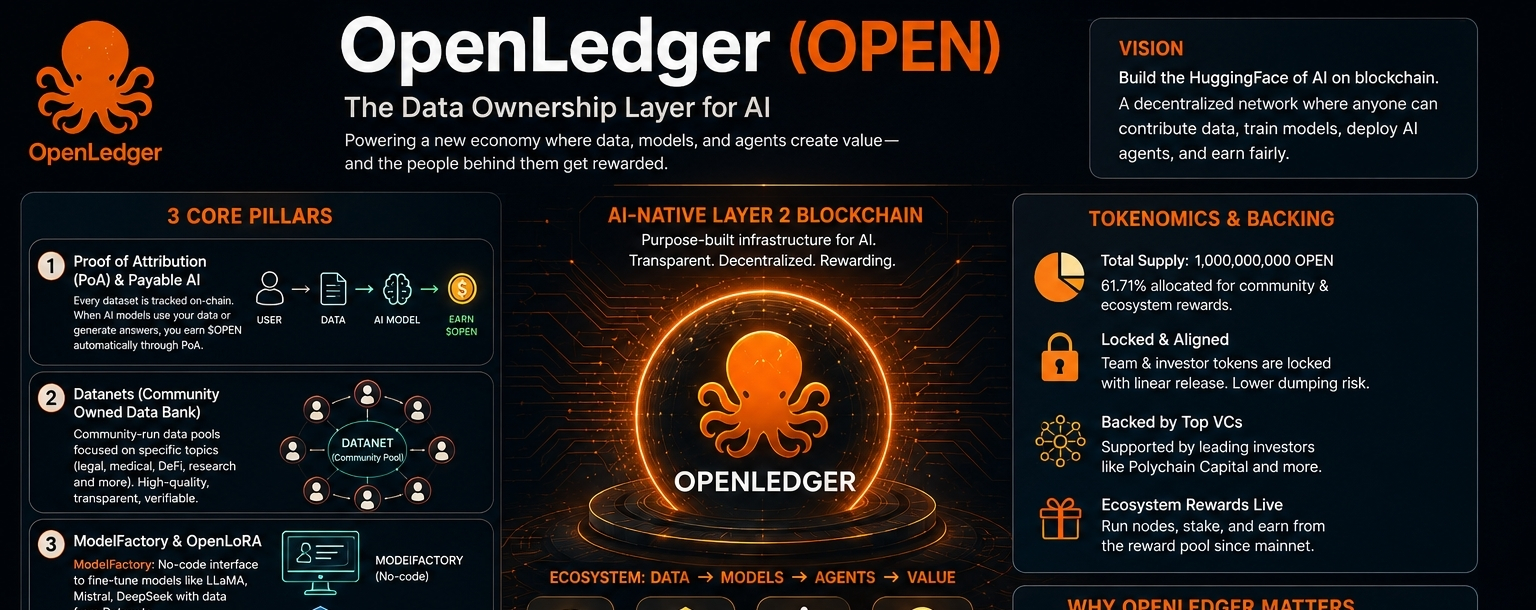
When I started reading deeper into OpenLedger, what caught my attention was not the idea of AI agents or decentralized infrastructure. Everyone says that now. What stayed with me was the project’s obsession with attribution. Tracking where data comes from. Recording contribution on-chain. Trying to build a system where the people providing value are not completely erased once the model becomes successful.
At first it sounded simple. Almost too simple.
Then the more I thought about it, the more it started feeling like one of those problems that keeps reappearing throughout history under different forms. The surface changes but the tension stays the same. People create value. Systems scale. Ownership concentrates somewhere else.
Social media did it. Big tech did it. Now AI is doing it too.
And maybe that is why OpenLedger kept returning to my attention. It feels less focused on selling intelligence and more focused on recording the invisible layer underneath intelligence. The data. The contribution. The source.
Their whole idea around Proof of Attribution and Payable AI feels important not because it sounds futuristic, but because it quietly asks a question most systems avoid asking directly:
If AI becomes valuable because of collective human input, then who should actually benefit from that value?
That question sounds obvious until money enters the picture. Then suddenly everything becomes harder.
Because attribution has never been clean. Not in technology. Not in business. Not even in normal life. Some people build foundations while others receive visibility. Some contributions matter quietly in the background while louder actors capture most of the rewards. Human systems have always struggled with this.
OpenLedger seems to understand that tension instead of pretending it does not exist.
Even the idea of Datanets stayed with me longer than I expected. Community-owned datasets sounds straightforward on paper, but underneath it is a much bigger observation about where AI is heading. Data is slowly becoming infrastructure. Not content. Not information. Infrastructure. Something valuable enough that people will eventually want ownership, verification, incentives, and accountability attached to it.
And honestly, that shift already feels like it has started.
Most AI conversations today focus only on outputs. Faster responses. Better images. Smarter assistants. But very few people spend time thinking about the input layer behind those systems. Where the knowledge comes from. Who organizes it. Who validates it. Who gets rewarded once it becomes economically useful.
OpenLedger keeps pulling attention back toward that layer.
That is probably why it does not feel like a normal AI project to me anymore.
Even the roadmap around agent economies feels less important to me than the philosophy quietly sitting underneath everything they are building. The idea that AI systems should not operate like black boxes extracting value from invisible contributors forever.
Whether that vision fully works or not, I honestly do not know yet.
Crypto has a habit of overestimating how easily technology can solve human incentive problems. Every cycle says transparency fixes trust. Every cycle discovers people still find ways around transparency. So I still carry doubts naturally. Probably more than I used to years ago.
But I also think experience teaches you to notice when a project keeps staying in your thoughts after the excitement fades.
That usually matters more than first impressions.
OpenLedger did not look special to me immediately. If anything, I expected to forget about it quickly like most AI narratives passing through the market right now. Instead it slowly became one of those projects I kept revisiting late at night, not because I was trying to force conviction, but because the core idea underneath it kept feeling strangely relevant.
Not AI replacing humans. Not machines taking over economies. Nothing dramatic like that.
Just a quieter question sitting underneath everything:
What happens when human contribution becomes one of the most valuable resources in the digital world, but the systems collecting that contribution remain invisible?
That feels like the real thing OpenLedger is circling around.
And maybe that is why it keeps holding my attention.