

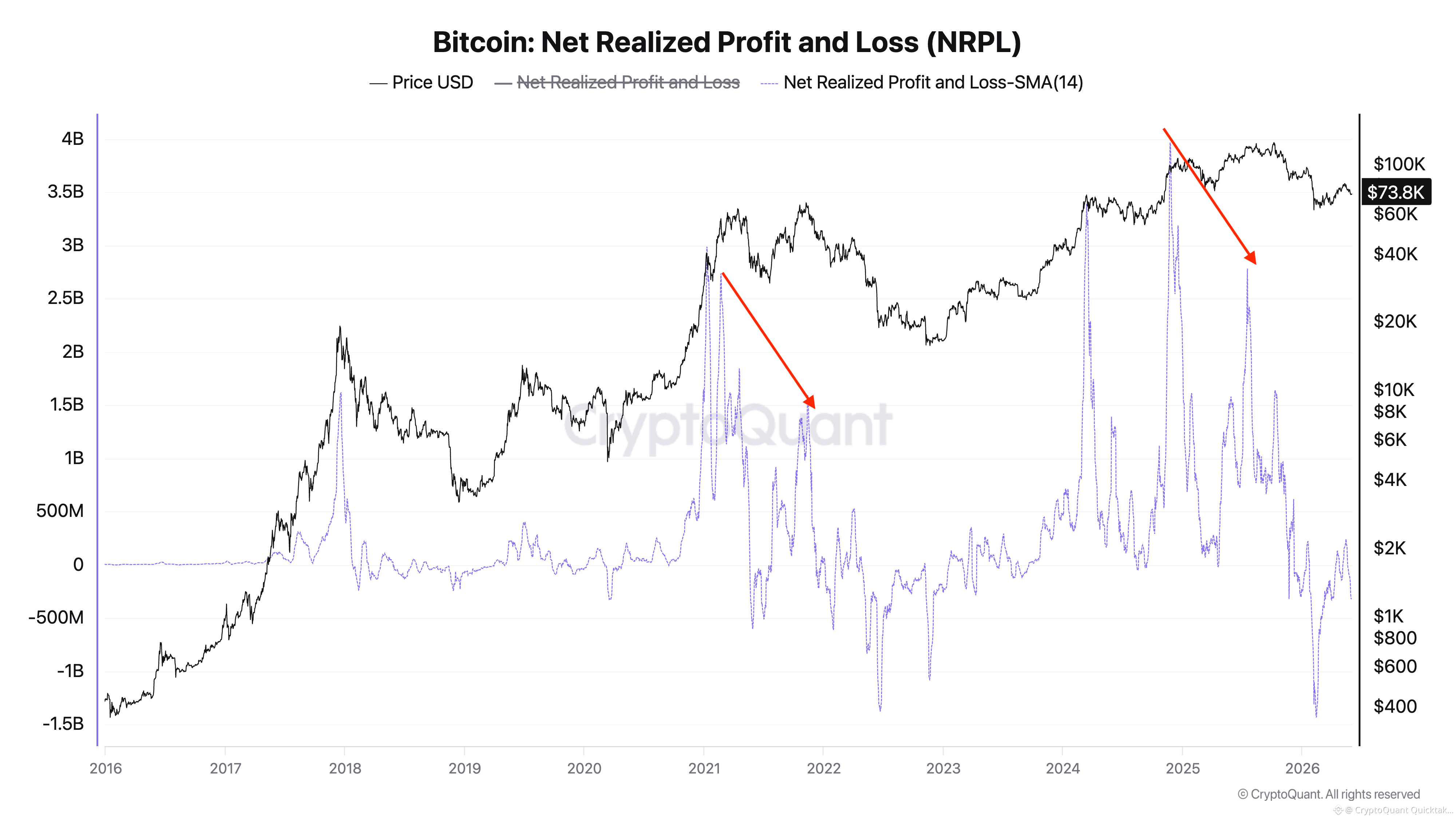
If price climbs above its prior local high but NRPL (Net Realized Profit and Loss) peaks lower than before, it is a warning that long-term holders (LTH) willing to sell have been exhausted and upward momentum may be running out.
NRPL swings hard day to day, so a 14-day moving average (SMA) is used to read the trend. The metric's base is when a UTXO was realized: the larger the recorded profit, the older the UTXO that was destroyed.
Later in a cycle, distribution has already progressed, so price gains slow. Short-term holders (STH) have a cost basis close to spot (within 155 days), so their per-unit profit is structurally small, and this margin narrows further. As a result, STH realizations move NRPL little, and what drives NRPL becomes the LTH who realize old UTXOs at large profit.
The asymmetry of holding age is the key. Long-lived LTH UTXOs cannot be re-created within the same cycle. Within a cycle, the oldest band that can still refill is the yellow band (6–12 months); older bands, once spent, are not restored in the same cycle.
So if price is above its prior local high while NRPL peaks lower, the old high-profit UTXOs have already been distributed at earlier highs with nothing left to give, and even the relatively younger yellow band's distribution may be winding down. It suggests the LTH left to take profit this cycle are running dry.
Written by AbstractRyu