

One thought keeps coming back to me whenever I look at the AI industry.
Most people who help create value rarely own any meaningful part of the value they create.
That sounds obvious at first, but the more you think about it, the stranger it becomes.
Millions of people interact with AI systems every day. They provide feedback, generate data, identify mistakes, test new products, and contribute information that helps models improve over time.
Without those interactions, many AI systems would develop far more slowly.
Yet when the value created by those systems increases, the economic rewards usually flow in a very specific direction.
Users remain users.
Contributors remain contributors.
The ownership layer exists somewhere else.
That is one reason OpenLedger feels interesting to me.
Not because it is another project talking about artificial intelligence.
There are already countless projects doing that.
What makes OpenLedger different is that it forces a discussion about participation.
More specifically, it forces a discussion about who gets recognized when intelligence becomes valuable.
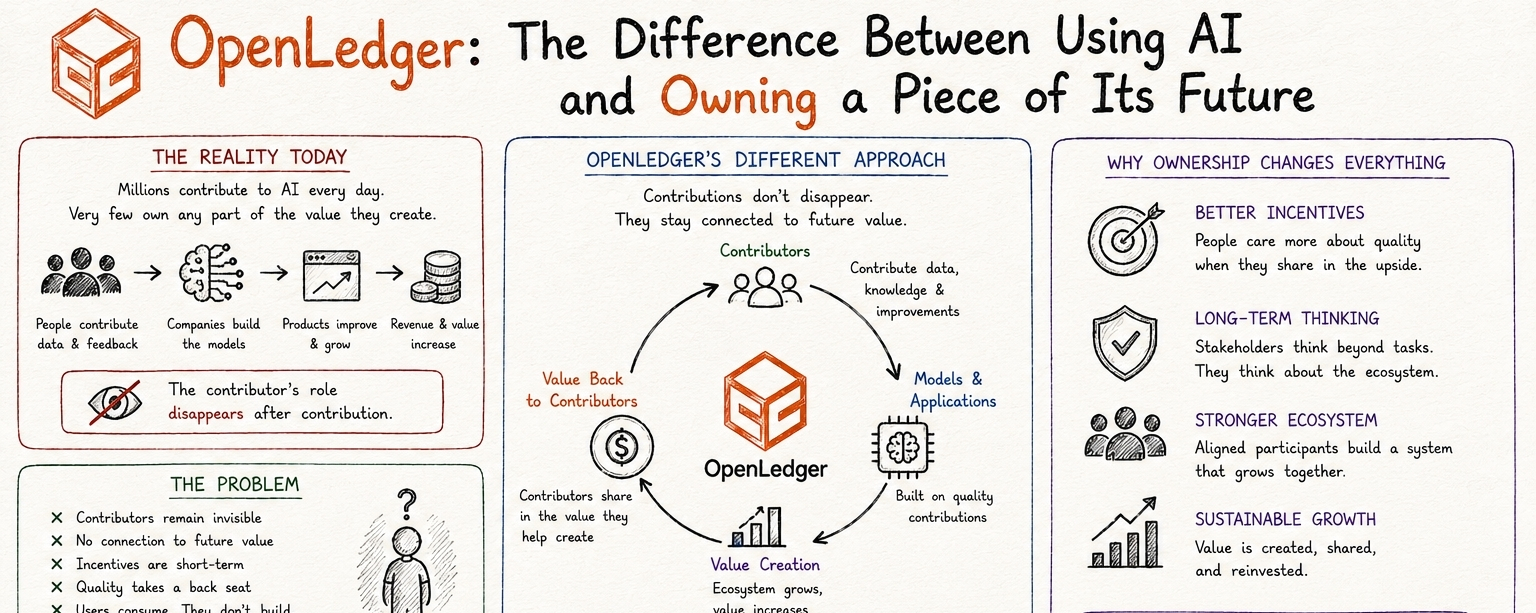
The traditional AI model is surprisingly simple.
People contribute data.
Companies build models.
Products improve.
Revenue grows.
The process works.
But the economic relationship often ends at the point of contribution.
Once the data enters the system, the contributor's role becomes increasingly invisible.
OpenLedger appears to challenge that structure.
Instead of treating contributions as something that disappears after submission, the protocol attempts to create a framework where contributions remain connected to future value creation.
That may sound like a small distinction.
I don't think it is.
Because incentives shape ecosystems.
When contributors know they are disconnected from future outcomes, behavior changes.
The focus often shifts toward short-term participation.
Provide the data.
Complete the task.
Move on.
But if contributors remain economically connected to the systems they help improve, the relationship changes.
Quality becomes more important.
Long-term thinking becomes more important.
The success of the network becomes more relevant to individual participants.
In other words, contributors start behaving more like stakeholders.
And stakeholder behavior tends to look very different from user behavior.
Users consume.
Stakeholders build.
Users participate.
Stakeholders invest time into growth.
Users leave when incentives disappear.
Stakeholders often remain because they benefit from long-term success.
This is why ownership matters.
Not simply because people like rewards.
But because ownership changes incentives.
And incentives often determine whether ecosystems become sustainable.
Of course, creating ownership is not enough by itself.
Many projects distribute rewards without creating meaningful alignment.
The challenge is making sure participation remains connected to actual value creation rather than artificial activity.
That is where OpenLedger will ultimately be tested.
Can it build a system where contributions are measurable?
Can value attribution remain transparent?
Can incentives reward usefulness rather than noise?
Those questions matter far more than marketing narratives.
Because the future success of AI ecosystems may depend less on who builds the biggest model and more on who creates the strongest contributor economy around it.
For years, the AI industry has focused almost entirely on intelligence itself.
Bigger models.
Better performance.
More capabilities.
OpenLedger introduces a different conversation.
What if the real innovation is not intelligence?
What if the real innovation is creating a fairer economic relationship between the people who help create intelligence and the systems that profit from it?
That question feels increasingly important.
Because as AI becomes more powerful, the ownership structure surrounding it becomes more important as well.
The future may not simply belong to the organizations building intelligence.
It may belong to the ecosystems that figure out how to align contributors, builders, and value creation in a way that feels sustainable.
And that is the reason OpenLedger remains one of the more interesting projects for me to watch.
Not because it is trying to build smarter AI.
But because it is asking who should own a meaningful piece of the future that AI creates.