
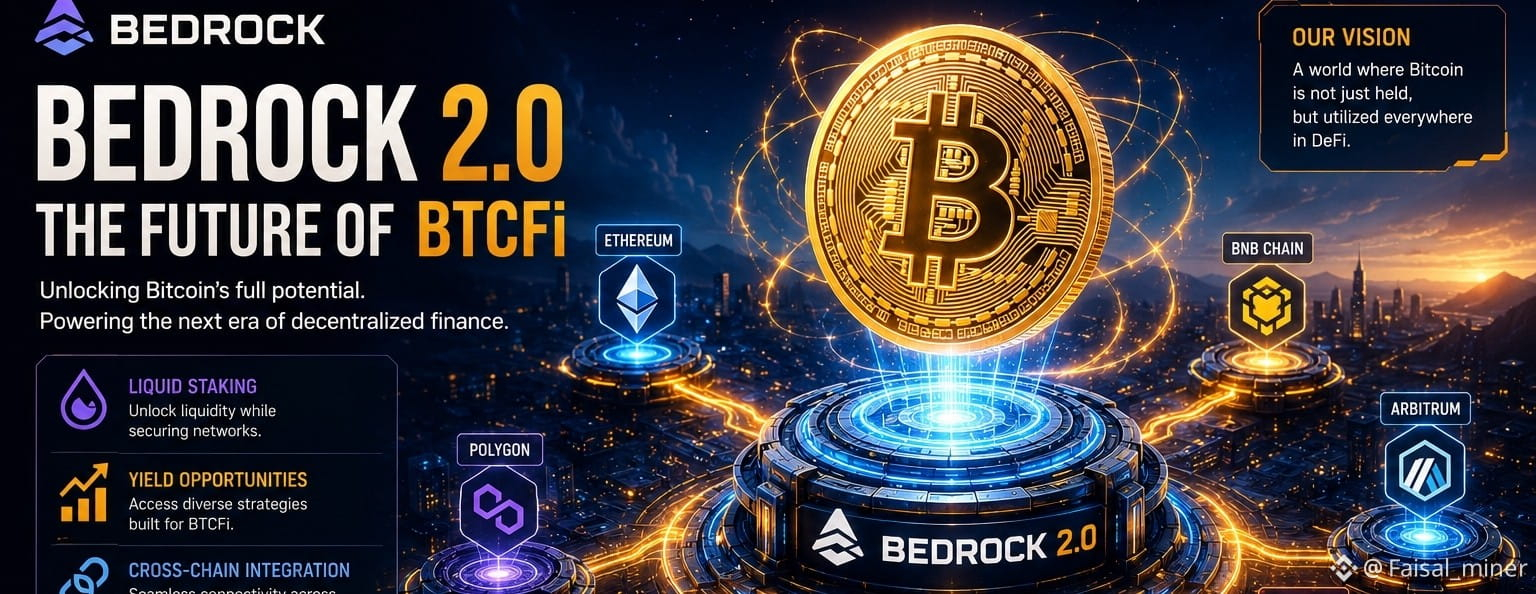
Why Bedrock 2.0 Could Become a Key Player in the Future of BTCFi
The cryptocurrency industry is constantly evolving, with new innovations pushing the boundaries of what digital assets can achieve. While Bitcoin remains the most trusted and valuable cryptocurrency in the world, much of its potential has remained untapped for years. Traditionally, Bitcoin has been viewed primarily as a store of value, often compared to digital gold. However, the emergence of Bitcoin Finance (BTCFi) is changing that narrative, creating new opportunities for Bitcoin holders to participate in decentralized finance without giving up exposure to the asset they believe in.
At the center of this growing movement is @Bedrock, a project that is building the infrastructure necessary to unlock Bitcoin's productive potential. With the introduction of Bedrock 2.0, the protocol is taking an ambitious step toward becoming a foundational layer for the future of BTCFi.
Understanding the BTCFi Revolution
For years, decentralized finance was largely associated with smart contract platforms such as Ethereum. Users could lend, borrow, stake, and provide liquidity, generating returns from assets actively participating in blockchain ecosystems. Bitcoin, despite being the largest cryptocurrency by market capitalization, remained relatively isolated from many of these opportunities.
BTCFi seeks to change that by bringing decentralized financial utility to Bitcoin holders. Instead of simply holding BTC in a wallet, users can potentially access yield opportunities, liquidity solutions, and cross-chain applications while maintaining exposure to Bitcoin itself.
As demand for capital efficiency grows, BTCFi is becoming one of the most exciting sectors in crypto. The ability to unlock liquidity from Bitcoin while preserving security could significantly reshape how digital assets are utilized across the blockchain industry.
What Makes Bedrock Different?
Bedrock is focused on creating a robust infrastructure that allows users to maximize the utility of their digital assets. Rather than treating Bitcoin as a passive asset, Bedrock aims to transform it into a productive component of the decentralized economy.
The protocol's vision revolves around three critical pillars:
1. Capital Efficiency
One of the biggest challenges in crypto is idle capital. Billions of dollars worth of Bitcoin remain inactive, generating no utility for holders.
Bedrock addresses this challenge by creating mechanisms that allow users to unlock additional value from their holdings. By improving capital efficiency, Bedrock helps users participate in broader financial opportunities without necessarily abandoning their long-term Bitcoin strategy.
2. Cross-Chain Connectivity
The blockchain ecosystem is becoming increasingly multi-chain. Different networks offer unique advantages, and users often want access to opportunities across multiple ecosystems.
Bedrock 2.0 embraces this reality by supporting a vision of enhanced interoperability. By connecting liquidity and functionality across blockchain environments, the protocol seeks to create a more seamless user experience and a stronger BTCFi ecosystem.
3. Security and Sustainability
Security remains one of the most important considerations in decentralized finance. Bedrock recognizes that long-term success requires balancing innovation with reliability.
By focusing on infrastructure, risk management, and sustainable growth, Bedrock aims to build a foundation that can support the next generation of Bitcoin-based financial applications.
The Significance of Bedrock 2.0
Bedrock 2.0 represents more than just an upgrade. It reflects a broader vision for how Bitcoin can integrate into the future of decentralized finance.
The new phase emphasizes:
- Greater scalability
- Improved liquidity mechanisms
- Expanded ecosystem participation
- Enhanced user accessibility
- Stronger BTCFi infrastructure
- Better support for long-term ecosystem growth
As more investors, developers, and institutions explore Bitcoin's role beyond simple ownership, platforms that provide reliable infrastructure may become increasingly valuable.
Why the Future Looks Promising
The crypto market has evolved significantly since Bitcoin's early days. Today's users are looking for more than price appreciation; they want utility, flexibility, and opportunities to make their assets work efficiently.
Several trends support the growth potential of projects like Bedrock:
Growing Interest in BTCFi
Bitcoin remains the largest and most recognized cryptocurrency in the world. As BTCFi develops, even a small percentage of Bitcoin's massive market capitalization entering decentralized financial applications could create significant opportunities.
Increasing Demand for Liquidity Solutions
Users want access to liquidity without necessarily selling their assets. Infrastructure that enables efficient liquidity management may play an important role in the future financial landscape.
Expansion of Multi-Chain Ecosystems
The future of blockchain is unlikely to belong to a single network. Instead, interoperability and connectivity will likely become essential features of successful protocols. Bedrock's focus on cross-chain functionality positions it well within this trend.
Community and Ecosystem Growth
No blockchain project succeeds through technology alone. Strong communities often serve as the foundation for long-term adoption and ecosystem expansion.
The growing interest surrounding @Bedrock and the increasing visibility of $BR demonstrate the importance of community engagement in driving awareness and participation. As more users discover BTCFi, community-driven growth may become a significant catalyst for future development.
Final Thoughts
Bitcoin is entering a new chapter. The conversation is shifting from simply holding BTC to exploring how Bitcoin can become a productive asset within decentralized finance.
Bedrock 2.0 represents a bold vision for that future. By focusing on liquidity, interoperability, capital efficiency, and infrastructure development, the project is positioning itself as a potential cornerstone of the emerging BTCFi ecosystem.
While the BTCFi sector is still developing, the opportunities ahead are substantial. If Bitcoin Finance continues its rapid growth trajectory, projects that provide the infrastructure layer—such as Bedrock—could become some of the most influential players in the next wave of blockchain innovation.
The future of BTCFi is still being written, but Bedrock 2.0 is aiming to help build its foundation.