
In every stage of Web3, what truly changes the industry landscape is often not a single application, but the 'entrance'.
Whether it is the early exchanges or the later DeFi protocols, the entrances that can gather traffic and funds ultimately become the core of the ecosystem.
And today, this logic is being played out again in the AI track.
With the development of AI technology, more and more AI assets and AI applications are beginning to enter the blockchain world. Generative content, intelligent agents, data networks... new forms are constantly emerging, and new value is continuously being created.
But at the same time, a problem is becoming increasingly apparent:
These assets and applications lack a true entry point.
The market is decentralized, liquidity is fragmented, and users are disconnected.
In such an environment, although the AI ecosystem is growing, its value is difficult to be fully released.
OpenOcto was born in this context.
Unlike most projects, OpenOcto chose to start from 'structure' rather than from 'function'.
What it focuses on is not a single product, but the foundation of the entire market operation.
Therefore, OpenOcto's first step is not to build a complex ecosystem, but to return to the most essential point - liquidity.
Through the establishment of a liquidity center, the project begins to aggregate funds and assets, attracting users into the market.
Once liquidity is formed, trading naturally occurs.
Decentralized exchanges (DEX) become the core of the second stage, where assets begin to circulate through the establishment of trading, prices gradually form, and the market gradually possesses a stable structure.
On this basis, the ecosystem begins to expand.
AI assets, AI applications, AI agents, and AI data are gradually connected, forming a diverse network. Different modules connect and drive each other, creating stronger synergy.
Ultimately, all of this will be carried on a unified infrastructure - the OpenOcto public chain.
This path seems simple, but it is highly logical:
Liquidity → Trading → Ecosystem → Public Chain
It is not a path of 'quick bursts', but a path of 'gradual construction'.
But it is precisely this path that often has a better chance of going further.
At the product level, OpenOcto has built a complete system around trading, including liquidity management, asset trading, NFT nodes, and ecosystem access capabilities. These modules do not exist in isolation but form a closed loop around 'liquidity and trading'.
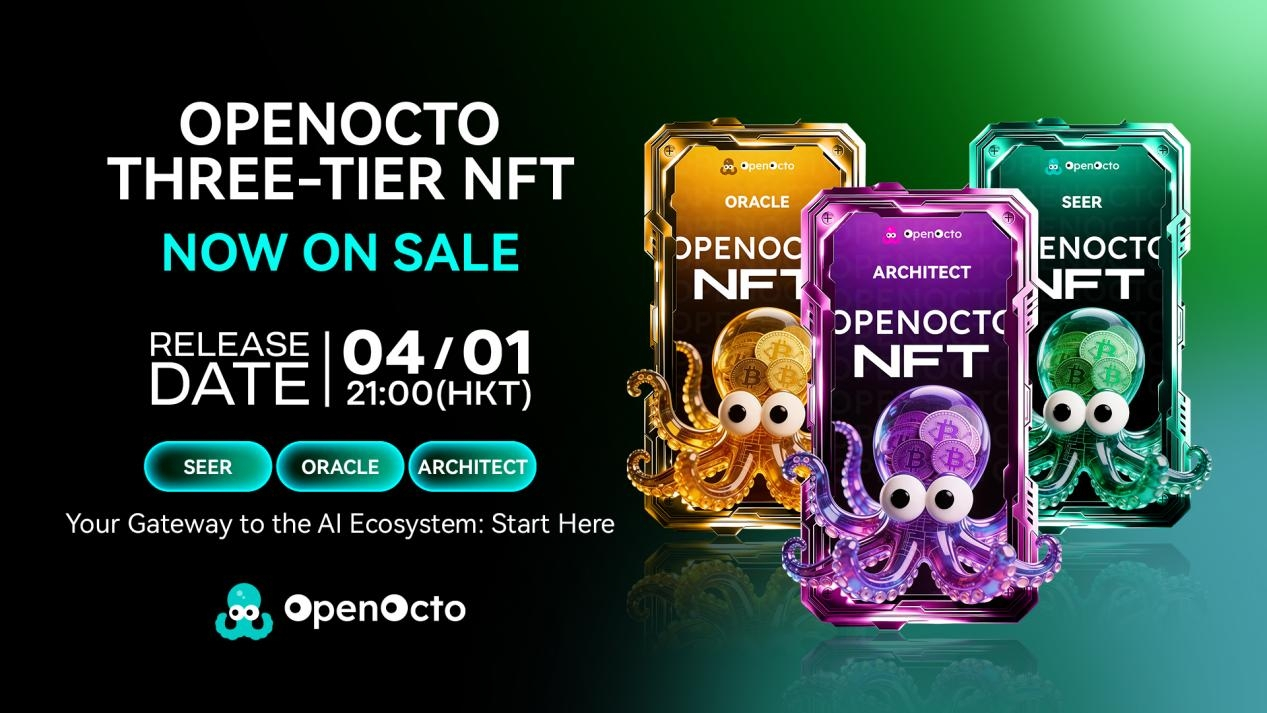
Among them, the NFT node system has become an important way to connect users and the ecosystem. Through designs of different levels, users can participate in platform development at different stages and form a closer binding relationship with the ecosystem.
From a longer-term perspective, OpenOcto's goal is not a trading platform, but a network.
A network driven by liquidity, connected by trading, expanded by the ecosystem, and supported by infrastructure.
In this network, assets can flow freely, applications can grow continuously, and users can participate deeply.
This is also the true meaning of the integration of AI and Web3.
Future competition is not just a competition of technology, nor is it a competition of a single product, but a competition of structure and entry points.
Whoever can connect more resources can build a stronger network.
OpenOcto chooses exactly this path.
And there is only one starting point for this path:
Liquidity.