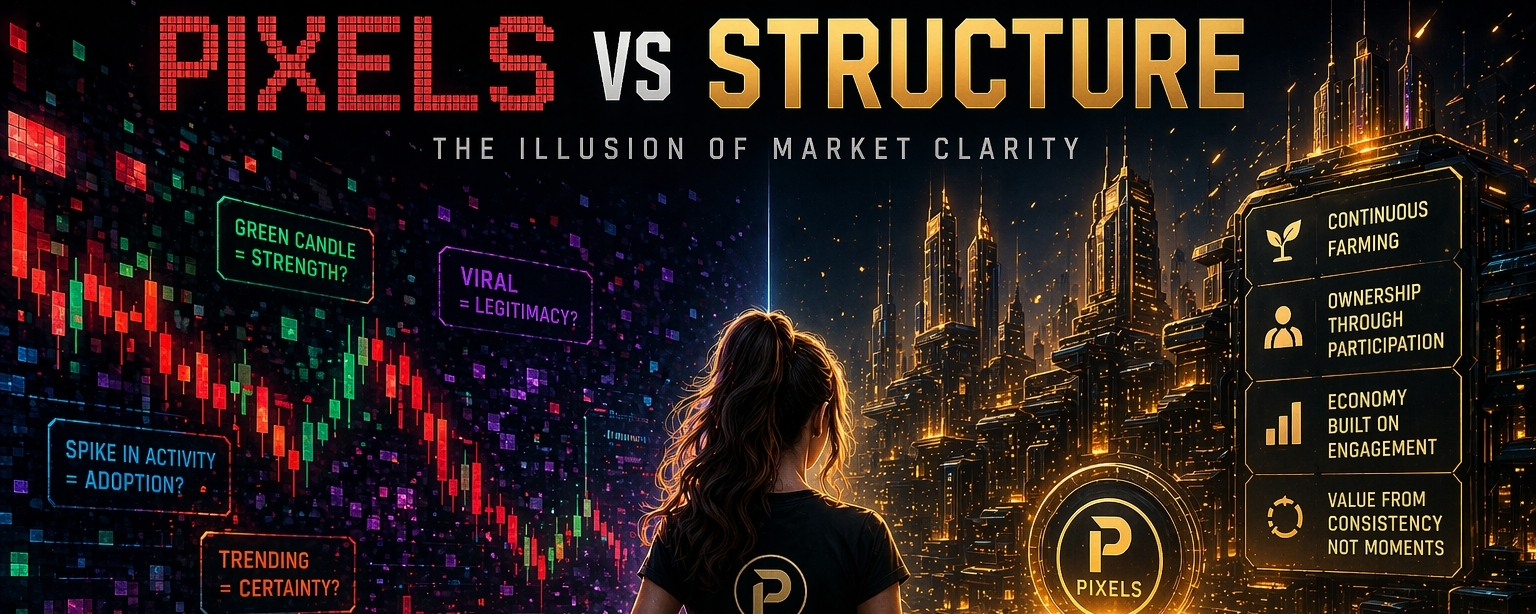
What you see in digital systems is never the full reality. It’s only the visible layer — fragmented, compressed, and stripped of context. A green candle looks like strength. A spike in activity feels like adoption. A trending narrative feels like certainty. But none of these are complete truths.
They are pixels — isolated fragments of a much larger structure. And pixels are deceptive by design. They are sharp enough to trigger reaction, but incomplete enough to hide the system that produces them.
A pixel is a moment. A structure is continuity. Pixels show movement. Structure explains behavior. Pixels answer what just happened. Structure answers why it keeps happening.
Most people stay at the pixel level. They react to isolated signals without understanding the architecture behind them. That’s why trends feel powerful but fade quickly. That’s why hype feels convincing but rarely sustains. That’s why visibility is often mistaken for value. They are fragments, not the system itself.
In fast-moving ecosystems, attention creates illusion. Rising charts are read as strength. Viral content is read as legitimacy. Sudden activity is read as growth. But what’s actually happening is fragmentation — temporary alignment of attention, liquidity, and narrative. Without structure, it all collapses back into noise.
@Pixels represents a different layer — not isolated interaction, but structured design. A Web3 ecosystem where farming is continuous, ownership is tied to participation mechanics, and economy is shaped by sustained engagement. Value doesn’t come from moments; it comes from consistency within the system.
Nothing exists alone. Every action connects into another layer.
Smart money doesn’t react to pixels. Reaction is emotional — and emotion is late. It focuses on structure: what mechanics drive the system, who benefits over time, what persists when attention fades, and where compounding actually exists. While most chase movement, smart participants study design.
Movement is temporary. Structure is persistent.
The real divide is simple — those who react to pixels, and those who understand the structure generating them.
One sees signals. The other sees systems.
So ask yourself: are you still reacting… or are you finally reading what creates it?
@Pixels $PIXEL @Binance Square Official