
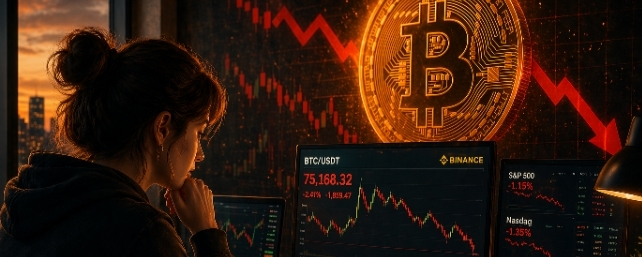
I didn’t read this move as just another piece of news. I tried to read it the way the market itself reacts—quietly, and often ahead of clear narratives.
When Bitcoin started sliding toward $75,000, and at the same time S&P 500 and Nasdaq Composite gave back their early gains, it didn’t feel random. It felt connected.
From where I sit as a trader working on Binance, this is how I interpreted it.
At the open, the market seemed positioned for optimism—possibly pricing in a softer stance on interest rates. But as the Senate hearing involving Kevin Warsh unfolded, the tone shifted. The idea that the Federal Reserve would remain independent—and not be pushed toward immediate rate cuts—changed expectations.
And markets don’t wait. They adjust.
So what I observed wasn’t just a drop. It was a repricing of liquidity expectations.
When the probability of rate cuts decreases, liquidity tightens. Borrowing doesn’t get cheaper. Risk appetite fades. And the first place that shows up is in high-beta assets.
That’s why BTC, tech stocks, and broader equities all moved together. This wasn’t crypto-specific weakness. It was a macro reaction.
Something I’ve been noticing more and more:
Bitcoin is still behaving like a macro asset.
It doesn’t move in isolation as often as people expect. It responds to the same forces that move the Nasdaq—interest rates, liquidity, and forward expectations.
That raises a question I keep coming back to:
If rate cuts are delayed, can $BTC really sustain a strong upward move on its own narrative?
Or are we still in a phase where crypto depends heavily on global liquidity cycles?
Another way I frame it for myself:
Markets don’t move on news.
They move on changes in expectation.
So maybe the real signal here isn’t what was said in the hearing—
but how quickly the market adjusted after hearing it.
And that’s the part I keep watching.
#Bitcoin #CryptoMarkets #Binance
