
most Web3 games try to win your attention by doing more like more rewards, more mechanics, more urgency, more noise. Pixels quietly does the opposite. And that difference is exactly why it works.
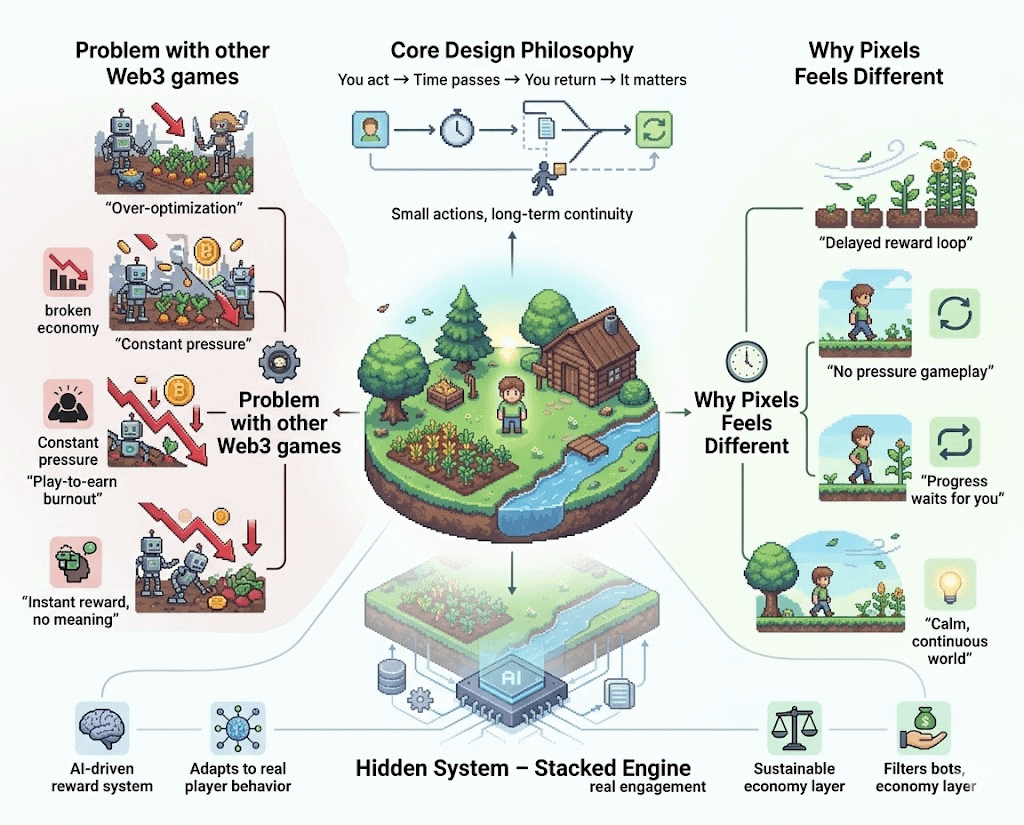
the first thing you notice isn’t the token or even the farming loop. It’s the pacing. You plant something, and then… nothing urgent happens. No flashing alerts, no pressure to optimize every second. You move, explore, maybe craft something, then come back later. The crop is ready.
that’s it.
simple, almost deceptively so.
But that simplicity creates something rare: mental space.
in most games, especially in Web3, every action feels like it needs to be maximized. You’re constantly calculating, efficiency, ROI, timing. It turns gameplay into a background spreadsheet. Pixels breaks that pattern by introducing soft delays and passive progression. Instead of demanding your attention, it trusts you’ll return.
and that changes behavior.
you stop reacting and start moving intentionally. You begin to remember your own routes across the map. You recognize where resources spawn without checking guides. Over time, the world stops feeling like a system to exploit and starts feeling like a place you inhabit.
that shift is subtle, but powerful.
underneath that calm surface sits something much more deliberate: Stacked is an adaptive reward engine designed from the failures of earlier play-to-earn models. Where older systems flooded players with tokens and hoped demand would follow, Stacked does the reverse. It observes behavior first, then adjusts rewards dynamically.
this matters because the biggest problem in Web3 gaming has never been attracting players, it’s keeping value stable once they arrive.
games like Axie Infinity proved that massive rewards can drive explosive growth. They also proved how quickly that growth collapses when rewards outpace real demand. Players farm, sell, and leave. The loop breaks.
pixels learned from that.
Instead of rewarding pure activity, it rewards meaningful engagement. If you explore, build, or interact with systems beyond basic farming, the game notices. Rewards feel less like emissions and more like responses. That subtle difference changes player psychology. You’re not just extracting value, you’re participating in a system that reacts to you.
still, the system isn’t perfect, and it doesn’t pretend to be.
one of the ongoing challenges is token retention. Like many blockchain ecosystems, Pixels uses a tradable asset, PIXEL, which can be earned and sold freely. That freedom is both a strength and a weakness. When too many players farm and sell without reinvesting, the economy faces downward pressure.
stacked helps by adjusting incentives in real time, but it can’t manufacture demand on its own. Real stability comes from making the token useful inside the game, for upgrades, crafting, progression. The more players need to use PIXEL, the stronger the economic loop becomes.
This is where Pixels sits in an interesting middle ground.
Unlike traditional Web2 games, where progress requires spending with no withdrawal, Pixels allows value to flow out. But unlike early Web3 games, it doesn’t aggressively force that value loop. It gives players freedom, sometimes too much.
and yet, despite that tension, players stay.
Not because of massive earnings. Not because of hype cycles. But because the experience itself is sustainable. The game doesn’t punish you for stepping away. It doesn’t create anxiety around missed opportunities. Progress doesn’t disappear - it waits.
that’s a completely different emotional contract.
instead of chasing the game, you return to it.
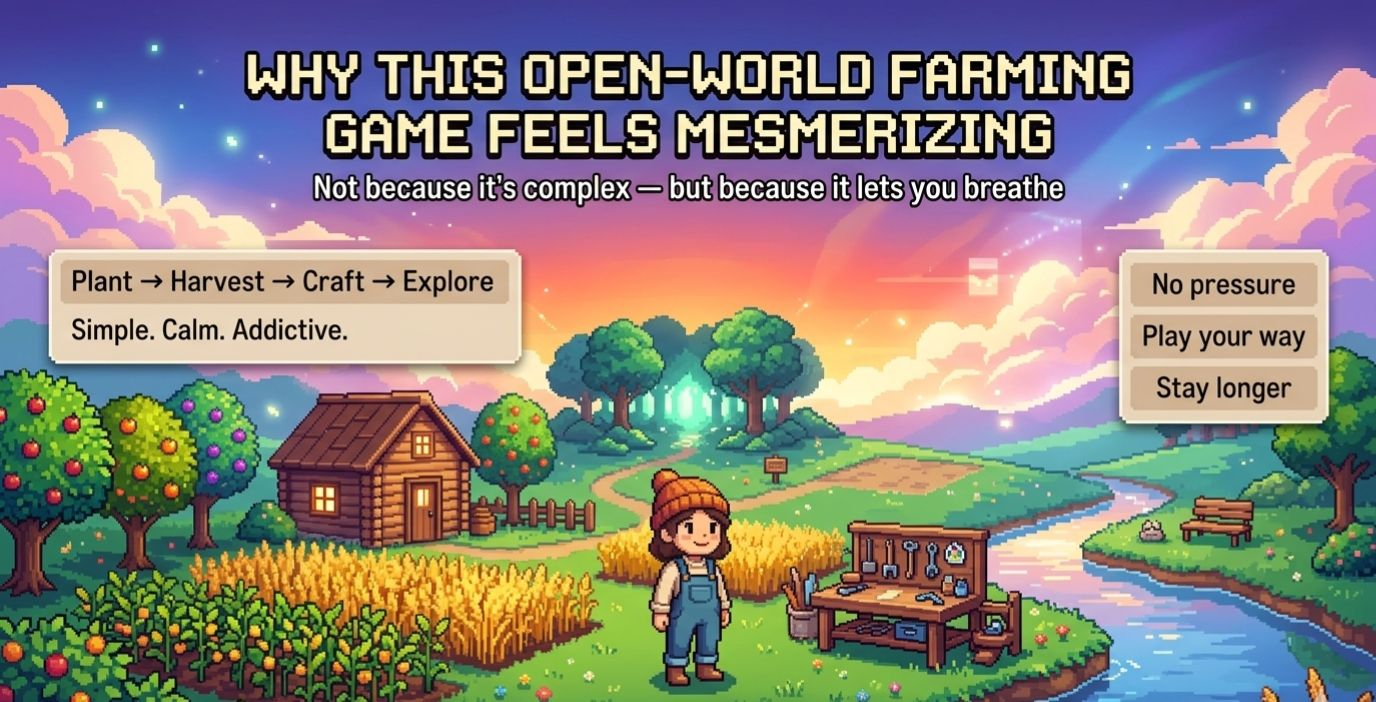
That’s why even repetitive actions don’t feel exhausting. The loop is still there, plant, harvest, craft, but the pressure is gone. You’re not trying to win every minute. You’re just continuing something you started earlier.
And over time, that continuity builds trust.
You believe that your actions will still matter later. That the system won’t reset or devalue your effort overnight. In Web3, where instability is common, that feeling is incredibly rare.
Zooming out, Pixels isn’t just a game experiment. It’s a signal for where Web3 gaming might be heading.
>Less noise.
>Less forced engagement.
>more adaptive systems.
>more respect for player time.
It shows that retention doesn’t come from intensity-> it comes from consistency.
And maybe that’s the real insight.
Pixels doesn’t try to make every moment exciting. It lets moments stay small, connected, and meaningful over time. That restraint is what makes the world feel alive.
You log in.
You continue.
You leave.
And somehow, you want to come back.
Not because you have to.
But because it feels right to.
$PIXEL #pixel @Pixels $CHIP
#MarketRebound #KelpDAOExploitFreeze #StrategyBTCPurchase