
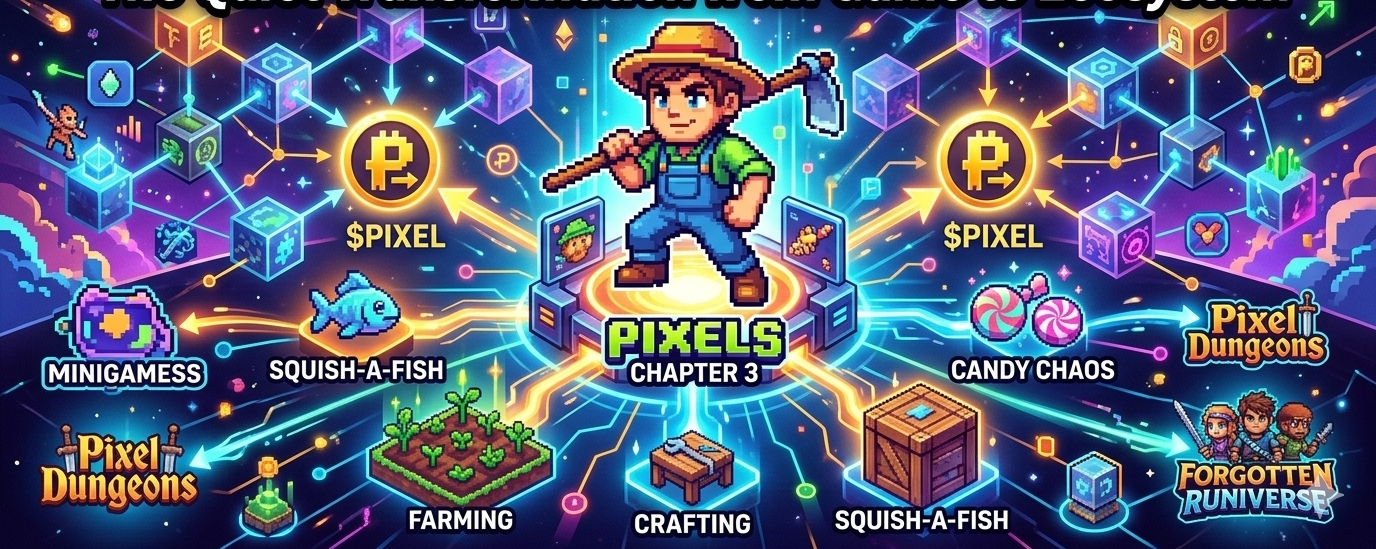

Let me start with something that needs to be said clearly. The more official updates roll out from Pixels, the more obvious it becomes: this project has moved well beyond being just a game. Instead, it is quietly turning into a network of small, interconnected systems growing inside what still looks like a simple game on the surface.
Heading into 2026, Pixels is no longer a single experience. It has developed into a multi-layered ecosystem. While it may sound impressive and well-put-together from the outside, the internal reality is far less tidy. That contrast is what makes the whole story so intriguing.
The main game still sits at the center. Pixels continues to serve as the heart of everything, blending farming, crafting, and social features to shape a living world. On the surface it feels like a relaxed casual title, yet beneath that lies a carefully designed economic loop. Players farm land, create items, trade, and cycle through the process again and again. All of it works to support the token economy. When viewed as standalone experiences, the three core games that support PIXEL staking remain the primary force keeping the ecosystem running.
At the same time, Pixels has expanded into a full gaming hub filled with mini-games and partner projects.
The real question is how stable this structure actually is.
There is no easy answer. Economies of this kind only become truly solid when they are powered by genuine, ongoing utility rather than pure speculation. Pixels is clearly moving toward that goal, but it has not fully reached it yet. Ranking among the top eight web3 games is a positive sign, yet leaderboards in this space tend to shift quickly and do not guarantee lasting success.
The ecosystem layer is where the biggest change is happening. #pixel is stepping outside its own borders. The PIXEL token is now being used in other games beyond its original world. This expansion of the token’s reach may prove more important than any single improvement to gameplay. It strengthens the overall cycle across titles.
Projects like Pixel Dungeons and Forgotten Runiverse come from different genres but share the same token flow. The ambition is clear: to make PIXEL function as a true cross-game currency. Achieving that is no small task. Each game creates its own player behaviors and token dynamics. Demand can rise sharply in one place and fall in another, turning the entire system into a constant balancing act.
There is a clear risk in this approach. As integrations multiply, so does complexity, and complexity often brings friction and unexpected problems.
The mini-games play a quieter but vital role. Titles such as Squish-a-Fish and Candy Chaos may sound light-hearted and even funny at first. Yet they serve as smart retention tools. They create short, addictive loops that encourage daily returns. What begins as “just one quick round” can easily stretch into three quarters of an hour. In web3 gaming, strong player retention is essential. Without it, the token economy simply cannot hold up over time.
Looking at the bigger picture, Pixels is clearly aiming to become a platform rather than just a game. The Realms scripting engine and deep NFT integration point to this long-term goal. Supporting more than eighty NFT collections is not merely about adding cosmetic items. It is an effort to build a shared ecosystem identity and open the door for others to create and contribute. That shift marks the real difference between a standalone game and a true platform.
Becoming a platform brings its own set of challenges. It demands excellence not only in game design but also in governance, economic management, and incentives for developers. Many projects have struggled once they reached this stage.
When it comes to the $PIXEL token itself, the most important shift is its attempt to evolve from a simple earn-and-sell token into one with real utility. The difficulty lies in the fact that many users still operate with an “earn and exit” mindset. This gap between current player behavior and the project’s vision for a sustainable economy remains one of the toughest obstacles. Changing how people think and act cannot be forced; it has to happen naturally over time.
Overall, Pixels feels like it is in the middle of a transition phase. On one hand, it is a growing ecosystem where multiple games, integrations, and NFT layers are coming together. On the other, the economy is not yet fully stable and still feels like an evolving experiment. These two realities sit side by side.
At times it seems capable of helping shape a new kind of gaming economy. At other moments it raises the question of whether the project is becoming overly complicated.
In the end, @Pixels is no longer a finished product. It has become an ongoing, living system. For systems like this, success will ultimately depend on time and genuine user behavior.
If everything lines up well, it could grow into something truly significant. If not, it may end up remembered as another ambitious but incomplete attempt.