

A lot of folks are analyzing @Pixels , but they still tend to scratch the surface: Is this game fun? Does Chapter 2 bring anything fresh? Can pets and land generate new hype? $PIXEL Is there still market elasticity? But if you connect the dots from the recent official announcements, you'll realize that what’s really worth studying about Pixels might not be a single gameplay feature at all, but rather its approach to creating something that few blockchain games do well—a layered user structure. It’s not just about letting everyone flood in and then using the same reward logic to handle all users; instead, it’s gradually placing players with varying depths, purposes, and investment levels into different tiers of the same world. The official site now emphasizes Play for Free, Land, PETS, bi-weekly updates, Staking, and the capability to 'experience new games', while the help center has clearly broken down Reputation, Marketplace, Guild, Live Ops & Ecosystem, and different staking methods. When you look at all these elements together, @Pixels it’s becoming more like an on-chain world that doesn’t just 'let people play' but 'helps different types of individuals find their place.'

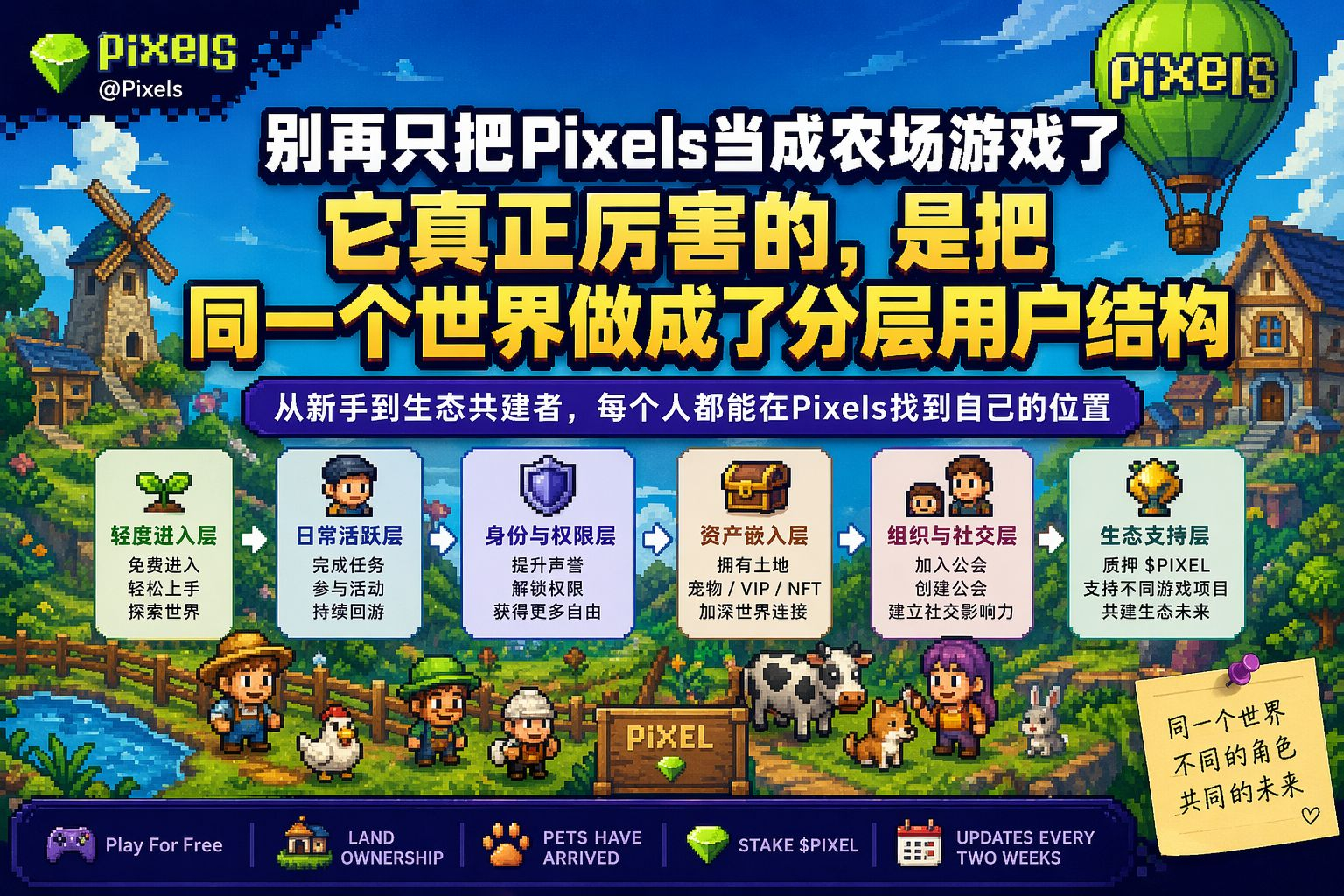
Why do I say that the ‘layered user structure’ is important? Because the vast majority of GameFi projects die in a similar fashion. They often only have one core user model: either everyone is treated as yield farmers, or everyone is seen as speculators, or everyone is just a short-term player willing to pay for version updates. The result is that once this single user model fails, the whole project collapses. Users attracted by high subsidies leave when the subsidies fade; those drawn in by market trends scatter when the trends cool; those enticed by novelty drift away once they get bored. In short, many chain games don’t suffer from weak gameplay but from thin user structures. They lack true layers, only existing in 'still here' or 'already gone' states. But a more mature online world shouldn’t only accommodate one type of player. It should allow light users to exist, deep users to accumulate, asset users to integrate, organizational users to exert influence, and long-term supporters and short-term experiencers to find their places within the same system. I believe the most scarce element in Pixels right now is precisely this.
Let’s first look at the bottom layer: the light entry layer. One of the most prominent entry points on the Pixels official site is still Play For Free, and the entire world is presented in a very light manner—pixel art, farms, animals, friends, land, tasks. These elements may seem simple, but their value is substantial because they determine whether the project can accommodate 'atypical Web3 users.' Many chain games bombard users with wallets, bridges, tokens, fees, complex rules, and highly financialized language from the get-go, which ends up blocking those who might actually stick around. Pixels stands out by first offering an easily understandable world instead of requiring you to learn finance before you can play a game. The website even states, 'Join one of the largest web3 communities & a player base eager to experience and play new games,' which is crucial; it indicates that the project doesn't just want to attract the most knowledgeable chain users but wants to bring as many people as possible in through a low-friction entrance. As long as a world can stably accommodate the light entry layer, it has the opportunity to build more layers above it.
Moving up one layer is the daily active layer. This layer differs from pure newcomers; they aren’t just stopping by—they’re willing to come back to do tasks, push progress, and participate in activities. The official site emphasizes 'Updates Every Two Weeks,' and the help center keeps modules like Quest, Live Ops, Gameplay, Energy, Guild, and Marketplace within the same sustainable operating system. To me, this signifies that Pixels isn't satisfied with one-time user acquisition; it’s continuously providing a path for 'light entrants' to upgrade to 'daily actives.' Why are bi-weekly updates important? Because they prevent the world from stagnating on static content. Why is Live Ops important? Because it ensures that daily logins aren’t just mechanical repetitions, but there are always new reasons to come back and take a look. Why are Energy, Quest, and Marketplace designs important? Because they collectively form the rhythm of daily activity. You’ll realize that Pixels’ brilliance doesn’t lie in any one feature being explosive; it’s in how it slices login reasons into manageable, light, and continuous pieces. Once users transition from 'just trying it out' to 'casually logging in,' this layer is established. When the daily active layer is established, the whole world begins to have warmth, fluidity, and a foundation for transitioning to higher layers.
The third layer is the identity and permissions layer. This is a layer many overlook, but I think it’s critical for Pixels. The official help center defines Reputation very clearly: it's a system that provides benefits and recognition to the 'best and most loyal users,' while also distinguishing genuine, good players from bad actors; high Reputation users will receive higher trade limits, withdrawal limits, and access to the in-game marketplace, while low Reputation users face the opposite restrictions. More specifically, the restrictions table indicates that withdrawals, market trades, guild creation, and guild verification are all tied to Reputation thresholds; for example, around 1500 Reputation unlocks withdrawals and market trades, while approximately 2205 Reputation allows you to create your own guild. The most interesting part isn’t that it prevents bad actors, but that it tells all users: within the same world, accounts of different qualities will have varying degrees of freedom to act. This is layering. Light users can enter but don’t necessarily possess all rights immediately; long-term users can gradually elevate themselves from 'ordinary players' to 'high-freedom accounts' through time and behavior accumulation. Once a world starts to bind identity and permissions together, it becomes more than just a collection of content; it begins to grow structure.
The fourth layer is the asset integration layer. Many people talk about Pixels assets, and the first reaction is still land, pets, VIP, NFTs, as if these are just decorations, bonuses, or speculative targets. But if you look at it through the lens of the official Reputation design, you’ll see it’s not that simple. The help center clearly lists ways to enhance Reputation, including Owning Land, Purchasing VIP, Owning Pets, Owning integrated NFTs, etc. In other words, assets in Pixels aren't just tradable static items; they are slowly becoming part of account quality and account hierarchy. Owning land isn't just about having more land; owning pets isn't just about adding a cute element; buying VIP isn’t just about a paid tag. These factors subtly change your position in this world. Thus, the asset logic in Pixels sets it apart from many ordinary chain games: it isn’t about 'buying something and waiting for the price to rise,' but rather 'turning assets into a deeper way of embedding yourself in this world.' If a user begins to enter the asset integration layer through land, pets, VIP, or NFTs, their relationship with the world transitions from merely consumer to gradually becoming a configurational relationship.
The fifth layer is the organizational and social layer. I’ve always believed that whether a chain game can transition from 'playable' to 'sustainable' hinges on its ability to foster organizational relationships that extend beyond individual loops. Pixels is doing something interesting in this regard. The help center not only includes Participating in Guilds and Connecting socials in the Reputation enhancement path but also clearly ties guild creation, guild verification, and Reputation thresholds together. This means that a Guild in this world isn't just a chat shell; it's a space that requires account quality and sustained participation to enter deeper organizational realms. If your score isn’t high enough, you can still play; but if you want to be an organizer, create a guild, or give your guild more credibility, you’ll need to take your role seriously. This naturally creates different layers of social roles: some are light participants, some are casual active players, some are core members, and some are guild organizers. Once a project stabilizes organizational users, the ecosystem starts to develop an 'internal skeleton.' Ordinary games rely on content to maintain heat, but truly vibrant worlds often depend on organizational players to transform that heat into order.
The sixth layer is the ecosystem support layer. This is the layer I find most imaginative in Pixels right now. The official help center has already placed staking under Live Ops & Ecosystem rather than just financial functions, and this arrangement speaks volumes. The official description of staking PIXEL states plainly: you can direct tokens toward different game projects, actively supporting development and expansion; on-chain staking has no minimum threshold, but in-game staking requires at least 100 $PIXEL and an active account. The FAQ further explains that more games will be added to the staking system in the future. The real value of this design isn’t merely 'another way to earn rewards,' but it adds another layer to the same world—it's not just everyone revolving around the core farming gameplay, but rather people starting to take on roles as 'ecosystem supporters.' Some play the main world, some manage assets, some organize guilds, and some will support a sub-project, a development line, or a future direction through staking. At this point, Pixels becomes more than just a game; it resembles an ecological space that can accommodate varying participation depths.
This is also why I say Pixels is truly strong—not because of a single gameplay point, but because it incorporates different layers of users into the same world without allowing these layers to collapse on each other. Light users can enter through free access; daily active users can develop return habits through Quests, Energy, Live Ops, and update cadence; high-quality accounts can exchange Reputation for more rights and higher efficiency; asset users can further integrate through Land, Pets, VIP, NFTs; organizational users can gain deeper positioning through Guilds; and ecosystem supporters can participate in the development of different game projects through staking. You’ll find that this is very close to what a mature online world should look like. Not everyone is doing the same thing; instead, everyone is engaged in different activities, but all these activities return to the same set of world rules. Most chain games are fragile because they only have one layer—everyone comes to the same place to do the same thing, and ultimately withdraw together. The potential of Pixels lies precisely in the fact that it has started to break away from this.
This layered user structure has significant implications for PIXEL. Many chain game tokens don’t lack utility; rather, they often have only one use, or everyone views them as the same thing. However, once user layering starts to take shape, the role of the token will also expand. For light users, it might just be a symbol of familiarity with the world; for active users, it will relate to daily progress and system feedback; for high Reputation users, it will connect to greater freedom of action, lower friction, and higher efficiency; for asset users, it becomes part of their configurations; and for ecosystem supporters, it turns into a resource allocation tool for supporting different game projects. A token's true upper limit often isn't how many uses it has written down but whether it can be required by different layers of people in various ways within the world. Pixels is already starting to show this possibility.
So now, when I look at Pixels, what interests me most isn't whether 'it's going to be an updated farming game,' but whether it can continue to deepen this layered structure. Whether the light entry layer can continue to expand determines if it has new blood; whether the daily active layer can remain stable determines if there’s still warmth in the world; whether the identity and permissions layer can remain effective determines if it will be crushed by low-quality traffic; whether the asset integration layer can continue to strengthen determines if the user-world relationship will deepen; whether the organizational and social layer can continue to take shape determines if it’s a genuinely structured world; and whether the ecosystem support layer can continue to expand determines if it will move from a single-game narrative to a larger ecosystem. For me, as long as a few layers out of these six continue to advance, there will still be a reason for Pixels to be re-evaluated.
This is why the CreatorPad event isn't just a traffic stunt in my eyes. Sure, Binance has put up a 15,000,000 PIXEL prize pool, running from 2026-04-14 to 2026-04-28 (UTC), and the posting rules are crystal clear: use #pixel, mention PIXEL, and tag @Pixels. The content has to be original and highly relevant. But the event is merely redirecting external attention; what really determines whether this attention can stick is whether there's enough depth within this ecosystem to accommodate different users. Many projects explode with traffic and then fizzle out when it’s gone. It’s not that they lack marketing; it’s that the ecosystem lacks layers, so all traffic can only do the same thing. The reason Pixels is still worth discussing and dissecting is precisely because it has multiple angles. You can write about gameplay, Reputation, Guilds, staking, the ecosystem, assets, and update cadence—this alone indicates it’s moving towards a more complex and vibrant world.
If I had to sum up my current judgment on @Pixels in one sentence, it would be: its true upper limit isn't about how polished a farming game can get, but whether it can host newbies, daily active players, deep accounts, asset holders, organizers, and ecosystem supporters all in the same world. Once that's achieved, it won't just be a chain game supported by a single demographic but a truly layered on-chain world with user structure, internal depth, and ecological richness. At that point, PIXEL’s significance won't merely be 'in-game currency' but will resemble a value connector between different identities, depths, and choices in this layered world. To me, that's where Pixels is most easily underestimated and most worth tracking.