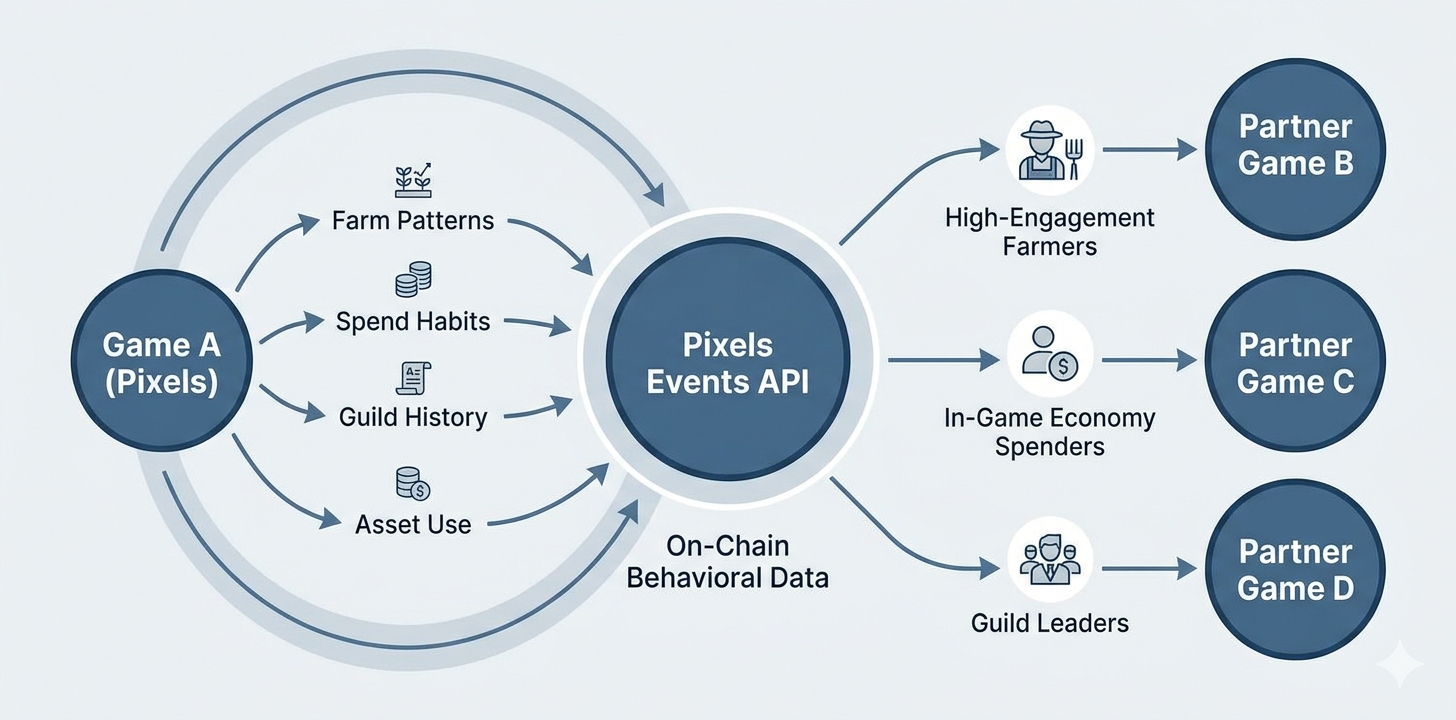
The primary friction for any new game, whether Web2 or Web3, lies in the sheer cost of acquiring and understanding a player base from zero. Traditional gaming solves this through immense marketing budgets, buying eyes and, perhaps more crucially, user data from centralized platforms. Web3 gaming, in its current state, has largely replicated this model, often starting with zero behavioral history for its users and forced to guess which addresses represent high-value, long-term participants versus synergistic Sybil attackers. This systemic acquisition problem, where every new game begins structurally blind to its own potential player economics, has remained largely unaddressed at an ecosystem level.
Pixels is currently building an infrastructure that aims to structurally lower this friction for its partner developers: the Pixels Events API. This system moves beyond simple wallet-based token holding metrics to expose granular on-chain behavioral data to partner games. A developer integrating into the Pixels ecosystem does not merely gain access to a user base; they inherit a complete behavioral profile for each connecting player. This profile includes specific, verifiable patterns: farming frequencies, resource spending habits, in-game asset utilization, and historical guild engagement metrics. A partner game can therefore utilize this portable data on day one to tailor initial experiences, target incentive programs, and identify users most likely to retain and monetize, all based on documented historical behavior rather than speculative projections.
The potential economic implications for ecosystem partners are direct. Estimated user acquisition costs for an active player in Web3 gaming were often placed between $15 and $40 in 2023, driven largely by the inefficiency of targeting new wallets in an environment with high noise-to-signal ratios. Access to a shared, high-fidelity behavioral database provides a structural alternative to these costs, as partner developers can target verified player archetypes immediately. The financial incentive to build within this ecosystem, rather than in isolation, becomes measurable in terms of both reduced direct marketing expenditure and accelerated player lifetime value optimization.
However, the functional value of this infrastructure is entirely dependent on the continuous generation of dense, high-quality behavioral data. A database of ten million wallets, of which eighty percent have been inactive for six months, is functionally less valuable than one with two million highly active daily users whose behavior is being continuously documented and updated. The narrative of Pixels' daily active user growth, therefore, must be viewed not just as a vanity metric for current token price speculation, but as the raw material required to make the Events API a viable tool for any prospective partner. The entire model rests on maintaining a critical mass of active players whose documented behaviors provide actionable insights, rather than just historical noise.
If this infrastructure proves effective, it suggests that the real value proposition of a gaming ecosystem to its partners is shifting.
The central question for the long-term outlook of Pixels is whether this type of proprietary, granular behavioral data can form a sustainable moat, or whether any better-capitalized competitor could replicate it. The core competitive tension lies in whether a rich historical dataset tied to a specific community is inherently superior, or if data is ultimately a commodity that can be re-generated more efficiently by anyone willing to subsidize massive, immediate player growth.