
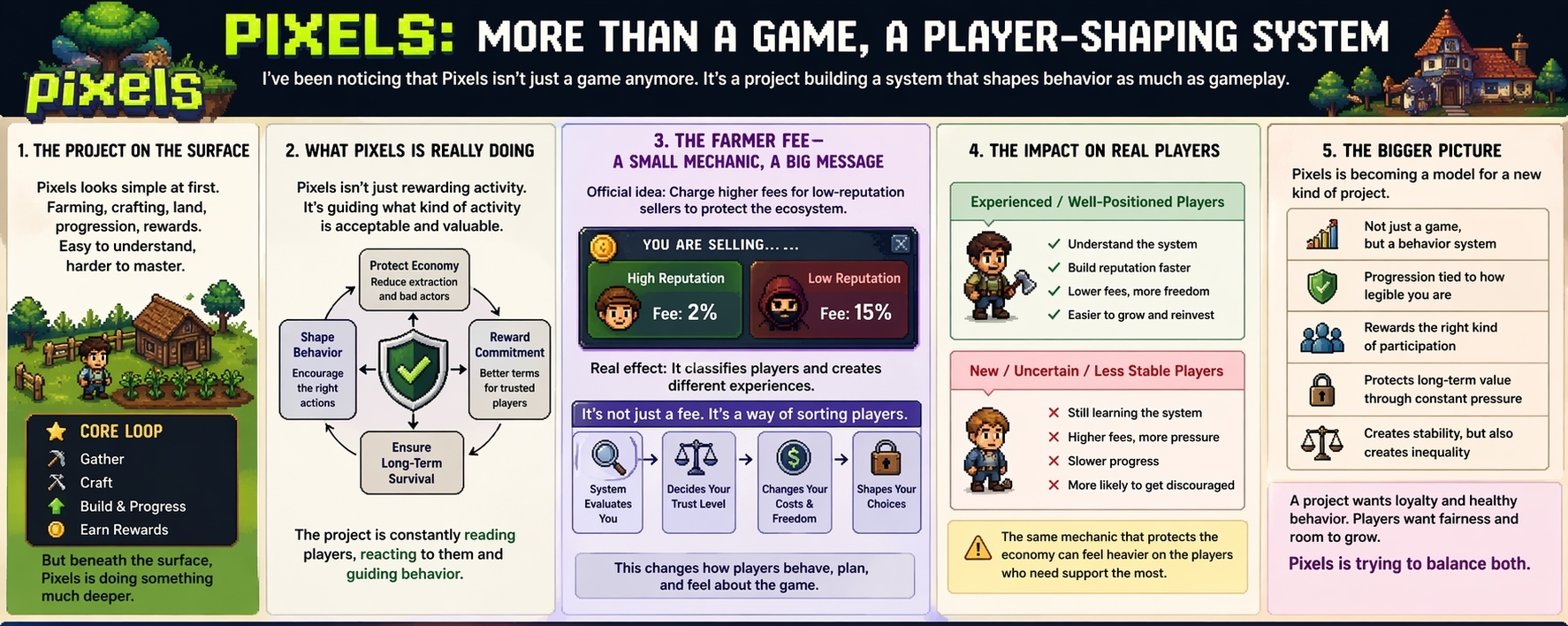

I’ve been noticing that Pixels doesn’t feel like just another Web3 game project anymore.
The more I watch Pixels, the more it feels like something broader is forming around it. Not only a game with its own economy, land, rewards, and player loops, but a project that is slowly showing what this kind of system can become when it starts shaping behavior as much as gameplay. That is what keeps pulling my attention back. I’m not really looking at Pixels as a pitch anymore. I’m looking at it as a living system.
What makes Pixels interesting to me is not only what the project says it is building, but what it quietly becomes once real players start moving through it every day.
On the surface, Pixels can still look simple. Farming, gathering, crafting, land, progression, rewards. The kind of setup that feels familiar enough to understand quickly. But once you spend time thinking about how the project actually runs, it becomes clear that Pixels is doing much more than offering a game loop. It is constantly trying to guide behavior.
That is the part of the project I keep coming back to.
Pixels is not just rewarding activity. It is trying to shape what kind of activity is acceptable, sustainable, and valuable inside its ecosystem. And once a project starts doing that, it stops being only about fun or progression. It becomes about control, trust, survival, and long-term balance.
The official framing usually sounds clean. Protect the economy. Reduce extraction. Reward committed players. Create healthier participation. Those goals make sense. Any project with an open economy has to think that way, especially in Web3 where players are not only playing but constantly calculating. If Pixels stayed completely open, it would probably get drained fast by short-term behavior.
So I understand the logic.
But the real project is more complicated than the official explanation.
Because in practice, Pixels is not only protecting an economy. It is building a system that reads players, reacts to them, and creates different experiences depending on how they fit the model. The project may talk about balance, but what it is often doing underneath is sorting. It is deciding who looks useful, who looks risky, who looks committed, and who looks extractive.
That changes the meaning of the project.
It means Pixels is not only designing content. It is designing incentives strong enough to influence behavior over time. It is creating pressure. Pressure to stay longer. Pressure to act in ways the system prefers. Pressure to become the kind of player the project is built to reward.
That does not always feel obvious when people talk about Pixels from the outside.
A lot of the conversation still treats the project like it is mainly about features, updates, token loops, or land utility. But I think the deeper story is that Pixels is testing how far a project can go in shaping player conduct without making that control feel too visible. That is where it gets more interesting, and also more uncomfortable.
Because real players do not enter the project on equal terms.
A player who has more time, more capital, more knowledge, or better positioning inside the ecosystem can usually adapt more easily. They learn the rhythms faster. They understand what the system rewards. They know how to move with less friction. A new or less stable player does not have that same flexibility. They feel the pressure sooner. They make more costly mistakes. They run into the project as a system before they get to enjoy it as a world.
That is where fairness becomes a real question.
Pixels may be trying to protect itself from extraction, but the same systems that defend the project can also weigh harder on normal players who are still figuring things out. So the project ends up carrying a tension inside itself. It needs enough friction to survive, but not so much that participation starts feeling like a test you are failing before you understand the rules.
That tension matters because Pixels is not just trying to keep players active for a week. The whole project depends on whether people believe the ecosystem is worth settling into. Not visiting. Not farming for a phase. Actually settling into.
And that is much harder.
A project like Pixels does not survive long term just because its economy is protected on paper. It survives if people feel there is still a fair reason to invest time, attention, and effort inside it. If the project becomes too defensive, too suspicious, or too optimized against the wrong behavior, it can protect the economy while quietly draining the feeling that makes players want to stay.
That is why I keep seeing Pixels less as a single game and more as a project trying to define a model.
It is testing what happens when a game economy becomes a behavior system. When progression is tied not only to effort, but to how legible and acceptable your behavior is to the project. When protecting long-term value requires constant small pressures on the people inside it. When retention is not only about content, but about making exit feel less attractive and staying feel more rational.
That does not make Pixels bad. It also does not make it automatically smart.
It just makes the project more serious than the usual Web3 gaming story people tell around it.
There is something real here. Pixels clearly understands that open economies cannot survive on optimism alone. The project is trying to build structure, not just excitement. But structure always comes with tradeoffs. The more the project protects itself, the more it risks becoming selective in ways that are hard for ordinary players to ignore. The more it rewards the right kind of participation, the more it may quietly punish people who do not yet know how to fit.
That is why I keep watching Pixels so closely.
Not because I think the project has solved the category, but because it feels like it is exposing the real problem inside it. A project wants loyalty, stability, and healthier behavior. Players want opportunity, fairness, and room to move without feeling managed too tightly. Pixels is sitting right in the middle of that conflict.
And I still do not think the project has fully resolved it.
Maybe it cannot. Maybe this is just the core tension of any project that mixes open economies, real incentives, and long-term retention under one roof. Pixels might become one of the clearest examples of how to make that balance work. Or it might show how easy it is for a project to protect its system so carefully that the system starts feeling heavier than the game itself. That uncertainty is still there, and honestly, that is what makes Pixels worth thinking about.