
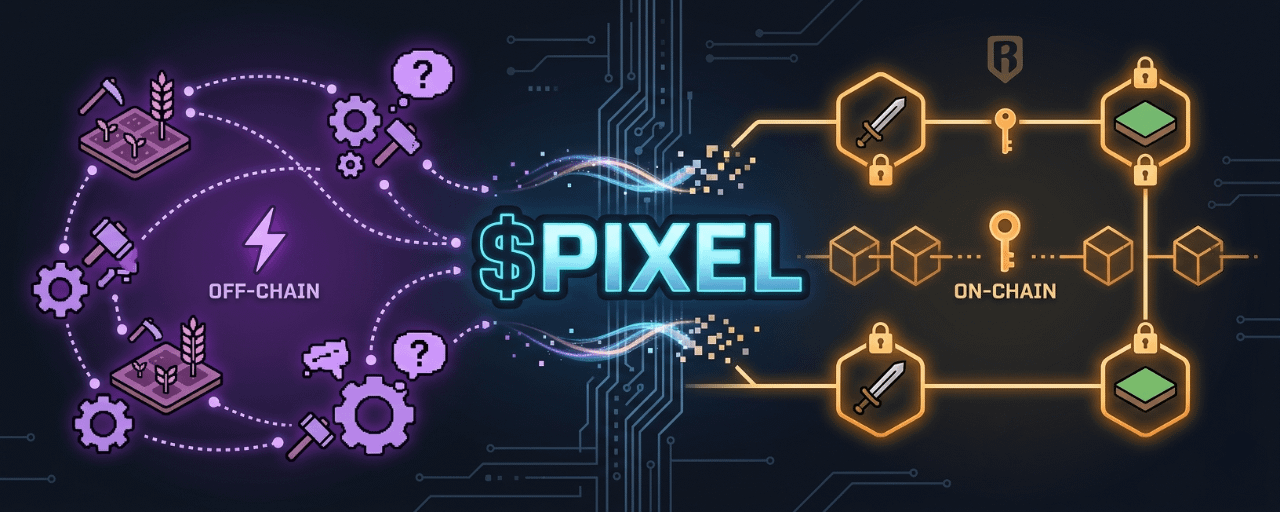
I stopped looking at mechanics and went one layer lower, execution. Not what players do, but where those actions actually live. Most people focus on tokens, items, rewards, but the more interesting part sits underneath. Pixels runs the majority of its activity off chain, and that decision changes the entire shape of the system.
I tried to trace a simple loop. Actions happen instantly, no visible friction, no gas considerations, no delay that usually comes with on chain interaction. That alone is not new, many games do it. What matters is what stays off chain and what eventually moves on chain. The split is not random. High frequency actions stay off chain where speed matters. Ownership, settlement, and anything that needs permanence moves to Ronin.
So I pushed this from a different angle. I compared what can be repeated at scale versus what cannot. Farming actions, crafting loops, task execution, all of these can run thousands of times without cost friction because they never touch the chain directly. But when something crosses into ownership or tradeable state, it shifts environment completely. That boundary is where the system changes rules.
$PIXEL This creates two layers that behave very differently. One is fast, flexible, almost disposable. The other is slower, constrained, and permanent. Most systems struggle because they try to do everything in one place. Pixels separates them, and that separation is not just technical, it affects how the economy evolves.
When activity stays off chain, scaling is cheap but also easier to exploit. That’s where behavioral filtering and systems like Stacked become necessary, not as an add on, but as a control layer. Because if execution is cheap, then validation has to become stricter somewhere else.
When value moves on chain, scaling slows down, but integrity increases. Assets become harder to manipulate, ownership becomes clearer, and the system anchors itself. The interesting part is not either layer alone, it’s how they connect.
I tested this by looking at transitions. When something moves from off chain activity into an on chain state, that moment feels different. It’s not just a step in gameplay, it’s a conversion between two environments with different rules. That’s where value starts to “stick”.
Seen this way, $PIXEL is not just circulating inside a game loop. It operates across both layers, fast inside the system, slower when it anchors to ownership or exchange. That dual role is what allows the system to scale without breaking immediately under its own activity.