

The Twin Star Channel is a left-side trading strategy, betting against the trend at the channel boundaries, playing for a return to the mean.
This strategy is better suited for #事件合约 than MACD/RSI, because event contracts rely on pinpointing positions and ultra-short-term micro-fluctuations, rather than trend following.
The high shorts and low longs of the Twin Star Channel essentially bet on statistical mean reversion—the likelihood of prices moving within the channel is much higher than breaking out. It’s a probability game, and the channel gives you a clear probability boundary; you have enough time to reverse within 300 seconds.
Then this 'Twin Star Channel' strategy is made up of two stars working together!
🔵 Large Channel = Guardian Star, only do 10-minute event contracts.
🟠 Small Channel = Shooting Star, only do 5-minute event contracts.
📌 The mantra is simple: open 10 minutes at the edge of the large channel, open 5 minutes at the edge of the small channel, high short, low long!
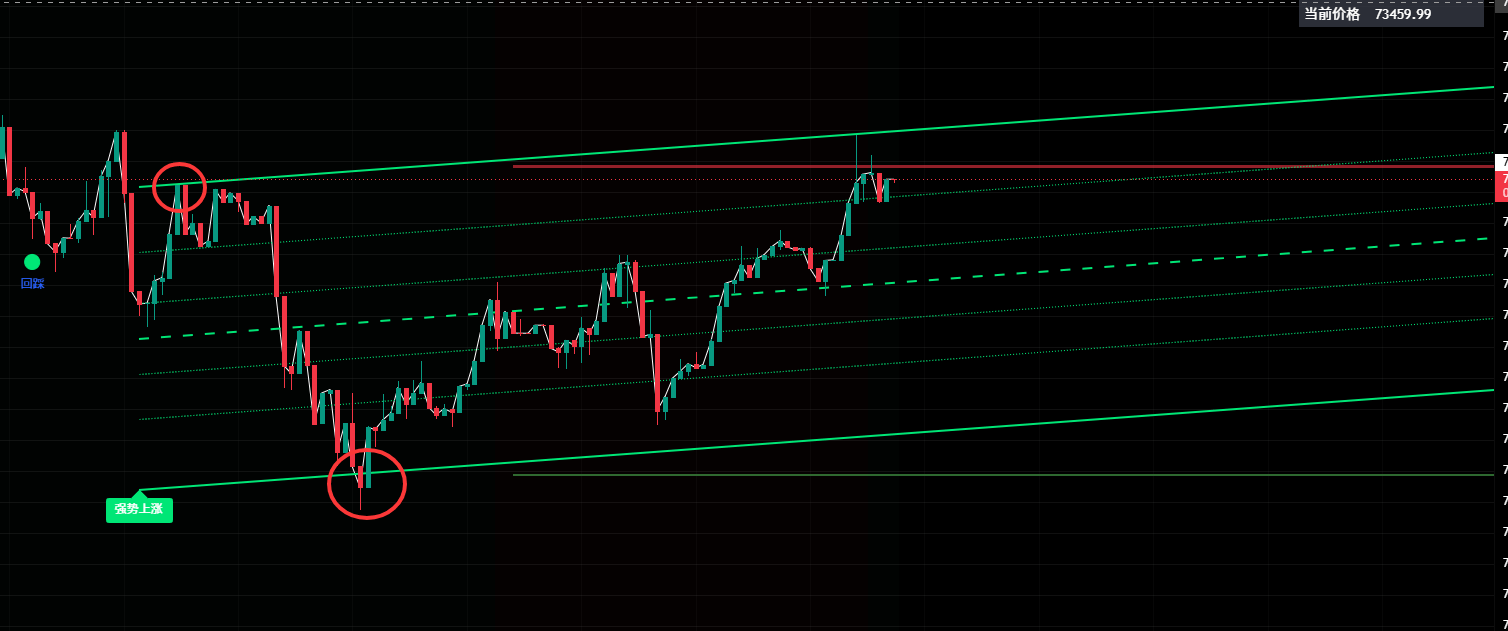
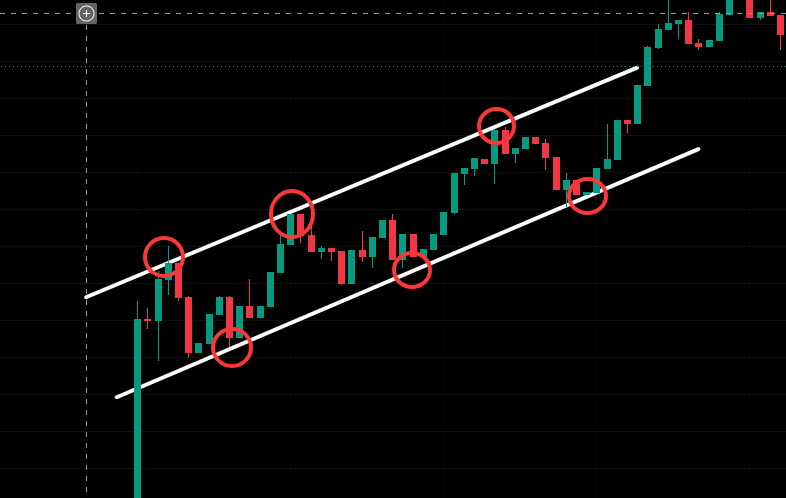
Note: The principle of this approach is to split the oscillation of small channels within a large channel. It's suitable for use in the mid-range of the large channel. Generally, when the small channel reaches the edge of the large channel, a new reversal begins. So don’t take positions too close to the edge of the large channel; wait until the large channel touches the edge line to open a 10-minute reversal position.
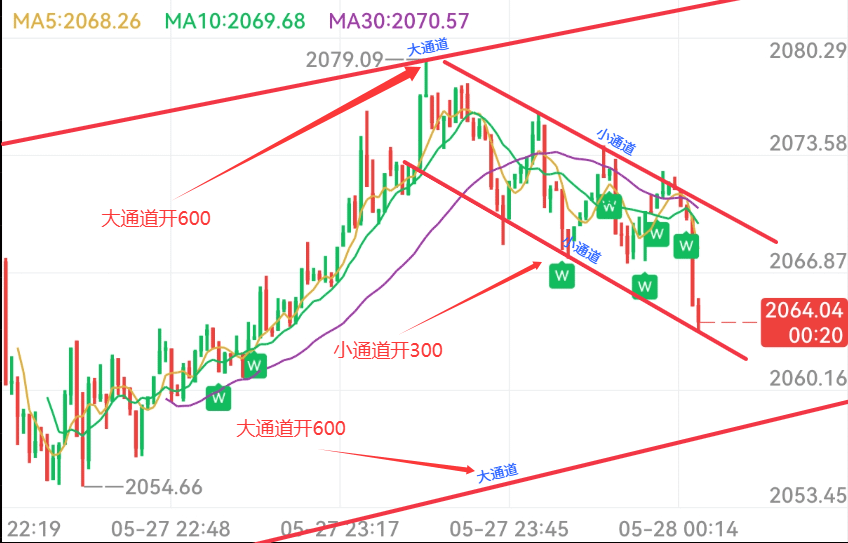
It's all about following the principle of selling high and buying low during consolidation. Of course, a small channel needs to go through a few lines, establishing a high and low point to create a range. Once the small channel is fully set, the moment the price hits the boundary is your entry point. You can totally cover a 300-second event contract, betting on the price reverting back within the boundaries—it's all about ‘mean reversion’.
Why is the Twins Channel more suitable for event contracts than traditional indicators (MACD / RSI)?
It's not that MACD or RSI are bad; it's just that in this specific battlefield of event contracts, they happen to be the soft spot of traditional indicators but the comfort zone for channel trading.
1. Event contracts are about 'position betting', not 'trend betting'. The essence of MACD and RSI is trend following and momentum measurement:
MACD golden cross and dead cross → judge trend reversal.
RSI overbought/oversold → judge momentum exhaustion.
But event contracts only last 5 minutes or 10 minutes, so in such a short time:
MACD just crossed golden; the market might have already moved halfway (lagging).
RSI can be overbought but may continue to be overbought; by the time it turns, the contract may have already expired (lagging).
On a 5-minute trend, MACD may not even complete a full golden cross-dead cross cycle.
The difference with the Twins Channel: it directly outlines visible price boundaries. You don't have to wait for indicators to signal; just ask yourself: 'What position is the price in the channel right now?'—this judgment is instantaneous and intuitive.
2. Traditional indicators are 'lagging', while channels are about 'anticipation'.

The lifecycle of an event contract is too short; what you need isn't 'will the trend continue?', but 'where will the price move in the next 5/10 minutes?'.
The high short and low long in the Twins Channel essentially bets on statistical mean reversion—the probability of price running within the channel is far greater than the probability of a breakout. This is a probability game, and the channel gives you a clear probability boundary.
3. The channel boundaries are 'visibly apparent support and resistance'.
MACD tells you about 'momentum', but strong momentum doesn't mean the price won't hit a wall at certain levels. What event contracts require is precise price location info, not momentum data.
The upper and lower bounds of the channel are calculated from the most recent real price highs and lows, not from abstract formulas. Especially in large channels, it essentially represents a confidence interval in statistics, where the probability of the price returning to the range is naturally greater than that of a breakout.
MACD/RSI help you judge 'direction', while the Twins Channel helps you judge 'position'. Event contracts are short sprints of 5 or 10 minutes; position matters more than direction. (Personal opinion)
4. This left-side approach has unique advantages in event contracts.
In traditional trading, left-side trading is risky because if the trend is strong and the boundary is broken, you'll have to bear losses.
But in event contracts:
Your losses are fixed (the invested principal), there’s no holding onto losing positions.
You’re only betting on whether the price will fluctuate slightly in the opposite direction within the next 5-10 minutes, not betting on a major trend reversal.
The channel boundaries are exactly where the price is most likely to pause or pull back; even if it breaks through, it often lingers near the boundary for a while, giving the 5-minute contract enough room for winning probability.
The Twins Channel takes the left-side trading logic and applies it to event contracts, which are tools of 'fixed loss', transforming a high-risk play into a probability game.
The Twins Channel is left-side trading, entering against the trend at the boundary to bet on reversion. It is more suitable for event contracts than MACD/RSI because event contracts rely on position judgment and micro fluctuations over 5 or 10 minutes, rather than trend following.