
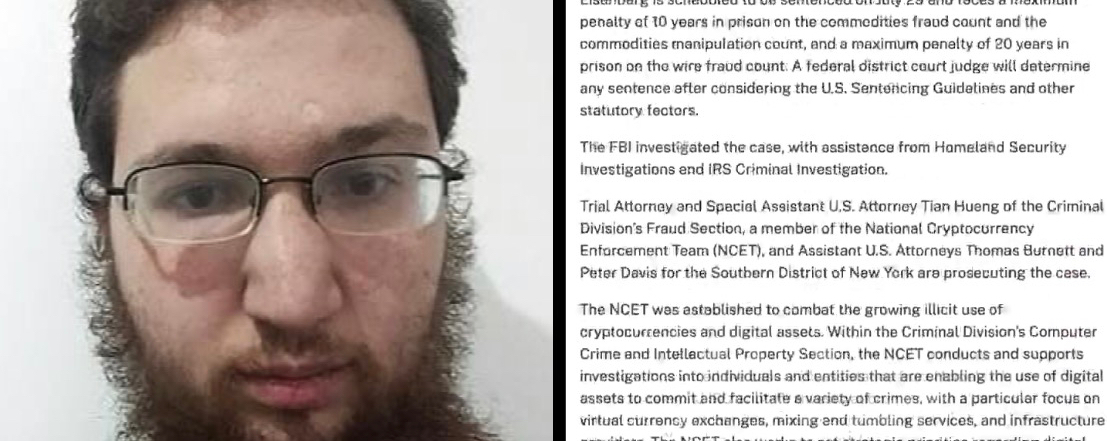
A guy drained $110 MILLION from a crypto exchange in 20 minutes. Then he used the stolen tokens to vote for his own amnesty.
He beat all federal charges in court.
But still ended up in jail because of what the FBI found on his laptop.
In October 2022, Avraham Eisenberg spotted a flaw in Mango Markets, a decentralized exchange on Solana. Not a code bug, but an economic design flaw.
Here’s what he did.
He deposited $5 million, split it into two wallets, used one wallet to short 483 million futures contracts, and the other to buy them all. Both sides of the same trade. Zero risk in the market. Maximum leverage.
Then he hit the spot market.
He aggressively bought the MNGO token on three exchanges with such low liquidity that his buying pressure inflated the price by 1,300% in 20 minutes.
The price oracle fed that inflated price back to Mango Markets. The smart contract recalculated the value of his wallet. Suddenly, his position was worth hundreds of millions.
He borrowed $110 million in Bitcoin, Ethereum, and stablecoins against fake collateral, withdrew it all, then shorted his tokens, crashing the price back down.
The platform instantly became insolvent. All users' funds vanished.
Then he went on Twitter, using his real name, and called it a 'highly profitable trading strategy'.
He said: 'All our actions were legal open market actions, using the protocol as designed'.
The Mango DAO held a governance vote on whether to let him keep $47 million as a 'bug bounty'. Approved. 9.46% voted yes. 0.33% voted no.
More than half of the yes votes came from just two developer wallets. And Eisenberg himself voted for his own amnesty using the tokens he had just stolen.
Then he fled to Israel.
The FBI found his search history: 'Elements of fraud', 'When does market manipulation become a crime?', 'Statute of limitations for market manipulation', 'Israel extradition rules', 'FBI surveillance'.
He also used a fake Ukrainian identity to set up some of his trading accounts. So much for 'transparent open market actions'.
In December 2022, he flew to Puerto Rico. The FBI was waiting. Arrested at the airport. Laptop and phones seized.
In April 2024, a federal jury convicted him on all charges: commodities fraud, market manipulation, and electronic fraud. This marked the first criminal conviction for open market manipulation in crypto.
Then his lawyers filed a Rule 29 motion.
And the judge threw everything out.
The commodities charges were thrown out. Wrong jurisdiction. Eisenberg was in Puerto Rico. The operations happened on Solana. The government's whole case for being in New York was that a third-party vendor had staff in Manhattan monitoring accounts. The judge said that wasn't enough.
The charge of electronic fraud? Total acquittal. The judge ruled that Mango Markets had no terms of service, no rules, and no prohibitions against what he did. The smart contract executed exactly as coded. The oracle reported the actual market price. And you can't commit fraud against a protocol that never told you what the rules were.
He won the biggest crypto fraud case in history.
But here’s the twist that nobody saw coming.
When the FBI seized his devices at the airport, they were looking for evidence of market manipulation. Instead, they found child abuse material on his laptop.
The 'plain view' doctrine. If agents executing a valid search warrant for one crime find evidence of another crime, it’s fully admissible.
He pleaded guilty. 52 months in federal prison.
He outmaneuvered an exchange for $110 million. Outplayed the DOJ. Beat the SEC. Surpassed the CFTC.
But he couldn't overcome the content on his own hard drive.
The feds came for the $110 million. They stayed for what they found on the laptop.