

On June 1, the entire tech circle was buzzing with two major announcements:
One was that Yushu Technology's Sci-Tech Innovation Board IPO got the green light, with a valuation pegged at 42 billion yuan;

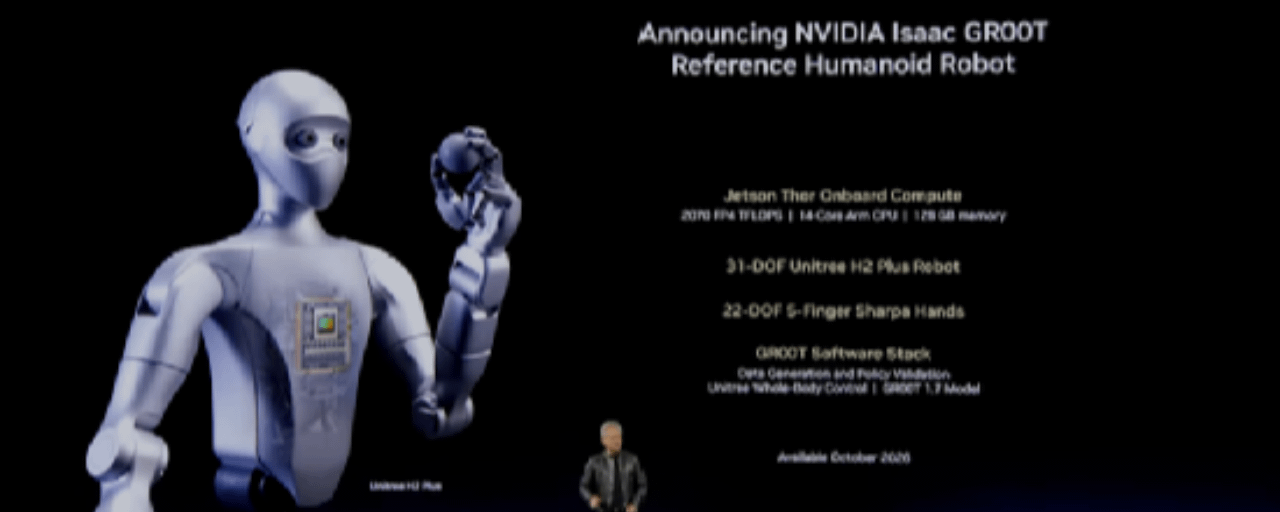
In another shocking move, Nvidia CEO Jensen Huang personally announced at GTC Taipei the joint launch with Yushu Technology of the world's first reference design for the IsaacGR00T humanoid robot aimed at academic research.
This isn't just a simple business collaboration; it's Huang finding the key piece for his 'Physical AI Empire.'
When everyone thought Nvidia would be closely tied to star companies like Boston Dynamics and FigureAI, Jensen Huang instead extended an olive branch to China's Yushu Technology.
Yushun Technology is taking off completely.

At 9 AM yesterday, the Sci-Tech Innovation Board's listing committee announced the results of its 41st deliberation meeting in 2026: Yushun Technology's IPO has been approved.
While everyone is still discussing the valuation of the 'first Chinese robotics stock', at 2 PM, Jensen Huang showcased this robot based on the Yushun H2Plus to a global audience at the Taipei International Convention Center.
"It stands 1.82 meters tall and weighs about 70 kilograms, similar to me."
A joke from Jensen Huang ignited the whole audience.
This reference design, named H2+, adopts a 'three-party division of labor' model.
Yushun Technology provides the robot body, Singapore's Sharpa company provides the Wave tactile five-finger dexterous hand, and Nvidia takes care of the entire 'brain' part from computing power, models to simulation systems.
The parameters of H2+ are truly luxurious.

Its body has 31 degrees of freedom: 6 for each leg, 7 for each arm, 3 for the waist, and 2 for the head, enabling it to perform the vast majority of daily human actions.
Equipped with Sharpa's dexterous hands, each hand has 22 degrees of freedom, with fingertip tactile pixels exceeding 1000, and pressure sensitivity reaching 0.005N, allowing it to firmly pick up a bottle of water or gently pinch a sheet of A4 paper.
The head-mounted 5MP wide-angle stereo camera has a horizontal field of view of 140°, almost equivalent to human eye vision.
Nvidia has stated that this system is not yet aimed at the consumer market, with the first batch being delivered to top global research institutions like Stanford University, ETH Zurich, and UC San Diego, expected to officially ship by the end of 2026.
Why Yushun Technology?
Jensen Huang's choice surprised many.
After all, Boston Dynamics' Atlas represents the ceiling of humanoid robot mobility, while FigureAI has already secured investments from OpenAI and Microsoft, and Tesla's Optimus comes with Musk's halo.
But if you understand Yushun Technology's strategy, you'll realize that Jensen Huang's choice is far from accidental.
First, Yushun is the world's best at 'mass-producing' humanoid robots.
While Boston Dynamics is still having Atlas do backflips in the lab, and Tesla is fretting over Optimus's mass production, Yushun has already sold humanoid robots to over 50 countries and regions worldwide.
In 2025, Yushun Technology's humanoid robot shipment is expected to reach 4,200-5,500 units, with a global market share of 27%-32%, second only to ZhiYuan Robotics.
More importantly, Yushun has driven prices down. The G1 humanoid robot starts at 85,000 yuan, while the R1 has lowered the entry price to 29,900 yuan, whereas similar international products are generally priced over one million yuan.
For Nvidia, reference designs cannot be 'PPT designs'; they must be affordable and usable for developers worldwide.
Second, Yushun's motion control capabilities have passed the most rigorous real-world scenario validations.
At the 2025 Spring Festival Gala, the Yushun H1 robot performed a flower dance and handkerchief twirl in perfect sync with live actors.
Many people only see the excitement while overlooking the harsh stage environment: complex lighting, fixed rhythms, and zero-tolerance requirements; any mistake could turn into a nationwide live broadcast accident.
These real-world tests have proven the stability and reliability of Yushun robots.
Third, Yushun is the robot company with the highest industry recognition.
From the early Go1 robot dog to the later H1 and H2 humanoid robots, Yushun's products have garnered billions of views on YouTube and TikTok.
Jensen Huang needs a hardware benchmark recognized by the global robotics community, not just a company with fame.
The war for humanoid robots has officially begun.
Many people say this collaboration marks the 'Android moment' for humanoid robots.
This statement is true, but not entirely.
Back when Android defeated Symbian, it relied on openness and being free, allowing all smartphone manufacturers to start on the same line.
What Nvidia is doing now is indeed very similar to what Google did back in the day: it doesn't compete with any robotics company for market share, but provides tools for everyone. Whoever uses my platform, I empower them.
However, the battle for humanoid robots is far more complex than the smartphone industry.
Tesla's closed-loop model still has a huge advantage.
It has the world's most advanced factory, reusable automotive data in the millions, and its own logistics and manufacturing scenarios. Optimus may not be the first robot sold to developers, but it could very well be the first to actually work in factories and achieve large-scale commercial use.

Figure AI should not be underestimated.
Backed by OpenAI, it boasts the best general large models in the world and has already signed orders with Amazon and BMW.
If OpenAI can perfectly transplant GPT's capabilities onto robots, it could very likely become Nvidia's biggest competitor.
Yushun Technology is the rising star in the robotics industry, maintaining its own independent product line. It’s likely to launch commercial robots based on the Nvidia platform in the future, possibly compatible with other large models as well.
So it's said that Nvidia's disruption of the industry is indeed premature; but one thing is certain, from today on, the humanoid robot industry is no longer about 'who can build robots is powerful,' but rather 'who can establish an ecosystem is powerful.'
For the past decade, Chinese robotics companies have been chasing after others. We have imitated others' technology, followed others' paths, and acted as others' factories.
But now it's different; Yushun has become the hardware standard for universal humanoid robots globally, meaning we are now at the upstream of the industry, participating in the game rules.
This collaboration is not an end, but a beginning.
The next five years may witness the fastest advancement in robotics technology in human history.
When AI finally has the hands and feet to touch the world, perhaps our lives will be completely transformed.