
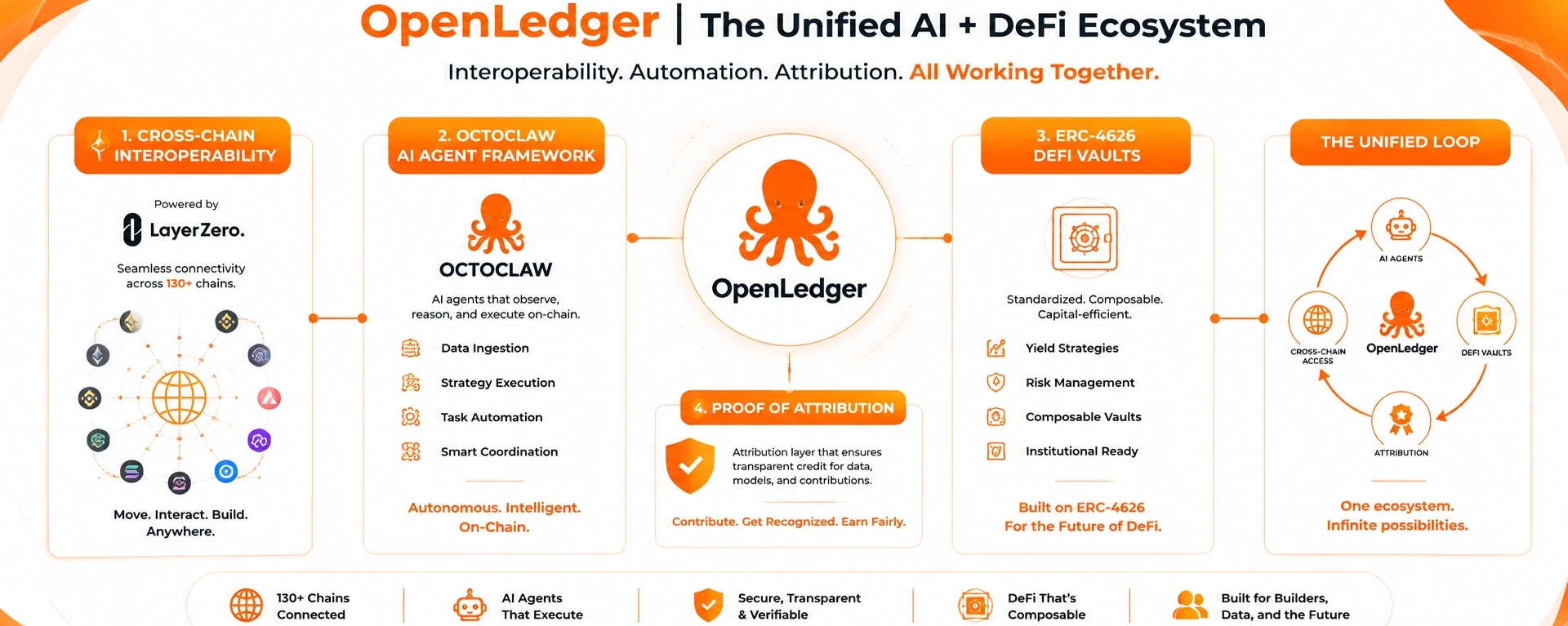
OpenLedger is one of those projects I keep coming back to because it sits right at the point where crypto seems to be changing shape.
I’ve been noticing that the industry is no longer just trying to connect chains or build another DeFi layer. It is trying to figure out what happens when AI agents, data, attribution, and capital all start moving through the same system. That sounds neat when written down, but in practice it is messy. And maybe that is why I find it interesting.
A lot of crypto projects say they are building ecosystems. Sometimes that just means they have a few products placed under one name. A bridge here, a vault there, an AI tool somewhere on the side. It looks connected from a distance, but when you spend more time with it, the pieces do not always feel like they need each other.
With OpenLedger, the idea feels a little more deliberate.
LayerZero gives it a wider cross-chain path. OctoClaw brings in agent automation. ERC-4626 gives the DeFi vault side a familiar structure. Proof of Attribution tries to answer a harder question: if value comes from data, models, agents, and users together, how do you trace where that value actually came from?
That is the part I keep thinking about.
AI in crypto has often felt like a surface-level trend. A chatbot on a dashboard. A trading assistant with vague promises. A layer that sounds futuristic but does not really change how the system works. OpenLedger seems to be aiming at something deeper than that. It is not just asking AI to explain crypto. It is trying to place AI inside the flow of value.
That could matter.
If agents are going to do useful work, they need places to act. They need liquidity. They need data. They need rules. They need access across chains. They also need some kind of accountability, because once automation touches capital, the questions become serious very quickly.
Who is responsible when an agent makes a bad decision? How much does the user actually understand? Can attribution stay fair once incentives become complicated?
I do not think these questions have easy answers.
That is why I am not looking at OpenLedger as something already proven. I see it more as an early attempt to connect several trends that the industry has been treating separately. Interoperability, automation, DeFi, and attribution all make sense on their own. The harder part is making them work together without hiding too much complexity from the user.
The strength of OpenLedger is that the story is coherent. The pieces belong in the same conversation. Cross-chain access gives agents more room to operate. Vault standards make DeFi participation less strange. Attribution gives the whole thing a reason to care about where value starts, not just where it ends.
But the weakness is also obvious.
A system this broad can become difficult to judge. More chains can mean more reach, but also more dependency. Automation can mean better coordination, but also less visibility. Vaults can be standardized and still carry risk. Attribution can sound fair in theory and become messy in practice.
Still, I think the attempt is worth watching.
The industry is slowly moving away from isolated apps and toward systems where intelligence, liquidity, and contribution are tied together. Whether OpenLedger becomes a strong example of that or simply exposes how hard it is, it points toward a real direction.
Maybe that is the bigger takeaway.
Crypto does not need more projects that only look unified from the outside. It needs systems where the connections actually matter. OpenLedger is interesting because it is trying to build around that idea. I am not sure yet if it will fully work, but I do think it is asking the right question.
Can crypto become intelligent, cross-chain, and automated without becoming impossible to understand?
That may be one of the questions that defines where the industry goes next.