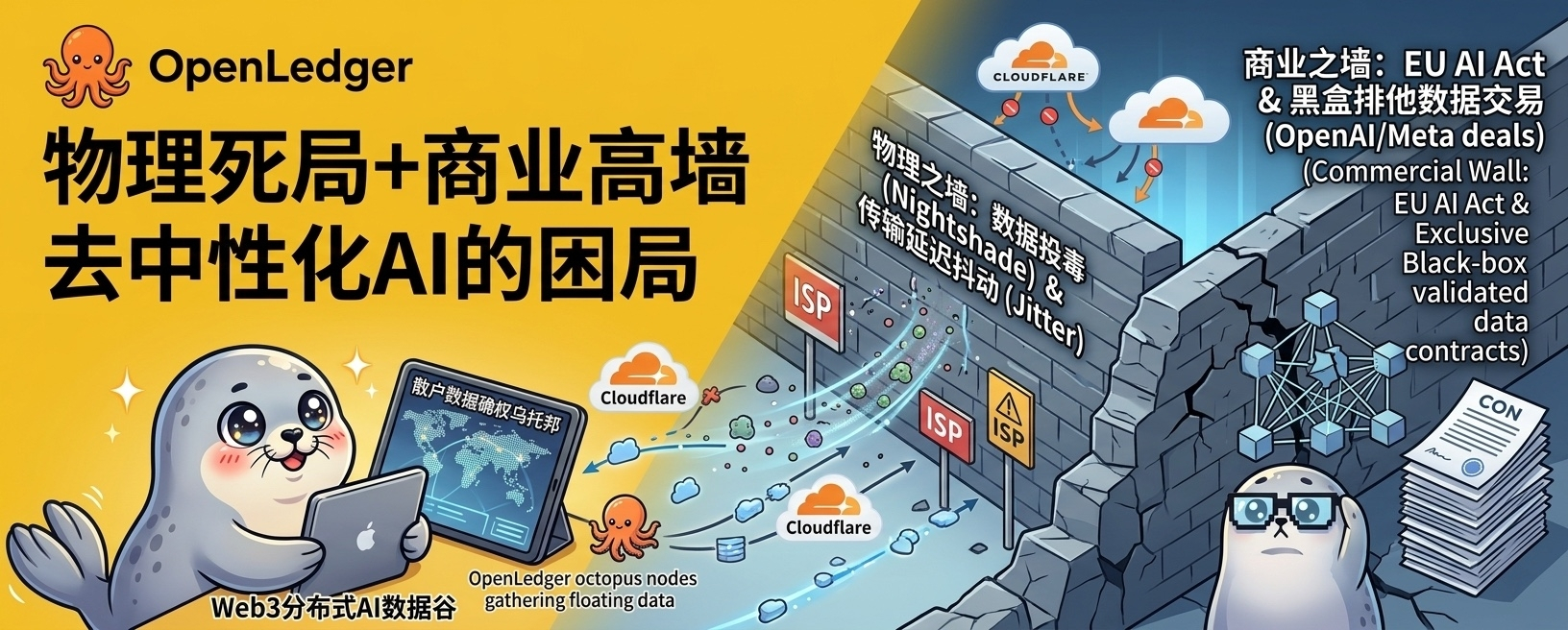

June in the Northeast is the rainy season, and the humid, sticky air combined with the incessant rain outside has me feeling inexplicably anxious. Coincidentally, today marks the final stretch of the $OPEN #CreatorPad task, and the air around me is thick with slogans urging us to get on board and shout 'AI era data equality!' I brewed a cup of bitter coffee and stared at the computer screen displaying the sensational old news about OpenLedger and Story Protocol teaming up to launch 'AI Automatic Royalty Rights Confirmation,' plunging into a long and painful emotional rollercoaster.
Today, when I forced myself to step out of a narrow legal perspective and looked at the entire tech blueprint and business loop through the lens of networking and machine learning fundamentals, that initial awe popped like a bubble, leaving me with a chill—I've realized that this grand narrative is as fragile as a waterlogged piece of paper in the face of the fundamental physical laws, data security, and the towering walls of real-world commercial law.
A stunning starting point: I once stood up and applauded.
We must acknowledge that the blueprint drawn in collaboration with \u003cm-33/\u003e and Story Protocol has a strong appeal on a purely logical level. In the traditional AI industrial chain, creators, data cleaners, and edge nodes always sit at the bottom of the food chain. Giants like OpenAI and Google, with their massive computing power and legal teams, shamelessly extract free global data to train their models. The Datanets (community-owned datasets) and ModelFactory proposed by \u003ct-35/\u003e precisely target this pain point. Its combination with Story Protocol creates a seemingly perfect closed loop: retail investors contribute data through nodes, and OpenLedger uses Proof of Attribution to record every bit of your contribution to the AI model on-chain; once the model generates calls (Inference) in commercialization, the underlying protocol of Story Protocol will automatically trigger, settling royalties in micro-transactions in real-time to the original data contributors through OPEN tokens.
Isn't this the absolutely fair Web3 distributed AI utopia we dream of? To be honest, when I first saw this design, I almost stood up and applauded. But it is precisely this logical consistency that made me feel increasingly burned as I uncovered layer after layer of hidden dangers in the following days.
The deadly loophole under the shadow of 'Nightshade': decentralized consensus cannot prevent 'data poisoning.'
OpenLedger has consistently emphasized that its Datanets can produce high-quality training materials. But there's a huge, almost unsolvable logical paradox: the consensus mechanism of a decentralized network can only verify whether the data has reached 'consensus,' but it cannot verify the 'absolute truth' of that data in the physical world.
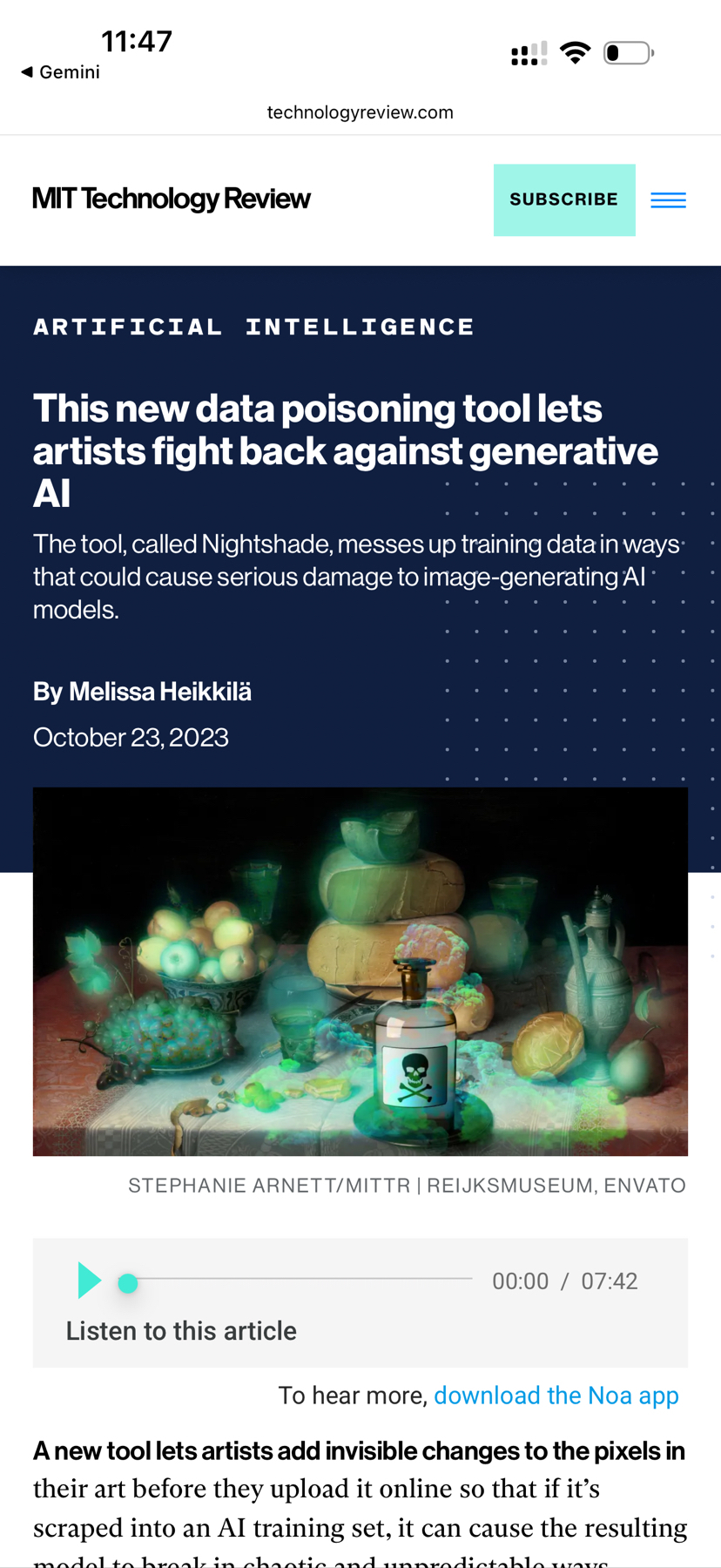
As early as 2023, a tool called Nightshade for adversarial AI poisoning was released by the University of Chicago, causing quite a stir in geek circles. See the image below. The terror of this thing lies in its ability to make imperceptible alterations to images or text at the pixel level. What you see is a cat, but the underlying vector of the AI model recognizes it as a dog.
Now, what happens when this terrifying tool is brought into OpenLedger's distributed network?
In a decentralized, permissionless network, any node can submit data. If a malicious hacker organization or competitor uses tools like Nightshade to perform 'invisible poisoning' on massive amounts of data and then disperse it through tens of thousands of anonymous nodes uploaded to the OpenLedger network, the network's consensus algorithm will only compare the hash values or formats of the data to see if they are compliant; nodes might even vote in favor of these 'poisoned data' due to aligned interests. What’s the result? Once B-end AI large models purchase this batch of contaminated decentralized data, the neural network weights of the entire model will suffer catastrophic damage, a phenomenon known as 'model collapse' in machine learning.
In traditional centralized big firms, data cleaning has strict internal isolation and accountability mechanisms; but in this fully distributed network, who takes responsibility for 'poisoning'? If the 'purity' of data can't be guaranteed 100% in practice, which billion-dollar AI unicorn would dare entrust the lifeblood of their large models to an anonymous network that could be maliciously poisoned at any moment? Just thinking about this gives me chills. The so-called 'data rights' assume that the data is 'good data.' If you can't prevent adversarial poisoning, the output of this network is just a pile of expensive digital garbage.
The physical curse of latency jitter: the nightmare of enterprise-level AI pipelines.
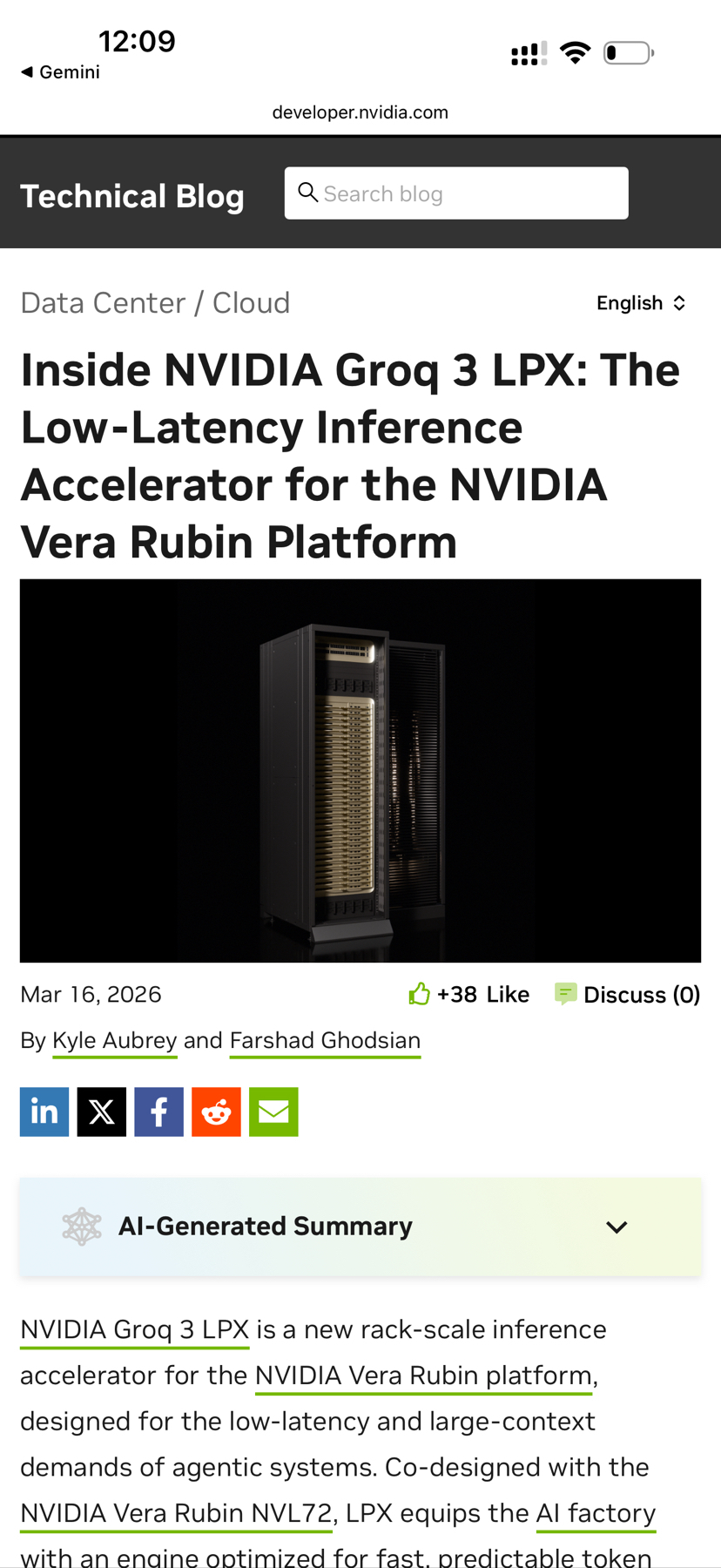
The second point that crushed my psychological defenses is the extremely real hardware physical wall. If you've been paying attention to Silicon Valley's dynamics lately, you'd know that companies like Groq, which are specifically designed for AI inference LPU (Language Processing Unit), or Nvidia's latest Blackwell architecture, are fiercely competing on one metric: ultra-low latency and extremely high data throughput coherence. The data processing pipeline of modern commercial AI requires that data transmission latency between vector databases and computing units reach the microsecond level. And what kind of network is OpenLedger trying to build? It wants to rely on endpoints scattered across the globe, with vastly different network environments, for distributed cleaning and vectorization of data.
I've had deep discussions with a former ops colleague who has real cloud-native deployment experience, and seeing this architecture just feels absurd. If your node in Japan happens to hit network congestion, or the node in the Middle East faces reduced bandwidth today, the entire data processing chain's 'latency jitter' can spike in an instant. For enterprise-level AI applications that demand absolute stability and real-time feedback, delays of several hundred milliseconds or even seconds, along with packet loss rates, are engineering disasters that are absolutely unacceptable. They try to challenge the physical laws of light-speed propagation and network topology with the politically correct notion of 'decentralization.' It's like trying to tow a Boeing 747 engine that requires extremely high synchronization with a thousand cobbled-together tractors. The concept is sexy, but the execution is painfully thin.
When I layer these two physical deadlocks together, the initial sense of wonder has been completely replaced by a nearly cold rationality.
The invisible cost of retail IP.
In the process of gradually calming emotions, there's another dimension that gives me chills that I must mention again, which is the physical layer crackdown happening in reality against decentralized data collection.
\u003ca-63\u003eI have previously provided a complete discussion on Cloudflare's 'one-click ban on AI crawlers' feature that was launched as early as 2024.\u003c/a-63\u003e
In short, when a home broadband node unknowingly touches the firewall of a target website, the residential IP can be instantly flagged as a 'malicious attack source' by international CDNs. This heavy blow directly impacts the capillaries on which the OpenLedger network relies, casting a dark shadow over the narrative of 'everyone contributes, everyone benefits.'
The missing commercial closed loop: under the shadow of the EU AI Act, who pays for 'on-chain self-indulgence'?
What’s even more despairing is the complete disconnection of this automatic royalty mechanism from the realities of law and commercial procurement logic. We must acknowledge an extremely brutal reality: the 'copyright' and 'royalties' defined by decentralized networks do not possess any enforceable refund and compliance capabilities within the legal domains of traditional Web2 AI giants. By 2026, companies like OpenAI and Meta have long evolved their core legal strategies to hoist the banner of 'fair use' or directly sign exclusive black-box data licensing agreements with large media groups. These B-end giants, who hold absolute discourse power in the industry, find no commercial incentive to connect with a decentralized royalty settlement protocol composed of globally anonymous retail investors that sits in a legal gray area. Without these major buyers on board, OpenLedger's automatic royalty payment mechanism will ultimately reduce to a chain-based 'self-indulgence' game among developers within the ecosystem.
\u003ca-21\u003eAs reported by the Wall Street Journal, OpenAI spent over $250 million to buy out exclusive copyrights from News Corp, a specific case I've already dissected in an earlier brief.\u003c/a-21\u003e
For instance, according to authoritative reports from Reuters, Google and Reddit reached a $60 million annual AI data agreement as early as 2024.

The iron curtain of EU regulation has nearly sealed off this already narrow path completely. With the gradual implementation of the EU AI Act, the 'cleanliness' of training data for large models has been elevated to unprecedented political and legal heights. According to the phased implementation requirements of the act, starting from August 2025, providers of general AI models must publicly disclose 'sufficiently detailed' summaries of their training data content and strictly enforce data governance and copyright compliance strategies; data inputs for high-risk AI systems are further required to be traceable, unbiased, and free from infringement. Recently, the European Commission has explicitly required all foundational model vendors operating within its borders to provide audit reports on data collection sources and cleaning processes; any data with an unknown origin or potential infringement risk could lead to the entire model being ordered off the shelves.
Under such stringent requirements for data lineage, OpenLedger's Datanets has almost stepped on every landmine. Its distributed pipeline relies on thousands of nodes globally that have not undergone KYC verification for uploads and initial cleaning; even if just one of those nodes maliciously mixes in a small amount of protected 'poison data,' the compliance of the entire dataset on the chain will instantly collapse. No commercial AI company would gamble the data cleanliness of an anonymous network on a large model that they invested hundreds of millions into training and that carries their core business. No matter how noble the ideals of decentralization are, in the face of cold compliance audit reports, any 'community consensus' cannot replace the legal efficacy of whitelist rights.
Conclusion | Keep the flame alive, but no longer pay the price for physical deadlocks and commercial illusions.
The rain outside keeps pouring, and the coffee in my cup has gone cold. I don't dislike the OpenLedger team; on the contrary, I'm a die-hard supporter of DeAI. I acknowledge the engineering breakthroughs of the OpenLoRA architecture for single GPU deployment efficiency and the visionary outlook of founder Pryce Adade-Yebesi. But when you peel away all the flashy layers, what I see is a fragile consensus that is defenseless against adversarial data poisoning, an underlying infrastructure that crumbles under the rapid latency demands of enterprise-level AI, and a business model that finds no foothold amidst the realities of copyright laws and procurement strategies from big players. This isn't born out of despair for the DeAI+DePIN track; rather, I desperately want this track to survive, to the point where I can no longer tolerate any project putting retail investors' home nodes and IP assets on the front lines to withstand the fury of the giants without commercial buyers, legal exemptions, and real IP protection.
Before the official can present a genuine, third-party security institution audited 'anti-data poisoning stress test report' proving its network latency can meet industrial-grade vector retrieval needs, and before they provide a real financial statement showing compliance procurement orders with world-class Web2 AI giants, I will keep my expectations at an all-time low. Any blueprint regarding 'trillion-dollar automatic royalties,' in my eyes, must deduct the necessary risk premium. Maintain minimal participation, keep the flame alive, but never blindly expand asset risk exposure—during this June filled with narrative traps, maintaining a bit of the harshness and rationality of a tech nerd may be the only dignity we can preserve for ourselves.
I turned off the screen, but that chill lingered for a long time.
\u003cc-59/\u003e