
(SPCX: The IPO frenzy of humanity's ultimate asset—buy into SpaceX, and secure absolute dominion over a multi-planet species!)
Introduction: This isn’t just an IPO; it’s a subscription right for the leap of human civilization!
When the Nasdaq bell rings for SPCX in 2026, Wall Street and the global capital markets will face a complete valuation paradigm shift! A target valuation of $1.75 trillion? A $75 billion IPO funding size? Under traditional P/E and DCF models, this may seem astronomical; but in the 'civilization-level monopoly' valuation paradigm, it’s practically a fire sale for humanity's future!
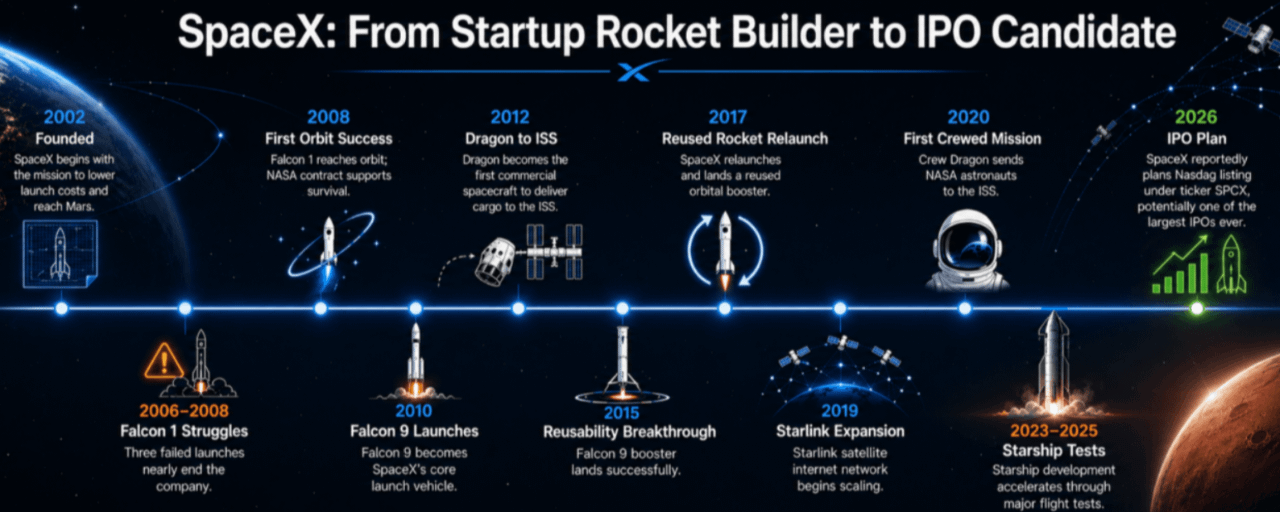
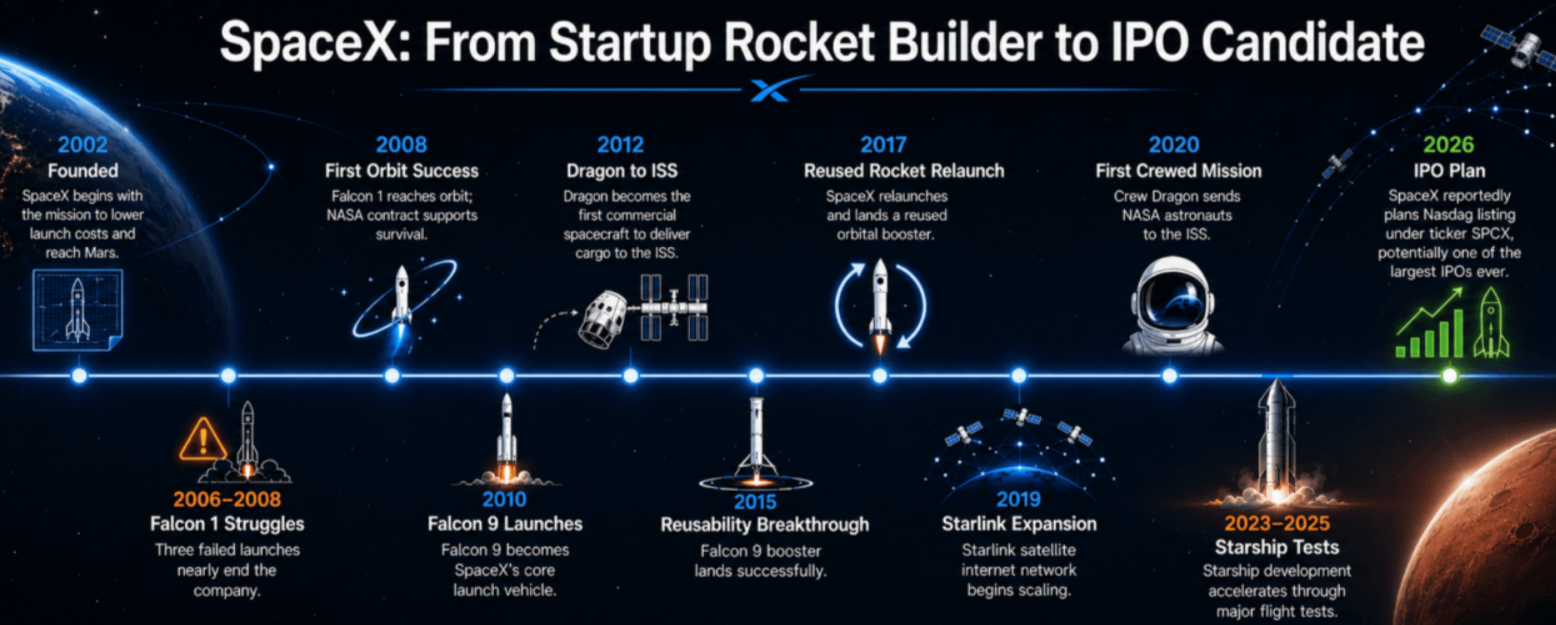
What Elon Musk buried in that small warehouse in El Segundo, California, in 2002 was not just a seed for an aerospace manufacturing company, but a super money printer aimed at draining global aerospace profits, monopolizing near-Earth orbital infrastructure, and ultimately mastering Martian civilization. From the survival of Falcon 1 to the dimensional strike of Falcon 9; from Starlink's space web to Starship's exploration of the stars. Every failure of SpaceX adds bricks to an insurmountable technological moat; every success sends the old aerospace giants to their graves.
Buying SPCX is not just buying a tech hardware company; you're going long on the inevitability of humanity becoming a multi-planetary species! You are purchasing the sole logistics monopoly between Earth and Mars! For the first time in history, ordinary folks can anchor capital directly at the forefront of human civilization's expansion through the secondary market. Missing out on Apple's mobile internet and NVIDIA's AI power, you absolutely cannot miss out on SPCX's space dominance! This is the grandest wealth transfer of the century, an ultimate asset jubilee!
Chapter One: The Promethean Fire — Mars Oasis and the Crazy Beginning (2001-2004)
To understand why $SPCX possesses unparalleled explosive power, you must return to that point interwoven with despair and fervor. In 2001, Musk, who had just achieved financial freedom through PayPal, did not choose to buy a yacht to live out his days; his brain, cursed by Mars, was wildly pulsating with a plan called 'Mars Oasis' — to send a small greenhouse to the surface of Mars, letting the red desert sprout Earth's first green.
This is an extremely romantic yet utterly ignorant idea. When Musk went to Russia with a checkbook trying to buy refurbished Dnepr rockets, the arrogant Russians not only didn't give him a warm welcome but treated him like an internet tycoon of unknown origin. It is said that on the flight back home, faced with the Russians' sky-high ransom, Musk pulled out a list of rocket raw materials in an Excel sheet: aluminum alloy, carbon fiber, avionics... If you add up the raw material costs, they only accounted for 3% of the rocket's selling price! Musk suddenly realized: it's not that rockets are too expensive, but that this industry, monopolized by the military-industrial complex for half a century, is corrupt, inefficient, and arrogantly appalling!
If you can't buy cheap rockets, then build your own! This is not just a commercial calculation but a declaration of war by a top-tier geek against the bloated old powers. In 2002, SpaceX was officially founded. Musk recruited the top crazies from traditional aerospace giants like TRW and Boeing: propulsion system expert Tom Mueller and a group of maniacs who dared to compress engineering cycles from ten years to just a few months. From day one, SpaceX's DNA has been stamped with two words: 'vertical integration' and 'rapid iteration.' They do not rely on outsourcing; they build everything themselves; they do not believe in long, tedious proofs but only in ignition tests and fast trial-and-error. This Promethean fire ignited from a garage is destined to burn down the throne of the old aerospace era!
Chapter Two: Rebirth from Fire — Falcon 1 and the Ultimate Gamble on the Brink of Death (2005-2009)
The birth of every great empire is accompanied by the pangs of death. The pangs of #SpaceX were more brutal than anyone could imagine. Falcon 1, the small two-stage orbital rocket bearing Musk's entire fortune and dreams, became a true 'money-eating monster.'
March 2006, first flight: ignition failure, crash.
March 2007, second flight: separation failures at all levels, failure.
August 2008, third flight: first stage successfully separates, but the second stage fails to ignite, the rocket rolls and crashes into the ocean at the edge of the atmosphere, failure.
Three failures for a startup solely reliant on private funding mean what? It means death! That summer of 2008, Musk faced not only the depletion of SpaceX's funds but also Tesla was on the brink of bankruptcy. He even broke down and cried at his wedding. At that time, the aerospace community generally viewed SpaceX as nothing more than an inexperienced joke, while traditional giants were popping champagne.
But Musk had no way out! He bet everything he had left on the fourth launch. On September 28, 2008, it was the greatest day in human commercial space history! The fourth launch of Falcon 1 roared, piercing through the clouds, and successfully entered orbit! That was the smell of liquid oxygen and kerosene burning; it was the miracle of humanity challenging the limits of physics! Shortly after this launch, NASA threw a lifeline of a $1.6 billion Commercial Resupply Services (CRS) contract to the struggling SpaceX. This was a resounding slap in the face of the old space system and a coronation for SpaceX's rebirth! Surviving, SpaceX immediately retired Falcon 1 and aimed all its firepower at the world-changing weapon — Falcon 9.
Chapter Three: Gravity Dominion — Falcon 9, Dragon, and Breaking the Ice with NASA (2010-2012)
If Falcon 1 proved that private companies could go to space, then Falcon 9 declared that space belongs to SpaceX. In 2010, Falcon 9's maiden flight succeeded; it wasn't just a more powerful rocket, but its modular and multi-engine design laid the groundwork for future reusability.
Soon after, the Dragon spacecraft made its debut. In May 2012, the Dragon successfully docked with the International Space Station, becoming the first commercial spacecraft in human history to deliver cargo to the ISS! Prior to this, only national space agencies (USA, Russia, Europe, Japan) could achieve this. At this moment, SpaceX transitioned from 'high-risk startup' to 'global aerospace core supplier.'
The significance of this turning point is extremely profound: it marks that NASA, the world's largest space buyer, has been completely convinced by SpaceX's technology and cost, starting to outsource national strategic missions to this private company. The long-standing monopoly curtain of the United Launch Alliance (ULA, a joint venture of Boeing and Lockheed Martin) has been torn open by SpaceX with an irreparable crack. Buying #SPCX means buying deep ties with #NASA and other national-level customers, which is the most unbreakable order moat on Earth!
Chapter Four: Dimensional Strike — The Industry Massacre Triggered by Reusability (2013-2018)
This was the five years that truly established SpaceX's status as a 'space monster' and the five years that traditional aerospace giants fell into despair. SpaceX was not just grabbing market share; it flipped the table and rewrote the game rules — rockets can be reused.
Before 2013, the world believed rockets were one-time consumables, like airplanes that are thrown into the sea after landing from New York to London. This led to extremely high aerospace launch costs. But Musk stubbornly believed that if the first stage rocket could be recovered, launch costs could be reduced to one percent of the original!
At that time, the 'experts' of the entire industry were mocking this idea, thinking that recovered rockets could not guarantee reliability. But SpaceX responded with an extremely hardcore violent aesthetic: on December 21, 2015, the Falcon 9 first stage successfully returned to the launch site after launch, landing steadily in the landing zone! When that several dozen meter tall white giant hovered in the night sky and slowly landed, jaws dropped all over the global aerospace community!
In 2017, SpaceX successfully executed an orbital mission with a reused Falcon 9 booster, marking a perfect achievement! This not only demonstrated the technical feasibility but also proved a complete commercial domination! As SpaceX's launch prices dropped to $60 million or even lower, competitors were horrified to discover that they were losing money with every launch! With its reusable technology, SpaceX swept the global commercial launch market like a dimensional strike, skyrocketing its market share. Buying SPCX means investing in this 'cost-negative infinity' dimensional strike capability, which represents the most brutal and lucrative business model in a free market!
Chapter Five: Space Titans — Starlink Goldmine, Manned Spaceflight, and Multi-Engine Explosion (2019-2022)
When everyone thought SpaceX was just a launch service company, Musk revealed his true ambitions — Starlink. It's not just a few communication satellites; it's the largest industrial manufacturing miracle in human history!
In 2019, the first batch of Starlink satellites was launched. Following that, there were launches of 60 satellites at once and even 100 satellites! Musk is essentially building satellites at the cost and speed of making cars! The Starlink plan aims to launch tens of thousands of low-orbit satellites, weaving a broadband net that wraps around the Earth with no dead corners. Why is Starlink the core engine of SPCX's valuation? Because it completely disrupts the business model of aerospace companies: launch services earn hard-earned money from B-end clients, while Starlink profits from the unlimited subscription fees of global C-end users! This is a telecom giant with global monopolistic infrastructure, without having to pay the hefty costs of laying cables! Today, Starlink has achieved profitability, with users surpassing millions; it is the Apple App Store of space, a fighter jet among money printers!
Meanwhile, SpaceX created another miracle in manned spaceflight. In May 2020, the Demo-2 mission successfully sent two NASA astronauts to the space station. This was the first crewed launch from the U.S. since the retirement of the Space Shuttle; and the first crewed orbital flight ever completed by a private company in human history! SpaceX is no longer NASA's contractor; it now possesses planet-level transport control.
Meanwhile, the development of the Starship is rapidly advancing in Boca Chica, that towering silver behemoth is poised to elevate humanity's transport capacity to a whole new level.
Chapter Six: Trials on the Way to Mars — The Violent Aesthetics and Rapid Expansion of Starship (2023-2025)
If Falcon 9 is SpaceX's present, then Starship is the indefinite option on SPCX's market value! From 2023 to 2025, Starship will be the period of testing truth through explosions and fire.
April 2023, first flight, multiple engine failures, rocket rolls and self-destructs; November 2023, second flight, successful thermal separation but ultimately lost contact. External skepticism rises again, but SpaceX's philosophy is: as long as it doesn't explode on the launch pad, it's a success! The massive telemetry data generated from explosions is more valuable than any computer simulation! This is extreme agile development!
In 2024, miracles will arrive. Starship not only successfully enters orbit but also accomplishes the jaw-dropping 'chopsticks catching a rocket' — the Super Heavy booster is precisely captured by a robotic arm at the launch tower! This marks the conquest of the ultimate challenge of complete reusability! Since then, the test density of Starship has been comparable to flights, with SpaceX executing to an extremely terrifying engineering capacity, turning Starship from a PowerPoint into a steel giant in low Earth orbit.
In terms of Starlink, breakthroughs in direct phone connection technology and the frequency trading with telecom operators have frequently materialized, making Starlink's moat unfathomably deep. At this moment, SpaceX's three major engines roar: launch services hold absolute global monopoly, Starlink cash cow is wildly profiting, and the Starship is about to usher in a new era of massive payload. In the private market, SpaceX's valuation is skyrocketing like a rocket, with coins hard to come by. But the real endgame is in 2026!
Chapter Seven: The Awakening of Ultimate Assets — $17.5 Trillion Valuation and Absolute Reasons to Buy SPCX (2026)
In 2026, the year of Mars, is also the year of SpaceX in the capital markets. SPCX is about to land on NASDAQ, with a target valuation of $17.5 trillion and a financing scale of $75 billion; this will be the grandest IPO in human financial history, bar none!
Those Wall Street old-timers clutching outdated valuation models might ask: What makes a rocket-launching company worth $17.5 trillion? The answer is simple: because SpaceX is not just a rocket company; it’s the infrastructure behemoth of Earth, the tax collector of space, and the creator of Martian civilization!
The three hard-core logic points for buying SPCX, any one of which is enough to support a trillion-dollar market cap:
First, Starlink: an unlimited leverage of a dominative telecom giant.
Starlink is no longer just satellite internet; it is the only all-weather, global communication network on Earth. In remote areas, in maritime and aviation, in military battlefields, Starlink is the only solution! Imagine billions of potential global users paying subscription fees from tens to hundreds of dollars a month; this is a cash flow more terrifying than AT&T and Apple combined! Even scarier, the cost of Starlink's 'base stations' has been pushed to the limit through its own reusable rockets, leaving other competitors with no qualification to imitate. If Starlink were to be separated out, its valuation would rival the world's largest telecom operators!
Second, launch monopoly: the absolute toll station in the aerospace realm.
With Falcon 9 and Falcon Heavy, SpaceX captured over 80% of the global commercial launch market. Any country or company wanting to send something into space must pay Musk a toll. As Starship comes into service, the launch cost per kilogram will plummet from thousands of dollars to dozens! It’s like jumping straight from the horse-drawn carriage era to the high-speed rail era; the explosive transport capacity will birth trillion-dollar new markets such as space manufacturing, space tourism, and asteroid mining. In these new markets, SpaceX is not only the sole transporter but also the rule-maker!
Third, Mars Sovereignty: the absolute dictator of a multi-planetary civilization.
This is the source of SPCX's craziest premium! The success of Starship means that human landing on Mars is no longer science fiction. Musk's goal is to establish a city of a million people on Mars, with only SpaceX handling all logistics, infrastructure, and life support systems! Once the Mars colonization plan advances substantially, SPCX will no longer belong to Earth's valuation system; it will be priced as ownership of a new planetary civilization! This 'civilization-level monopoly' is an asset class that has never appeared in human financial history; $17.5 trillion? This is just the starting point!
But we must remain vigilant: the richness of the narrative versus the starkness of reality.
We must not let enthusiasm cloud our judgment. The $17.5 trillion valuation is predicated on the timely service of Starship and the exponential growth of Starlink users. Aerospace engineering has no 'ifs,' only cold data and destroyed wreckage. If the conversion speed of Starship from Demo to Production doesn't meet expectations, if Starlink's end-user costs and retention rates encounter bottlenecks, if the U.S. government's regulatory stick strikes SpaceX's monopoly position, a short-term valuation correction will be extremely bloody.
From Demo to Production, it's a life-or-death leap from the lab to a money printer. SpaceX's past history proves they excel at creating miracles, but the mass production of the Starship and the global profitability of Starlink still need to deliver concrete results after 2026.
Conclusion: Bet on humanity, go all in on SPCX!
The wheels of history roll forward, the giants of the old era decay, while SpaceX's silver dragon cleaves through the atmosphere, heading for deep space. The SPCX IPO is not just a wealth feast, but the ultimate choice for ordinary people betting on the direction of human civilization.
Don’t wait until Musk steps on Mars to regret! The moment SPCX's code flashes on NASDAQ, buy decisively! Go long with heavy positions! Endure possible volatility and long landing times, and hold tight to this greatest core asset in human history! Because this is not just an investment; it’s an eternal contract linking your name with the stars and the sea! Buy SPCX, buy the future! Let profits soar alongside rockets!