


The trading bot runs flawlessly for fifty-eight minutes on FOGO testnet, sub-40 millisecond settlement, every transaction confirming in one block, orders executing with the kind of precision that makes high frequency strategies actually viable.
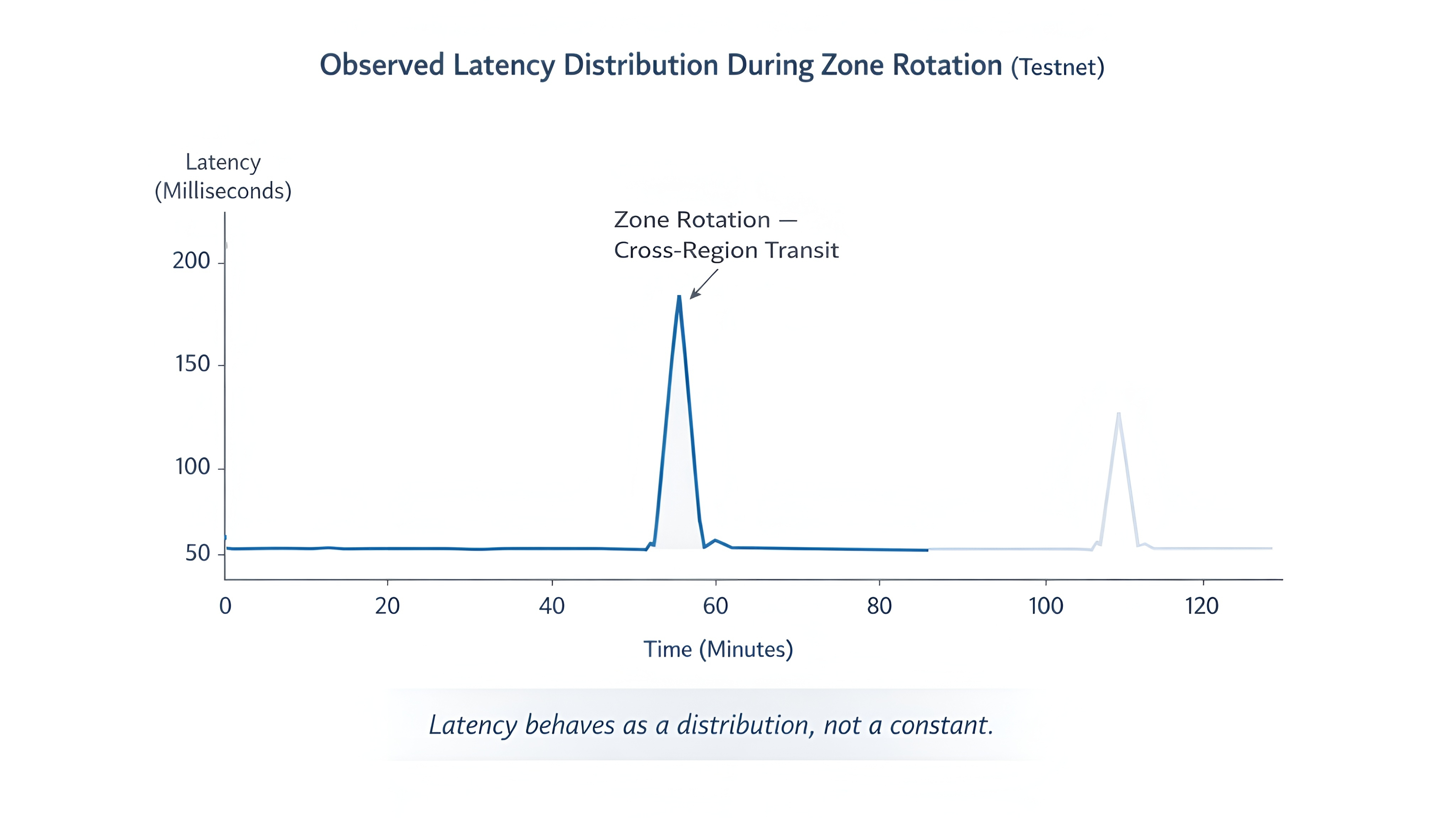
Then at 7:00 AM UTC the latency spikes to around 180 milliseconds and three orders time out and the bot's assumptions break.
The developer checks the logs, node is healthy, network connection stable, FOGO validators all online, no congestion, blocks still producing every 40 milliseconds, nothing appears wrong from the monitoring dashboard, but the bot just experienced latency that should not exist on infrastructure this fast.
What happened is zone rotation, which is the mechanism that nobody who builds on fast chains expects to encounter, because most L1s either have globally distributed validators that create constant latency, or they have geographically concentrated validators that create constant low latency, but FOGO has validators partitioned into zones that rotate, which means latency is not constant, latency oscillates based on which zone is currently active and where your application infrastructure happens to be located.
The Handoff That Creates Temporary Geography
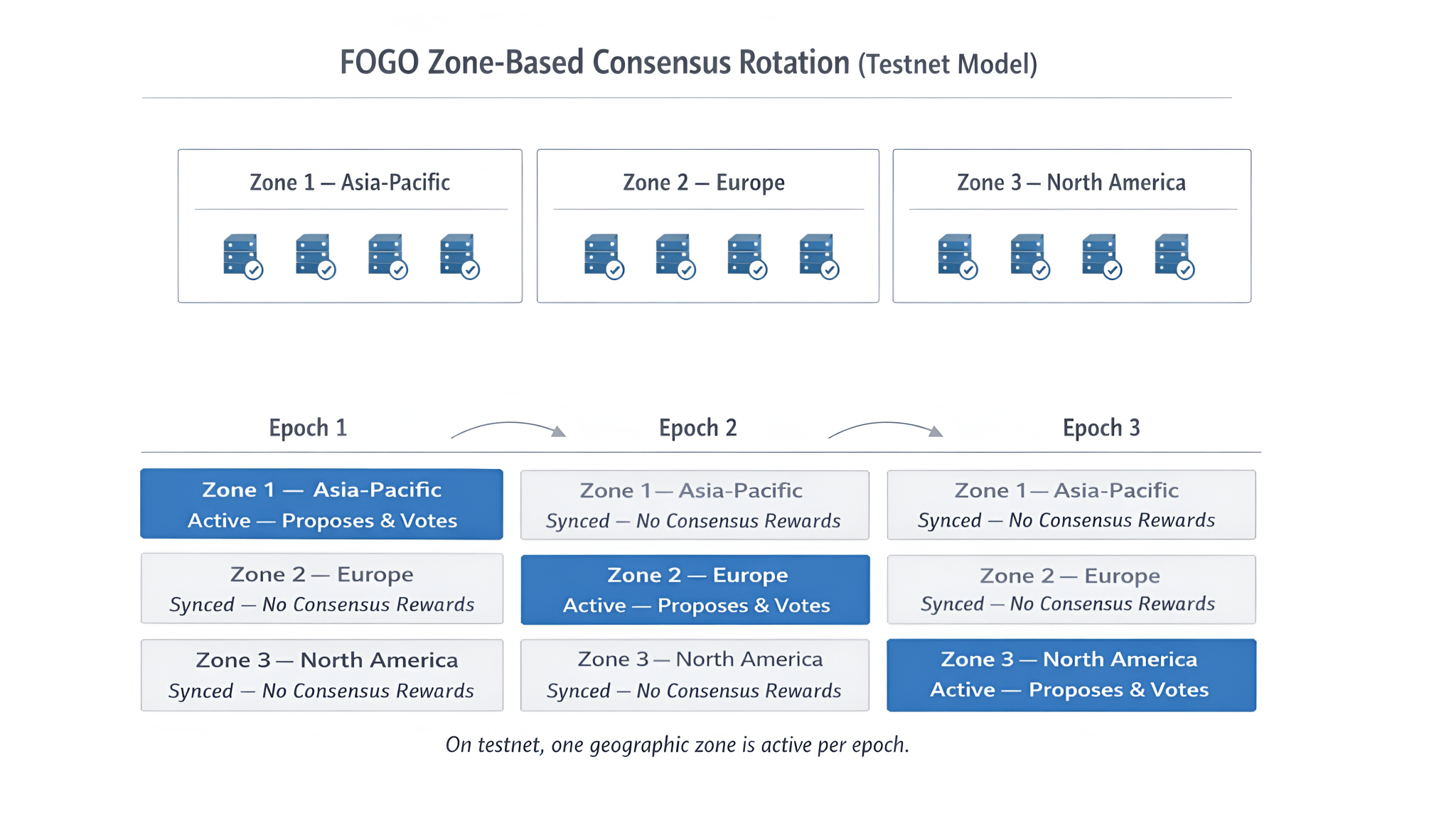
FOGO's consensus operates through geographic zones, with validators assigned to regions like Asia-Pacific, Europe, and North America, and during each epoch only one zone is active, which means validators in that zone propose blocks and vote on consensus and finalize transactions, while validators in inactive zones stay synced but do not participate, and this architecture delivers the 40 millisecond finality that FOGO is designed around, because when validators are geographically concentrated the speed of light becomes less of a constraint.
The part that breaks applications is the transition between zones, because when an epoch ends the active zone changes, and consensus authority transfers from one geographic region to another, and during that handoff window there is a coordination period where the previous zone's validators stop proposing and the new zone's validators activate and vote aggregation switches regions and network topology reconfigures.
During that window, applications that were communicating with validators in the previous zone are now sending transactions to validators that are no longer active, and the transactions need to route to the new active zone, and if the application is geographically distant from the new zone it experiences the full cross-region latency that FOGO's zone architecture was designed to avoid.
The trading bot was hosted in Virginia, and for the fifty-eight minutes when North America zone was active, transactions traveled maybe 1500 kilometers to reach validators, which takes roughly 15 milliseconds round trip through fiber, and combined with consensus and execution the total latency stayed under 40 milliseconds consistently.
But when Asia-Pacific zone activated at 7:00 AM, consensus moved to validators in Tokyo and Singapore, and now transactions from Virginia travel roughly 18,000 kilometers round trip, which the FOGO litepaper notes often reaches 170 milliseconds just for the network transit, and that does not include consensus time or execution overhead, so the observed around 180 milliseconds during handoff is actually the physics of light moving through fiber optic cable across half the planet.
Why Constant Latency Assumptions Break
Most applications built for fast settlement assume that if a chain advertises 40 millisecond finality, that number is consistent, because on globally distributed chains latency is determined by the furthest validator, which creates a high baseline but that baseline is stable, and on geographically concentrated chains latency is determined by regional distance, which creates a low baseline that is also stable.
FOGO's zone rotation creates neither pattern, instead it creates oscillating latency, where for the duration of one epoch your application experiences low latency if you are geographically near the active zone, and then when rotation happens you experience high latency if the new active zone is far from your infrastructure, and then rotation happens again and latency might drop or stay high depending on where the next zone is located relative to you.
The trading bot was designed with a 100 millisecond timeout on order execution, which seemed extremely conservative given that FOGO's documentation specifies 40 millisecond finality, but the timeout was based on an assumption that latency would be consistent, and when zone handoff pushed latency to around 180 milliseconds the timeout triggered and orders failed, not because anything was broken, but because the application did not account for zone rotation.
This is the pattern I keep seeing when developers integrate with FOGO, which is that they test during one epoch, measure consistent low latency, build assumptions around that latency, and then their application encounters zone rotation and the assumptions fail, and the failure is not obvious because the chain is still working correctly, blocks are still producing on time, finality is still happening in 40 milliseconds within the active zone, but the application is experiencing cross-zone latency that breaks its execution model.
The Geographic Lottery That Determines Performance
What makes this particularly challenging is that application performance on FOGO is partially determined by where you deploy your infrastructure relative to where zones are located, because if your application servers are in the same region as a zone, then when that zone is active your latency will be minimal, and when other zones are active your latency will increase, but if your infrastructure is not colocated with any zone, then you experience elevated latency regardless of which zone is active.
The trading bot in Virginia performs best when North America zone is active, because Virginia to wherever North America validators are hosted is relatively short distance, maybe 40 milliseconds total including consensus, but when Asia-Pacific zone activates latency jumps to around 180 milliseconds, and when Europe zone activates latency settles around 90 milliseconds, which means the bot has three different performance profiles depending on epoch timing.
A bot hosted in Singapore would see the opposite pattern, low latency during Asia-Pacific epochs, high latency during North America epochs, and the performance characteristics of the application would be identical in terms of code and logic but completely different in terms of execution speed based purely on geography.
The Multi-Region Strategy That Almost Works
The developer tried deploying the trading bot in three regions, one near each zone, with logic to detect zone rotation and switch to the geographically nearest instance, which in theory should maintain low latency across all epochs because there would always be an instance near the active zone.
The implementation was more complex than expected, because detecting zone rotation requires either polling the chain to check which zone is active, or monitoring block production patterns to infer when handoff happened, and both approaches introduce delays, because by the time the application detects that a new zone activated and switches to the appropriate regional instance, several seconds have passed, and during those seconds the application is still routing to the wrong region and experiencing high latency.
The other issue is that zone handoff is not instantaneous, there is a coordination period where the previous zone is winding down and the new zone is ramping up, and during that window neither zone is fully active, which means transaction routing becomes ambiguous, and the application cannot reliably determine which regional instance should handle requests.
What actually worked better was accepting that zone rotation creates latency variance and designing the application to tolerate it, which meant increasing timeouts to accommodate cross-zone latency, implementing retry logic for transactions that timeout during handoff, and building the trading strategy to be less sensitive to execution latency so that the occasional around 180 millisecond confirmation does not invalidate the entire order flow.
The Tradeoff That Zone Architecture Makes Explicit
FOGO's zone rotation is not a flaw in the design, it is the design, because the entire point of geographic validator partitioning is to reduce latency by concentrating consensus in one region at a time, and the tradeoff for achieving 40 millisecond finality within the active zone is that applications outside the active zone experience higher latency during that zone's epoch.
The alternative would be global validator distribution, which creates consistent latency but that latency is determined by the slowest path between validators, and the FOGO litepaper specifically notes that New York to Tokyo round trips reach 170 milliseconds, which means globally distributed consensus cannot achieve 40 millisecond finality because the speed of light does not allow it.
So the choice is between consistent 150+ millisecond finality globally, or 40 millisecond finality within zones with latency spikes during handoff, and FOGO chooses the second option, which means developers need to choose whether their application can function with oscillating latency or whether it requires consistent latency and therefore should not build on zone-partitioned architecture.
Why This Pattern Shows Up Everywhere On FOGO
Zone rotation affects more than just trading bots, the same latency oscillation appears in any application that submits transactions with timing assumptions, which includes DeFi protocols that liquidate positions based on oracle updates, gaming applications that process user actions in real time, payment systems that confirm transactions within specific time windows, and any workflow where the application logic depends on knowing how long settlement will take.
The pattern that works on FOGO is to treat latency as a distribution rather than a constant, where most of the time you get 40 milliseconds but periodically you get 150+ milliseconds, and the application needs to function correctly across that distribution.
FOGO does not hide the geography, and the latency spikes that appear every hour are not bugs, they are the cost of having validators concentrated enough to deliver 40 millisecond finality.
The infrastructure works. The handoff happens. And the extra latency returns every hour, waiting for developers to either design around it or be surprised by it.