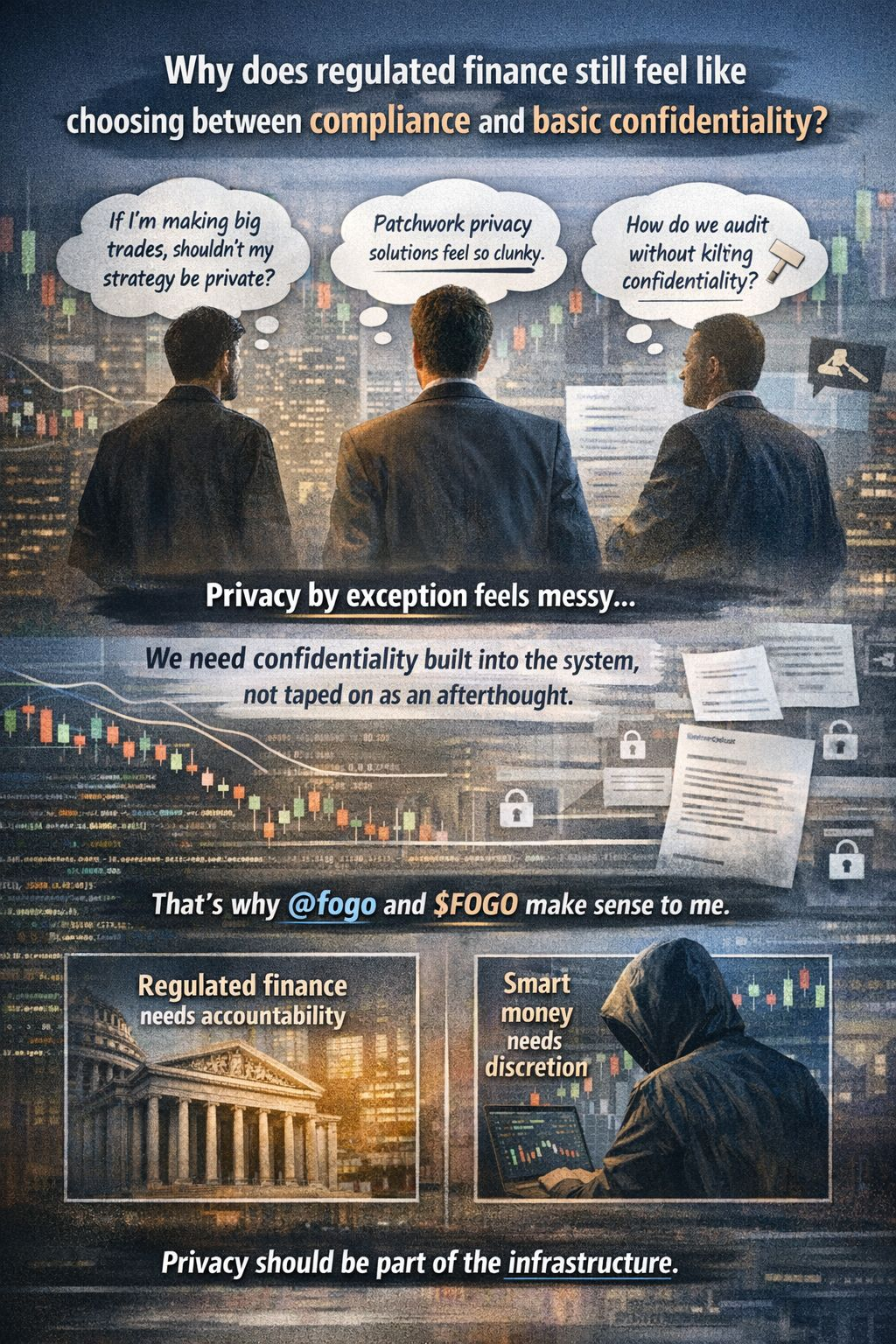
I keep thinking about a very simple, very practical moment: an asset manager wants to rebalance a position. Not speculate wildly. Not manipulate markets. Just execute size responsibly.
And the first question isn’t about price.
It’s: who is going to see this before it settles?
In traditional finance, that question has answers. There are norms, legal protections, and infrastructure assumptions around confidentiality. Orders aren’t broadcast to the world in raw form. Counterparties don’t automatically get a live feed of intent. Surveillance exists, yes but it is structured, regulated, and purpose-bound.
In crypto, especially on transparent base layers, that assumption flips. Intent becomes public infrastructure. Strategy becomes metadata. And suddenly, regulated participants face a strange dilemma: participate in an open network and expose sensitive information, or avoid the system entirely.
That tension isn’t philosophical. It’s operational.
Builders feel it when they try to design compliant products on top of chains that treat transparency as default and privacy as an add-on. Institutions feel it when legal teams ask uncomfortable questions about market integrity. Regulators feel it when they realize full public transparency does not automatically equal better oversight it often just means uncontrolled information asymmetry.
This is why “privacy by exception” keeps failing in practice.
Most solutions today try to bolt confidentiality on top of fundamentally transparent architectures. You see patches: selective disclosures, obfuscation layers, complex permissioning schemes. But they often feel like retrofits. Like adding curtains to a building made entirely of glass.
The problem isn’t that transparency is bad. It’s that unconditional transparency at the base layer creates structural side effects.
If every transaction broadcasts intent, sophisticated actors can exploit that visibility. If every movement is publicly traceable, institutions must assume worst-case interpretations. If compliance relies on after-the-fact analysis of completely open data, regulators inherit noise rather than clarity.
It becomes awkward.
Users don’t feel dignified. Builders don’t feel confident. Institutions don’t feel protected. Regulators don’t feel empowered.
What regulated finance actually needs is something much simpler: infrastructure where confidentiality and accountability are co-designed.
Not secrecy without rules. Not transparency without nuance.
Privacy by design means that discretion is native, not exceptional. It means auditability exists in structured ways rather than through mass exposure. It means that compliance can be enforced without broadcasting competitive strategy.
This is where I start thinking about fogo.
If FOGO is building a high-performance L1 using the Solana Virtual Machine, the interesting part isn’t just execution speed. Speed is table stakes at this point. What matters more is whether performance can coexist with institutional-grade assumptions.
Because regulated finance doesn’t need louder blockchains. It needs predictable ones.
And predictability comes from architecture.
When privacy is bolted on later, it introduces uncertainty. Who can see what? Under which conditions? How consistent is enforcement? Can rules change midstream?
But when privacy is foundational, the system feels different. The boundaries are clearer. Participants understand the rules before they act. Compliance teams aren’t forced into creative interpretations of technology that wasn’t built for them.
There’s also a deeper psychological layer here.
Markets function on trust not blind trust, but structured trust. Institutions must trust that counterparties cannot unfairly exploit informational asymmetries. Regulators must trust that oversight mechanisms are reliable. Users must trust that participation doesn’t automatically expose them to invisible predation.
Pure transparency paradoxically undermines that trust.
Because while everything is visible, not everyone has equal capacity to interpret and act on that visibility. Sophisticated actors win. Less equipped participants lose. And regulators are left trying to referee in real time.
Privacy by design doesn’t mean hiding wrongdoing. It means aligning information flow with legitimate purpose.
An order should be confidential until execution. Audit trails should be accessible to authorized oversight, not to opportunistic observers. Data should be structured in ways that serve compliance, not speculation.
That is an infrastructure problem.
And infrastructure problems don’t get solved by narratives. They get solved by base-layer decisions.
If @fogo is positioning itself as serious infrastructure rather than hype, then the real test isn’t TPS metrics alone. It’s whether the chain can support financial actors who operate under real regulatory constraints without forcing them into technological compromises.
Because here’s the reality: regulated finance is not allergic to crypto. It’s allergic to unpredictability.
It cannot operate where strategy leaks by default. It cannot rely on systems where confidentiality is a plugin. It cannot explain to boards and regulators why competitive intent was publicly visible by design.
Privacy by exception keeps creating edge cases.
Privacy by design creates norms.
And norms are what allow markets to scale responsibly.
There’s another angle that often gets overlooked: long-term capital.
Short-term traders might tolerate radical transparency because their strategies are transient. But long-term capital pensions, sovereign funds, insurance pools operates differently. They move size. They rebalance methodically. They answer to governance structures.
For them, exposure risk isn’t theoretical. It’s fiduciary.
If crypto infrastructure wants that capital, it must evolve beyond ideological transparency. It must offer environments where discretion and compliance are not adversaries.
That’s why I see the conversation around FOGO less as a performance story and more as a structural one.
High performance matters. But high performance without thoughtful information architecture just accelerates existing flaws.
Speed amplifies whatever design choices sit underneath it.
If those choices embed privacy by design, speed enables responsible scale. If they don’t, speed simply magnifies fragility.
Regulated finance doesn’t need a loophole. It needs alignment.
Alignment between confidentiality and compliance. Between oversight and fairness. Between execution and dignity.
The chains that understand this won’t feel revolutionary. They’ll feel stable.
And in finance, stability is what ultimately wins.
That’s why the future likely belongs not to the loudest infrastructure, but to the most carefully designed.
fogo and FOGO sit in that conversation for me not as hype, but as a test of whether crypto can mature into something institutions can actually trust.
Because privacy by design isn’t a feature.
It’s a prerequisite.