
My eyes are red but can't stop reading the Night's whitepaper so i have been reading the architecture section for the past two days and honestly the Kachina reference kept stopping me every time i passed it
It's just like i am watching a coin's like PIPPIN or ROBO chart every time my heart stops.
So
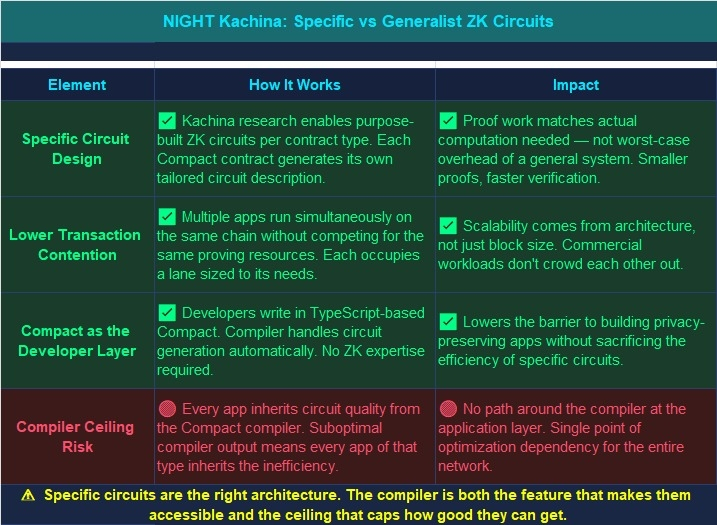
most ZK systems are generalist. they provide a universal proving framework and let developers build whatever they need on top. flexible, powerful, and expensive. every application generates proofs against the same general-purpose circuit machinery regardless of what it actually needs to prove. the circuit doesnt know or care what the application is doing. it just processes.
midnight takes a different approach
the ZK architecture is built on Kachina-based research, which enables specific rather than generalistic types of ZK circuits. that distinction sounds subtle but the downstream consequences are significant.heres what specific circuits actually mean. instead of routing every application through the same universal proving machinery, each Compact smart contract generates its own circuit description tailored to what that contract actually does.
So
a digital identity verification contract gets circuits shaped for identity verification. an asset tokenization contract gets circuits shaped for asset tokenization. the proof work matches the actual computation required rather than the worst-case overhead of a general system.
the immediate consequence is efficiency
specific circuits produce smaller proofs for the same work. smaller proofs verify faster. faster verification means more transactions fit in the same block without competing for the same computational resources.and this is where the scalability argument actually lives. the whitepaper notes that multiple apps may run simultaneously on the same chain with lower transaction contention. that sentence is doing a lot of work
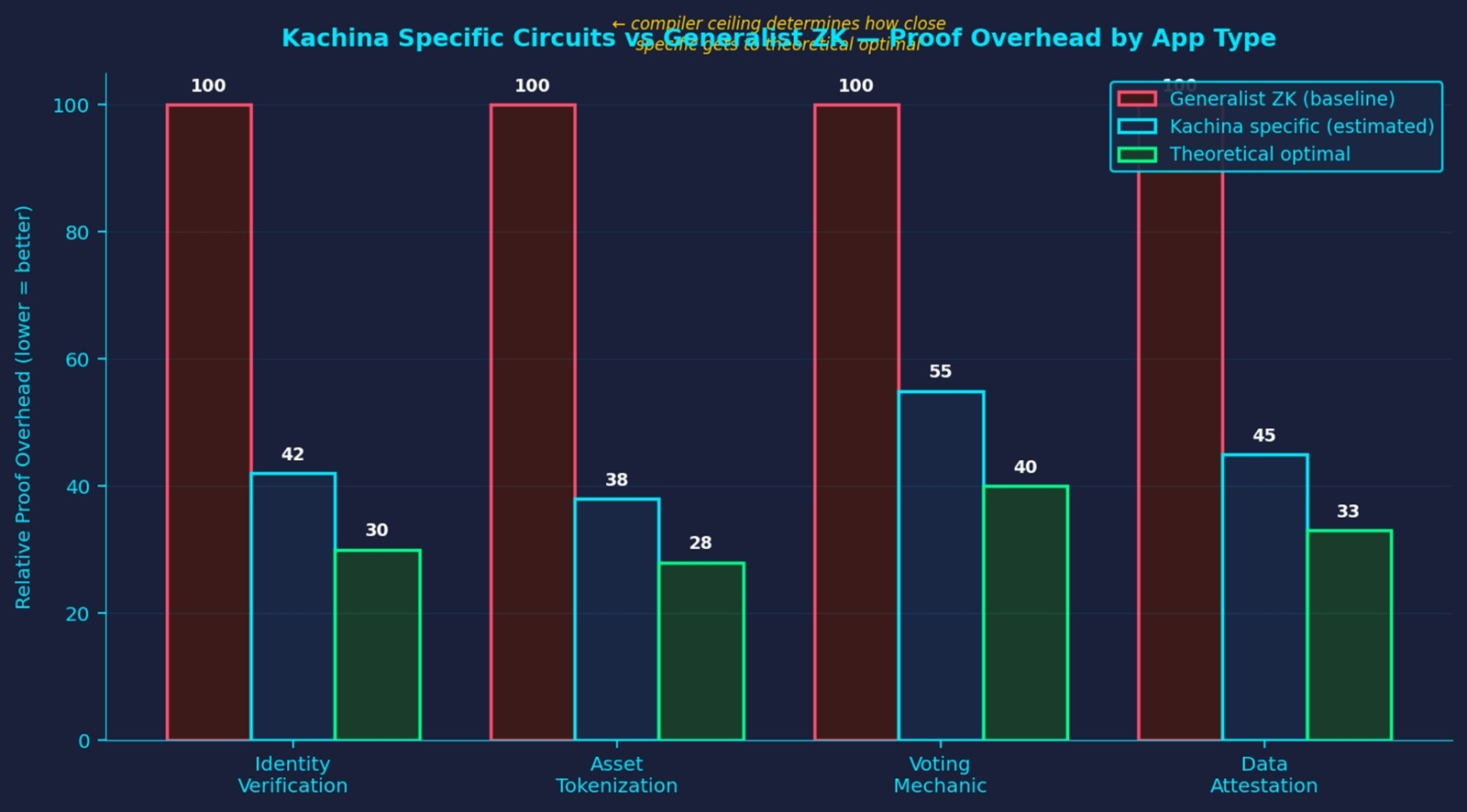
it means that midnight is not designed as a single-lane highway where every application competes for the same throughput. specific circuits mean each application occupies a lane sized to its actual needs rather than the widest possible lane.
what this design gets right is the architecture intent. building a privacy chain around specific circuits rather than a generalist prover is the correct choice for a network targeting commercial applications where proof efficiency directly affects operating costs.
but heres the part i keep sitting with. every Compact smart contract inherits its circuit quality from the Compact compiler
the compiler generates the cryptographic materials and circuit descriptions automatically. developers dont touch the ZK layer directly - thats the whole point of Compact as an abstraction.which means the optimization ceiling for every single application on midnight is the optimization ceiling of the Compact compiler itself. if the compiler generates suboptimal circuits for a given contract type, every app of that type inherits that inefficiency. there is no path around it at the application layer.
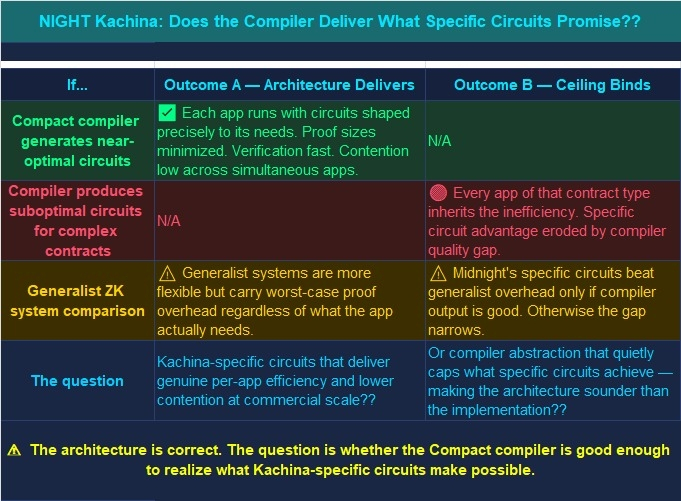
the architecture is sound. the single point of optimization dependency is real.
honestly dont know if Kachina-based specific circuits deliver the per-application efficiency that makes midnight genuinely scalable for simultaneous commercial workloads or whether the compiler abstraction layer quietly caps what specific circuits can actually achieve in practice?? 🤔
#night @MidnightNetwork $NIGHT
