
stayed up last night going through the Scavenger Mine apportionment section and honestly the more i mapped out the formula the more i realized this phase is doing something most people completely miss
everyone talks about Scavenger Mine as a mining phase
solve a puzzle
claim tokens
but
the mechanics underneath are significantly more structured than that framing suggests - and the most interesting part isnt the puzzle at all. its what happens to the tokens that dont go to participants.
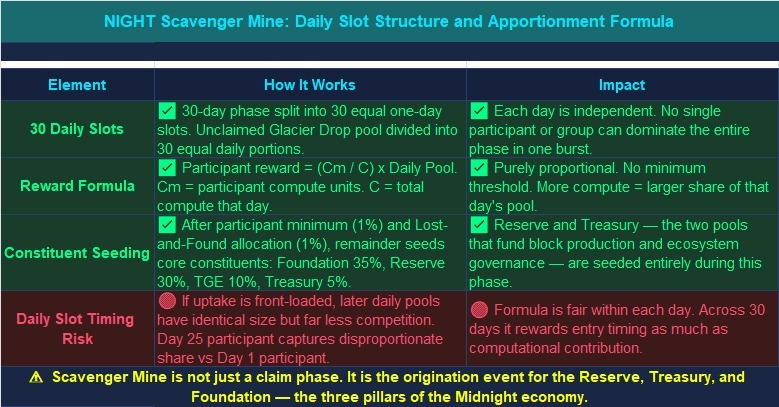
here is how the phase actually works. the 30-day period is divided into 30 individual one-day slots. the pool of unclaimed Glacier Drop tokens gets split into 30 equal daily portions. at the end of each day, rewards are allocated based on how much computational work each participant contributed relative to total work completed that day. miss a day and you miss that days portion.
no catch-up across days
the individual reward formula is clean. if a participant completes Cm units of computation out of total computation C on a given day, they receive Cm divided by C multiplied by that days reward pool. proportional, no minimum threshold beyond completing the puzzle.
but heres where it gets interesting
the unclaimed pool doesnt go entirely to participants. a minimum of 1% of total supply is guaranteed to Scavenger Mine claimants. an equal amount is earmarked for Lost-and-Found. everything remaining goes to core network constituents - Foundation 35%, Reserve 30%, TGE 10%, Treasury 5%.
Scavenger Mine is doing two things simultaneously. public claim mechanism and seeding event for the entire core network infrastructure. the Reserve that pays block producers for potentially hundreds of years gets its allocation here. the Treasury that funds ecosystem governance gets seeded here.
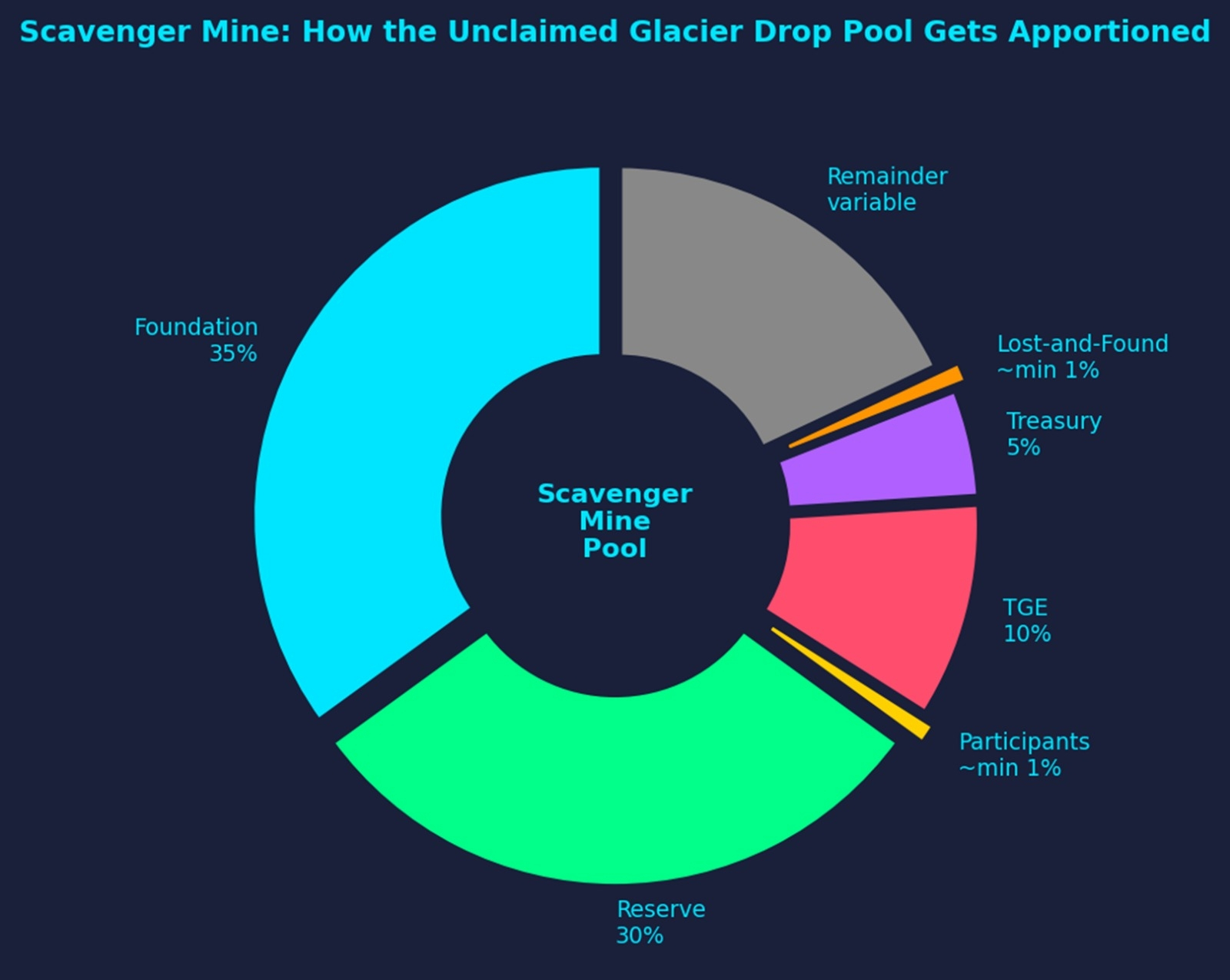
the phase scales with Glacier Drop uptake - the more tokens left unclaimed in phase one, the larger the pool for both participants and constituents.
what this gets right is the structural elegance of connecting public participation to protocol infrastructure seeding in a single event. its not just distribution
its origination
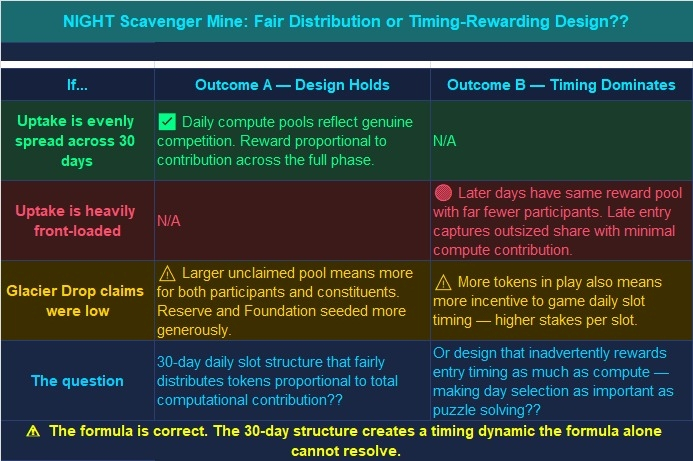
the part i cant fully resolve is the daily slot structure. if Scavenger Mine uptake is front-loaded - most participants solving puzzles early -later daily pools have identical size but far less competition. participants who show up on day 25 capture a disproportionate share just by timing their entry. the formula is fair within each day. across 30 days it creates an uneven field that rewards timing as much as compute contribution.
But what i came to know that HYPE of this project is real
honestly dont know if the 30-day daily slot design distributes tokens fairly across a broad public or inadvertently rewards late entry over total computational contribution?? 🤔
#night @MidnightNetwork $NIGHT
