$SIGN @SignOfficial #SignDigitalSovereignIntra
I didn’t think S.I.G.N. would affect me this much, but it really changed how I see things.
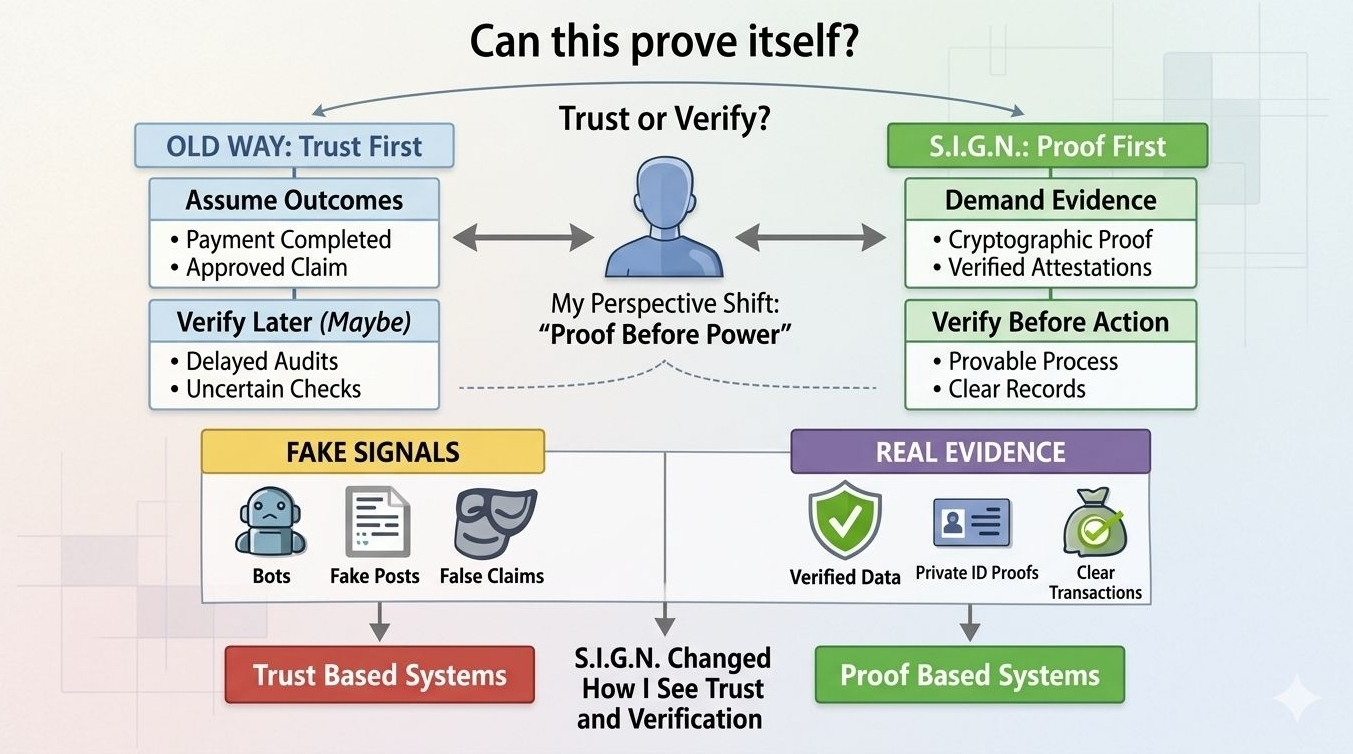
Honestly, I went into it thinking it was just another complex framework with big words like “infrastructure” and “protocol,” but the more I explored it, the more it actually made me question how I’ve been trusting systems my whole life. I realized I’ve been accepting outcomes without ever asking for real proof. Yeah, a payment says completed, a system says verified, a program says approved—but I never really stopped and thought, “Can I actually verify this myself?”
That’s where S.I.G.N. genuinely surprised me. It didn’t just explain a system—it exposed a gap I didn’t even realize existed.
I started seeing things differently. I noticed how almost everything around me runs on trust first and proof later, if ever. I mean, I use apps, I rely on digital platforms, I even follow financial signals sometimes, and I just assume the backend is correct. But S.I.G.N. kind of forced me to rethink that mindset. It introduced this idea that stuck with me: if something matters, it should be provable, not just believable.
And yeah, that sounds simple, but the more I thought about it, the more powerful it felt.
What really stood out to me is how S.I.G.N. flips the entire flow of how systems operate. Normally, I see systems give power first and verify later. A transaction goes through, and then maybe it gets audited. A benefit is given, and then later someone checks if it was correct. But here, it’s different. Here, nothing meaningful happens unless there’s proof attached from the beginning. I found that shift kind of refreshing, because it removes that “we’ll check later” mindset that so many systems rely on.
I also couldn’t help but connect this idea to what I see on platforms like Binance Square. When I scroll through content, I can instantly tell the difference between someone who’s just making noise and someone who actually knows what they’re talking about. The posts that stand out are the ones with real reasoning, actual insights, or even honest mistakes. The ones that feel real. And yeah, I’ve noticed how systems like CreatorPad are starting to reward that kind of authenticity instead of just hype. In a way, S.I.G.N. feels like it’s applying that same standard to entire systems, not just content.
Another thing that really caught my attention was the concept of attestations. At first, I thought it was just a technical term, but when I understood it, it actually made a lot of sense. It’s basically a way to turn a claim into something verifiable. Not just a record sitting somewhere, but a proof that can be checked anytime. I found myself thinking, “Why don’t more systems work like this?” It just feels more honest.
I also liked how this approach changes the way identity works. Personally, I’ve always found it annoying that I have to share so much information just to prove something small. Like, why do I need to expose everything just to confirm one detail? With S.I.G.N., I saw a different approach. I can prove a specific claim without revealing unnecessary data. That felt more respectful and more logical to me.
When I looked at the financial side, it made even more sense. I’ve seen how confusing and unclear transactions can get, especially when multiple systems are involved. But here, every movement of value carries context. It’s not just about sending money, it’s about explaining why it was sent, who approved it, and under what rules. That level of clarity is something I didn’t realize we were missing until I saw it presented this way.
What really made this click for me, though, is the timing. We’re living in a moment where it’s getting harder to tell what’s real. AI can generate content, bots can fake engagement, and systems can create the illusion of legitimacy. I’ve personally seen posts that look convincing but have no real substance behind them. So when I came across S.I.G.N.’s approach—where everything has to be backed by proof—it just felt… necessary.
IT made me think that maybe the future isn’t about who says something the loudest, but about who can actually prove it.
I won’t lie, at first it felt like a technical concept meant only for developers or governments, but the more I understood it, the more I realized it affects people like me directly. It changes how I should think about trust, how I evaluate systems, and even how I create or consume content. It pushes me to value evidence over assumptions.
Now when I look at systems, I kind of have this new question in my mind: “Can this prove itself?” And if the answer is no, it doesn’t feel as reliable anymore.
That’s probably the biggest impact S.I.G.N. had on me. It didn’t just teach me something new—it changed how I see everything that claims to be “verified,” “approved,” or “trusted.”
And yeah, once you start thinking like that, it’s hard to go back.
#SignDigitalSovereignIntra $SIGN @SignOfficial