
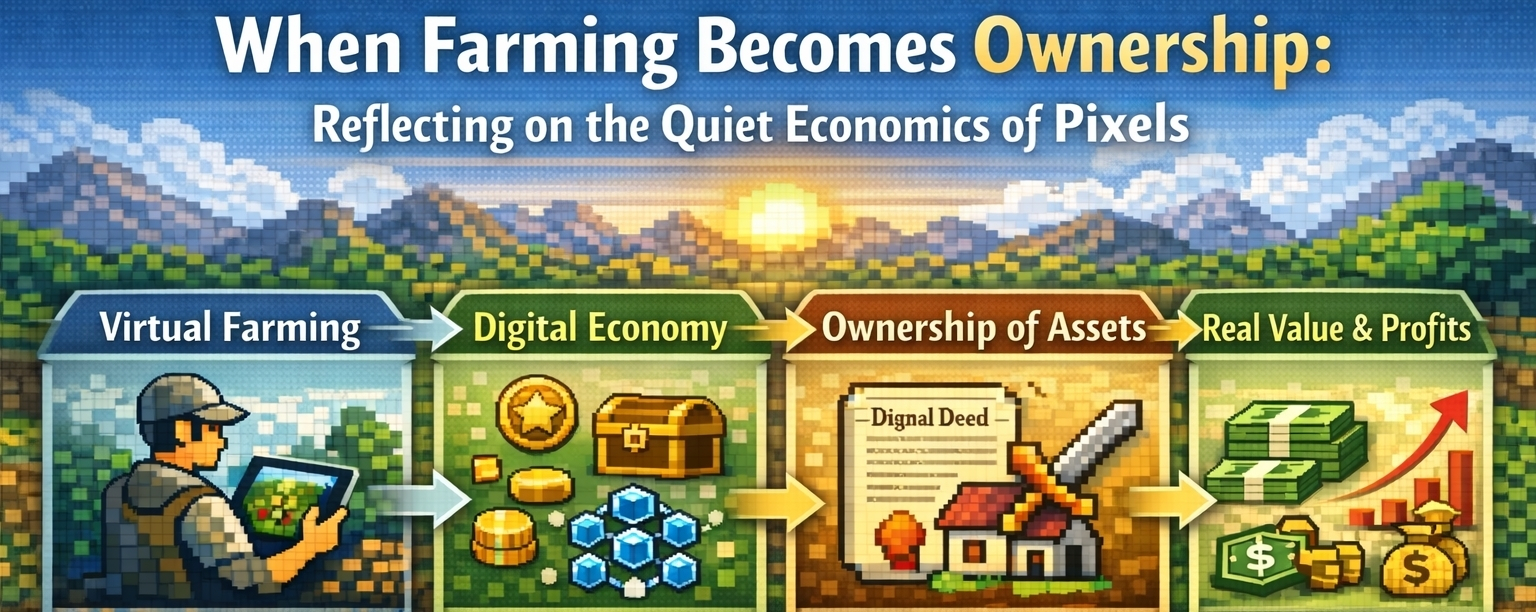
I've been exploring Pixels lately, and the more time I spend thinking about it, the more it feels like one of those projects that quietly raises bigger questions than it first appears to. At a glance, it looks simple—almost comfortingly simple. There’s farming, gathering, crafting, and wandering through a colorful pixelated world. It feels warm and familiar, like the kind of casual social game people slip into when they want to relax for a while. But beneath that cozy surface is a very different kind of structure, one built around digital ownership, tokens, and blockchain logic. And that contrast is what keeps pulling me in. Pixels looks like a soft little farming game, but underneath, it’s trying to redefine what it means to spend time inside a virtual world.
I think what caught my attention first was how unassuming it all feels. A lot of Web3 projects make the blockchain part impossible to ignore. They push the token, the ownership, the marketplace—the mechanics of value are front and center. Pixels doesn’t really do that. It invites you in through play first. You plant crops, collect resources, explore the land, interact with others. The blockchain side sits behind the curtain. That design choice feels deliberate, and honestly, it feels smart. Because for all the talk about onboarding the next wave of users into Web3, most people do not enter digital worlds because they are excited about wallets or on-chain assets. They enter because something feels fun, familiar, or interesting.
That’s where Pixels becomes more than just another farming game to me. It feels like an attempt to see whether blockchain can become invisible enough to stop being the “main event.” Instead of asking players to care about infrastructure, it asks whether infrastructure can quietly support the experience without demanding attention. That sounds subtle, but it changes the whole feeling of the project. Rather than building a financial system disguised as a game, Pixels seems to be trying to build a game that happens to have an economic layer beneath it. Whether that balance can really hold is what fascinates me.
Because once real incentives enter a game world, everything changes—even if the gameplay itself remains simple. Farming in an ordinary casual game feels peaceful because the rewards are symbolic. You grow crops, expand land, progress a little, and the satisfaction comes from the rhythm of it. But when that same activity is tied to assets, rewards, or tokens, the meaning shifts. Suddenly farming is not just a relaxing mechanic—it can become economically valuable behavior. The player may still enjoy it, but another layer is added. Time spent in the world becomes measurable in a new way.
And I keep wondering what that does to the spirit of the experience. When value enters play, does the act remain playful? Or does it slowly begin to feel like work? Pixels sits right in that blurry space. On one hand, the idea of players earning from the worlds they contribute to sounds fair, even empowering. Traditional games often ask for endless time investment while the platform captures all the value. Web3 flips that narrative by giving players ownership over pieces of the ecosystem. In theory, that creates a more balanced relationship between players and the world they help sustain.
But theory is one thing, and actual human behavior is another. The moment incentives become visible, people respond to them. Some players will join because they love the game world, but others will join because they see opportunity. They will optimize every mechanic, calculate every reward loop, and approach the world strategically rather than emotionally. That doesn’t mean they are doing anything wrong—it’s simply how incentives shape behavior. But it raises a quiet question about what kind of community forms in a world where efficiency can matter as much as enjoyment.
That question feels especially important in a game like Pixels because the mechanics are so accessible. Farming, gathering, and crafting are repetitive by nature. Their charm comes from rhythm and familiarity. Yet those same loops are also ideal for optimization. When rewards are attached to repetition, the relaxing loop can quickly become an extraction loop. A player may begin by planting because it feels enjoyable, then gradually continue because it feels profitable. That transition might happen so smoothly that the player barely notices it.
And that’s where the emotional tension of Pixels starts to emerge for me. It offers a world designed to feel gentle and communal, but it exists within structures that can encourage competition, accumulation, and strategic behavior. That doesn’t make the project dishonest—if anything, it makes it more real. Because that same tension exists in the real world too. Systems designed for participation often become systems of optimization. Communities built around shared experience often become shaped by incentives. Pixels is interesting because it doesn’t escape those tensions; it brings them into the open.
The idea of ownership is a perfect example. At first, digital ownership sounds like an obvious improvement. Instead of spending time earning items that exist only inside a closed ecosystem, players gain assets they can truly hold and exchange. That feels empowering. It gives weight to the time spent inside the game. But ownership also changes relationships. The moment land or resources carry value, scarcity becomes more meaningful. Access matters more. Early participants gain advantages. Markets form. Inequality can emerge.
I find that part fascinating because blockchain often presents ownership as freedom, but ownership also introduces hierarchy. If certain players control key assets or scarce resources, then the open world begins to organize itself around those imbalances. The system may be transparent—everyone can see who owns what—but transparency doesn’t necessarily create fairness. In fact, sometimes it simply makes the inequalities easier to measure.
That brings me to trust, which might be the deepest layer of all this. One of the promises of Web3 is that players no longer need to trust centralized systems in the same way because ownership and transactions are verifiable. That’s valuable. But even in a transparent system, players still place enormous trust in the people designing the incentives. Developers still shape scarcity, rewards, progression, and access. They still influence whether the economy feels sustainable or fragile. So while blockchain changes the nature of trust, it doesn’t eliminate it.
In Pixels, this trust becomes part of the everyday experience even if players never consciously think about it. They trust that the economy will remain balanced enough to feel rewarding. They trust that incentives won’t distort the community beyond recognition. They trust that the world they are investing time into will remain meaningful tomorrow. Those are not technical questions—they are human ones. And I think that’s why Pixels feels so interesting. It may be built on blockchain, but its biggest challenges are social.
Because once players enter the world, the technology fades and human behavior takes over. Some people will collaborate, some will compete, some will speculate, and some will simply enjoy the rhythm of the game. The systems may be coded, but the culture that forms around them is unpredictable. That unpredictability is where the real experiment lives. Not in whether the farming works, or whether the transactions settle, but in what kind of behaviors emerge when ownership and play are blended together.
The more I reflect on Pixels, the less I see it as a farming game and the more I see it as a live social experiment disguised as one. It asks whether a virtual world can feel playful while carrying real economic meaning. It asks whether ownership deepens engagement or quietly changes motivation. It asks whether communities can stay authentic when incentives become part of the environment.
I don’t think there’s a clear answer yet, and maybe that uncertainty is what makes the project feel so alive. Pixels isn’t interesting because it has solved the puzzle of Web3 gaming. It’s interesting because it exposes how unfinished that puzzle still is. It shows how easily fun and value can intertwine, how ownership can empower and complicate at the same time, and how every carefully designed system eventually meets the unpredictability of human behavior.
And maybe that’s the real question I’m left with: when a game becomes an economy, what exactly are players cultivating? Crops, resources, and digital assets, yes—but also habits, incentives, and relationships. Over time, those invisible things may shape the world far more than the visible mechanics ever do. Pixels gives us a glimpse of that process in motion, and I can’t help wondering what kind of world grows from it once the systems meet the messy reality of the people inside them.
And maybe that’s what makes Pixels so unsettlingly fascinating—it isn’t just building a game world, it’s planting the seeds of a new kind of human behavior. Beneath the quiet rhythm of farming lies the possibility of something far more unpredictable: a world where play, value, and ambition grow tangled together. The real mystery isn’t whether the system works, but what kind of instincts it awakens once thousands of people step inside. And when that digital soil begins to shape real desires, you have to wonder—what exactly is being cultivated here: a game, an economy, or an entirely new way of living online?
