
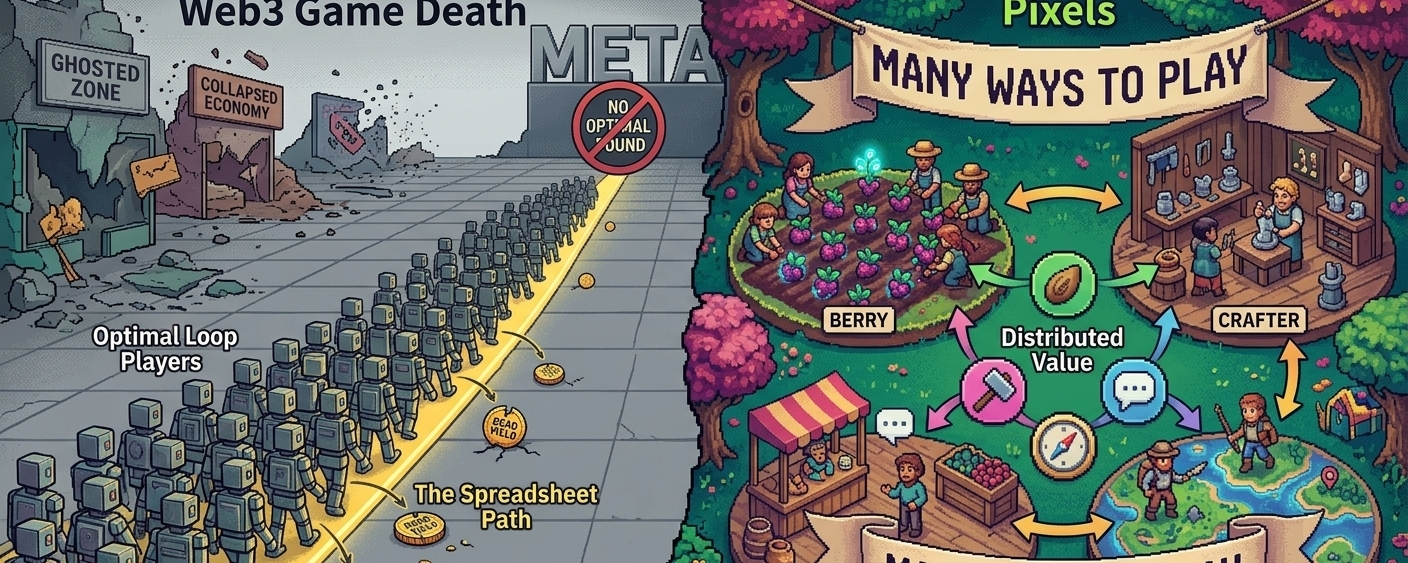
The biggest headache in Web3 gaming isn't actually a technical glitch; it’s just us. We’re the problem. The second players figure out the fastest way to squeeze out a reward, the rest of the game world basically dies on the vine. Everything collapses into this one "optimal loop," and any part of the world that isn't on that specific path gets ghosted. What was supposed to be an open world ends up looking like a boring, narrow spreadsheet.
Pixels handles this differently by changing the vibes at the foundation. Instead of building the game around one "best" way to win, it spreads value across a bunch of different activities that actively clash with each other—you physically cannot optimize all of them at once. It doesn't stop people from trying to be efficient, but it makes that strategy feel... incomplete. No single routine can dominate the economy for long.
This creates a subtle but massive shift: players stop acting like calculators and start acting like people in a living world. When there isn’t one "perfect" way to play, the idea of "beating the game" stops making sense. Instead of everyone crowding into the same meta, the community naturally spreads out. Some people dive deep into resources, some just wander, and others focus on the social or crafting side. The game becomes a map with many centers rather than one single finish line.
Honestly? This is why people stay. In most Web3 setups, once the "best" loop is found, new players are forced into these crowded, hyper-competitive spots where the rewards are already drying up. They get frustrated and quit. But in a spread-out system, value doesn't get stuck in one pipe. It stays distributed, which takes the pressure off any single activity to keep the whole economy afloat.
There’s a psychological win here, too. When you aren't forced into one "correct" path, you actually feel like you have a choice. Exploration feels smart again, not just like a waste of time. You aren't punished for trying something "inefficient" because "efficiency" is constantly shifting. That uncertainty brings back the curiosity that most reward-heavy games accidentally kill off.
On the money side, this stops the worst exploits. In a lot of token-based games, once a "god-tier" farming loop is discovered, everyone floods it until the whole thing breaks. A distributed system fixes this naturally: if too many people crowd one spot, the rewards drop fast. This forces everyone to keep moving, exploring, and rebalancing.
The real takeaway? Pixels isn't just balancing a game; it’s preventing the game from caving in on itself. Instead of letting everyone converge on one strategy, it keeps things messy and diverse on purpose. That diversity isn't a fluke—it’s built into how you progress.
It’s a different way of thinking about stability. Most games try to stay stable by tightening the rules. This approach stays stable by making sure a "single best way to play" never forms in the first place. The world stays bigger than any one person’s strategy, and that’s what keeps the game feeling like a game.
