
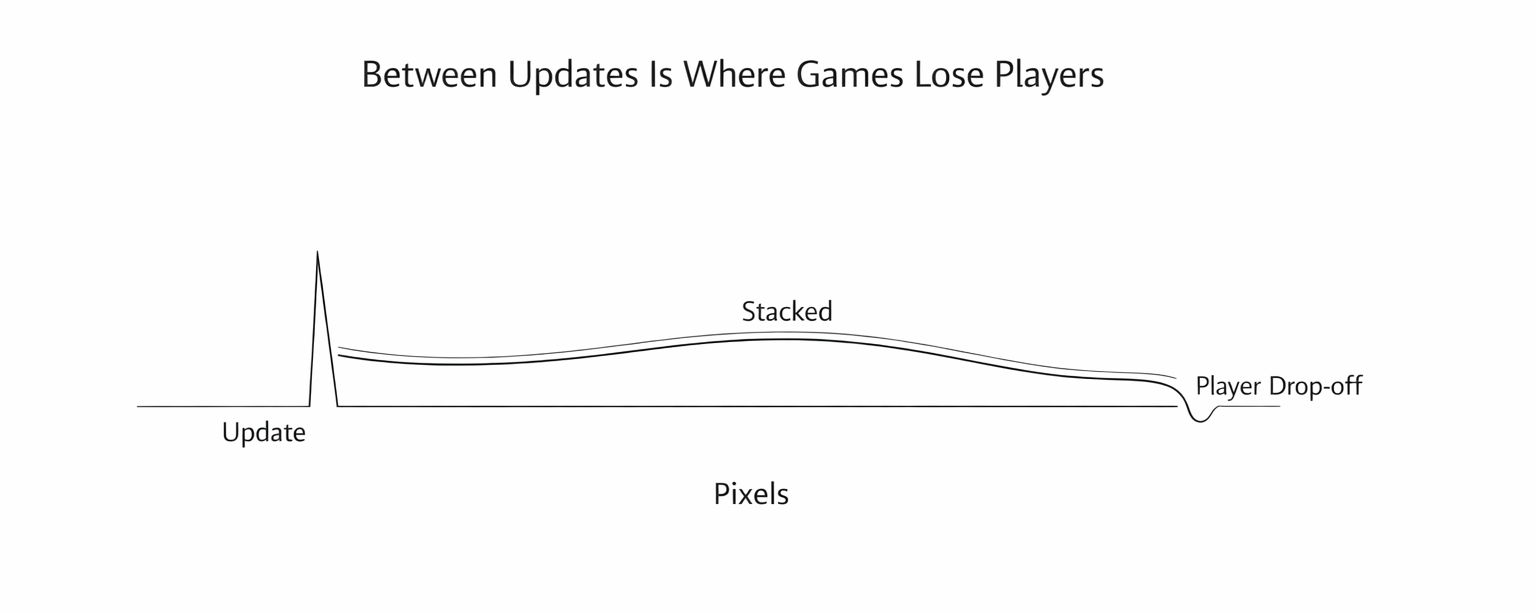
There is a moment every Web3 game dreads but almost none of them plan for seriously.
The gap between updates.
A new feature drops. Players flood back. Engagement spikes. The dashboard looks healthy. The team celebrates. And then the update cycle ends and the next one is six weeks away and nobody has a real answer for what keeps players inside the game during that silence.
Most studios respond to this problem the same way. More content. Faster updates. A roadmap packed so tightly that there is always something new on the horizon to point at. It sounds like a plan. It is actually an avoidance strategy dressed up as a roadmap.
The Pixels team knows this from the inside. They lived it. And the conclusion they arrived at after living it is the foundation Stacked was built on.
More content is not a retention plan.
That sentence sounds obvious when you say it out loud. It is apparently not obvious enough, because the entire Web3 gaming industry is still organized around the assumption that engagement follows content. Ship features. Players stay. Stop shipping. Players leave. The solution is always more shipping.
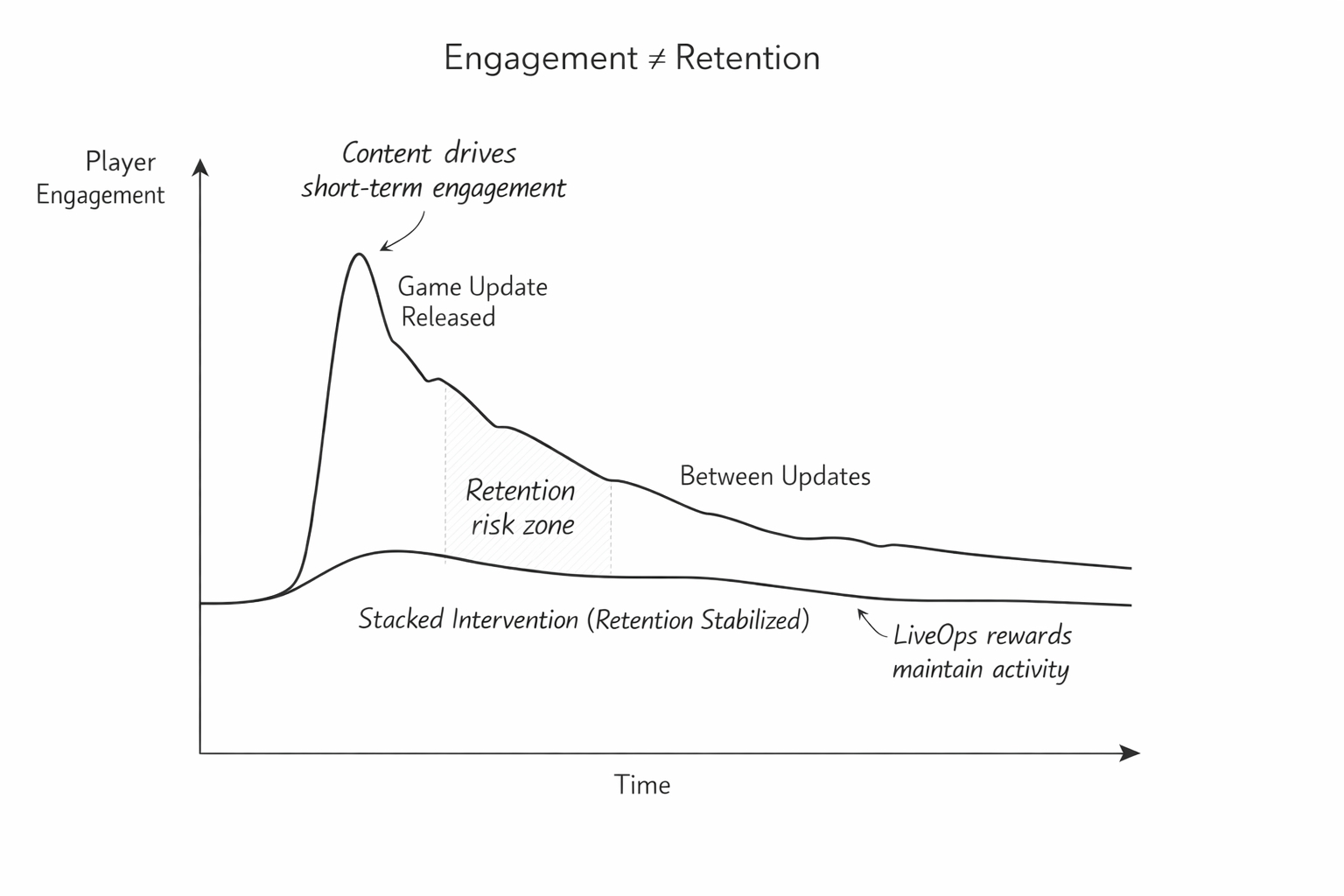
Pixels challenged that assumption directly. Because if you study how players actually behave inside a live game — not how you wish they behaved, but how they actually behave — the pattern that emerges is more specific and more actionable than "they leave when there's nothing new."
Players leave at predictable moments. Not random ones. There are identifiable points in the player journey where churn risk spikes — specific days, specific behavioral triggers, specific moments where the game's value proposition stops feeling worth the time investment. Those moments are not evenly distributed across the player base. Different cohorts hit them at different points for different reasons.
That specificity is what makes Stacked's approach fundamentally different from a content calendar.
Stacked is a rewarded LiveOps engine built specifically to keep $PIXEL players engaged between updates, not just during them. The distinction in that phrase is everything. During updates, engagement takes care of itself. The content does the work. Between updates is where retention actually gets decided — and between updates is precisely where most Web3 games have no infrastructure at all.
What Stacked deploys into that gap is not generic rewards. It is dynamic rewards, player segmentation, winback campaigns, and a full offerwall — each component targeting specific player behaviors at specific moments in their journey.
Player segmentation means Stacked is not treating all Pixels players as one homogeneous group with identical needs. A player who logs in daily and farms consistently has different retention risk and different reward sensitivity than a player who engaged heavily for two weeks and has been absent for ten days. Sending the same reward to both of those players is not a retention strategy. It is a spray-and-pray approach that wastes budget on players who were going to stay anyway and fails to reach players who needed a specific nudge at a specific moment.
The winback campaign capability is the piece I find most interesting from a game economy perspective. Winback campaigns target players who have already left — or are showing the behavioral signals that precede leaving. In traditional gaming, winback is expensive and imprecise. You are essentially paying acquisition costs again for players you already acquired once. Stacked's behavioral data makes winback surgical rather than expensive. The system identifies which lapsed players are worth targeting, what reward would change their calculus, and at what moment that intervention has the highest probability of working.
That is not a feature. That is a different philosophy about what player relationships look like across time.
And the offerwall component connects Stacked directly to the broader question of how Web3 games monetize without destroying their own economies.
An offerwall in a traditional mobile game is usually a list of sponsored actions — watch an ad, download an app, complete a survey — that feel completely disconnected from the game itself. They generate revenue for the studio but create a jarring experience for the player because the actions have nothing to do with why the player is there.
Stacked's offerwall is designed to sit inside the Pixels ecosystem logic rather than outside it. The actions that generate rewards are connected to genuine game engagement. The value flows to players who are doing things that actually matter for the ecosystem's health rather than players who are mechanically completing disconnected tasks for token drips.
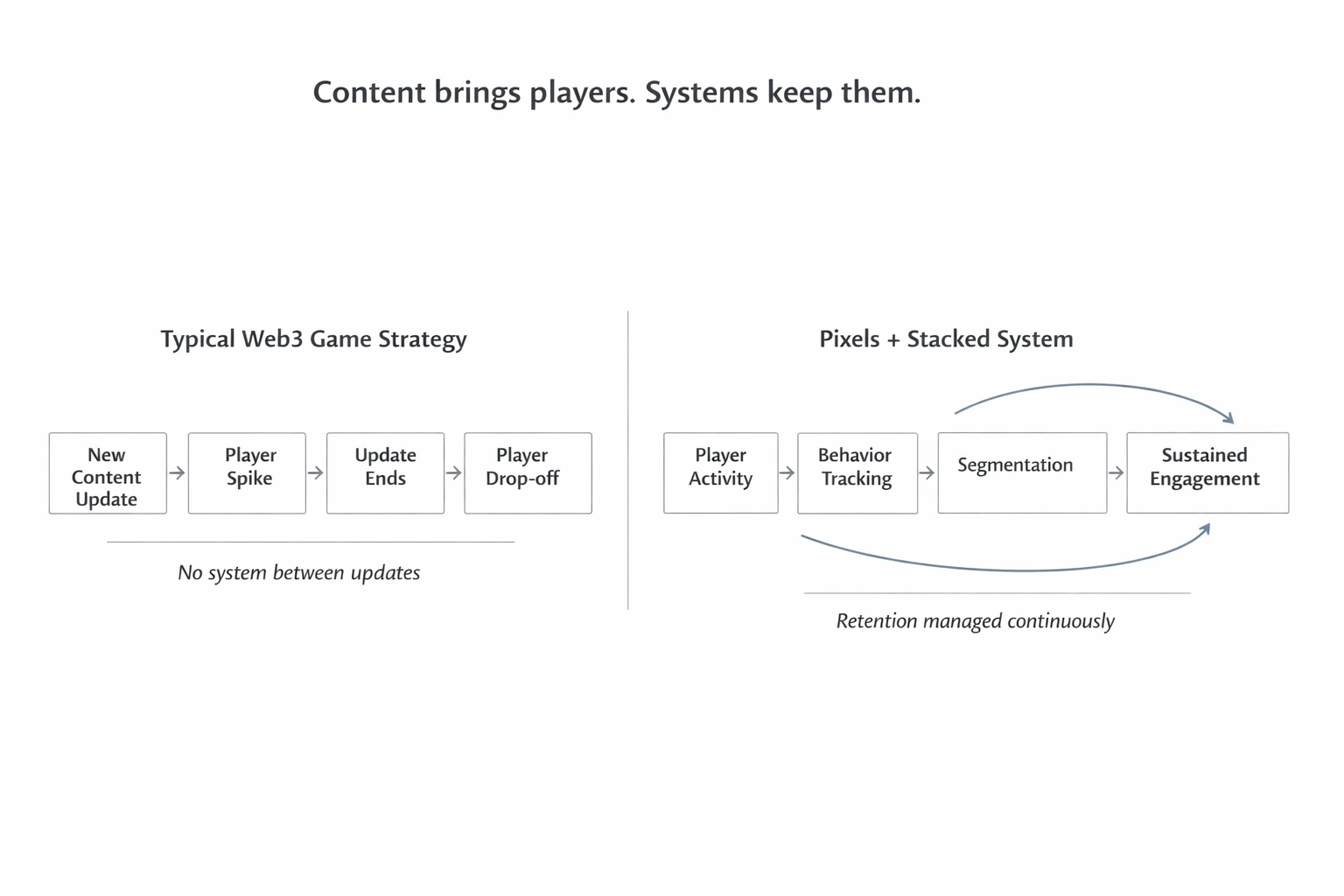
That design coherence — rewards tied to genuine engagement rather than arbitrary actions — is what separates sustainable LiveOps from the farming exploitation that destroyed $BERRY and dozens of other Web3 game economies before it.
$PIXEL sits at the center of all of this. Not as a passive store of value. As the active currency running through a retention infrastructure that processes real player behavior at real scale. The 200 million rewards already processed through the Pixels ecosystem are not a historical milestone. They are evidence that the infrastructure works under load, that the fraud prevention holds under adversarial conditions, and that the reward design philosophy produces outcomes worth measuring.
Content brings players in. Stacked keeps them.
That division of labor — acquisition versus retention, handled by different systems optimized for different problems — is how sustainable game ecosystems actually get built. Pixels figured that out the hard way. Now they are building the infrastructure to give every other Web3 studio the shortcut they never had.