
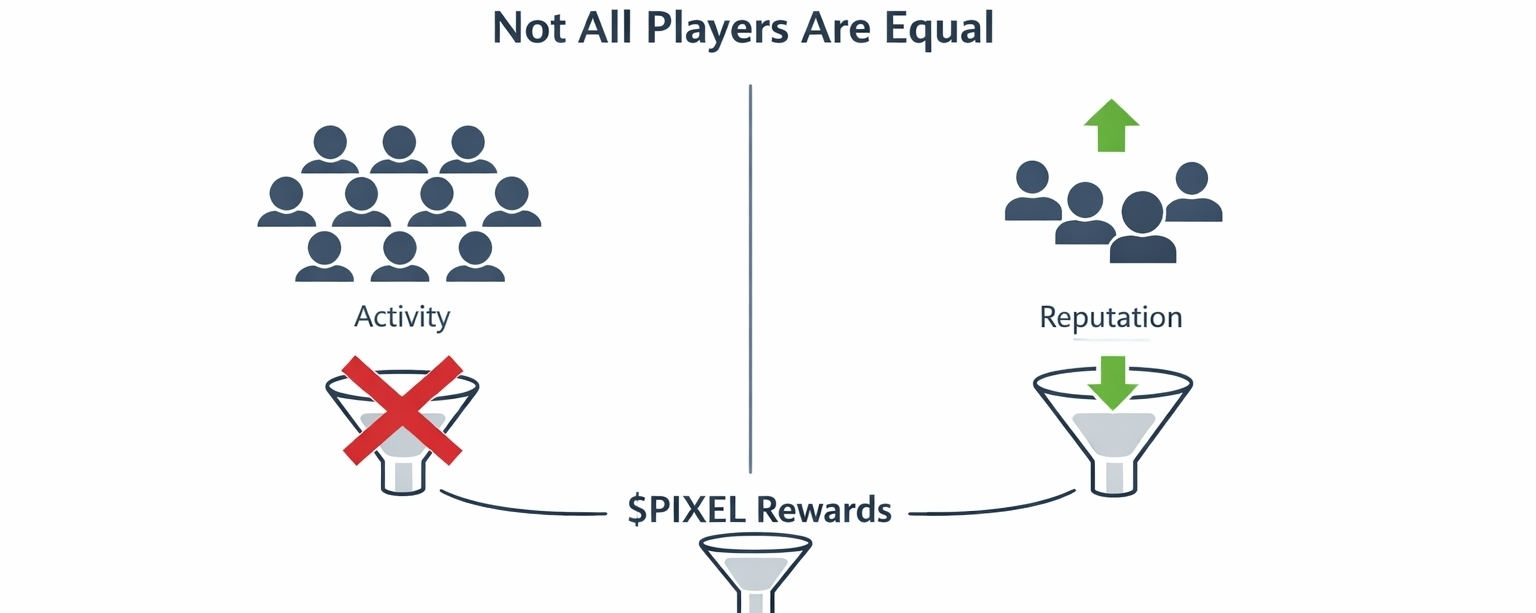
I almost skipped past this part of Pixels' documentation.
Reputation. It appears in the help docs almost as a footnote. A stat. Something that affects your chances of getting $PIXEL tasks on the board. Higher reputation, better task access. Simple enough. Move on.
I did not move on.
Because the more I sat with how reputation actually works inside Pixels, the more it started to look less like a game mechanic and more like a quiet economic philosophy the team embedded into the system without making a lot of noise about it.
Here is what the documentation actually says. Reputation in Pixels is not just earned by playing well. It is affected by how you play. Certain behaviors build it. Others damage it. And the consequences are not cosmetic — reputation influences your access to PIXEL rewards, your standing in the task system, and eventually other parts of the ecosystem that the team has flagged as reputation-gated in future updates.
That is a strange thing to build into a Web3 game. And I mean strange in the interesting way, not the suspicious way.
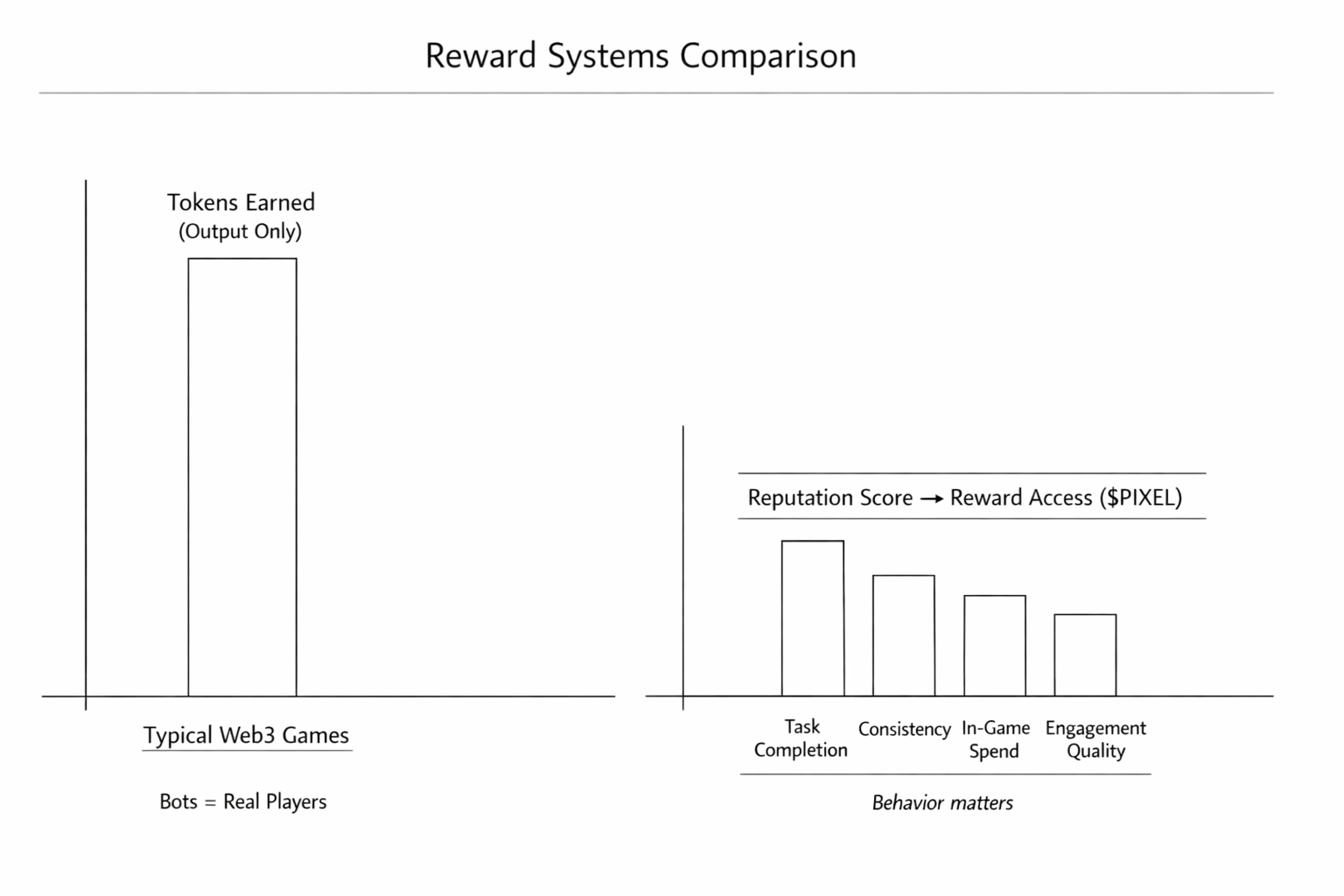
Most token systems reward presence. Show up. Complete tasks. Earn tokens. The logic is purely additive. You accumulate. The game does not really care how you accumulated or what your behavior looked like along the way. A bot and a genuine player look identical to a system that only measures output.
Pixels is trying to measure something different. Not just what you produced but how you behaved while producing it. Whether your activity looks like genuine engagement or mechanical extraction. Whether your patterns inside the game suggest you are building something or just farming the reward surface.
That distinction is genuinely hard to operationalize. I want to be honest about that. Building a reputation system that accurately separates genuine players from sophisticated bots is not a solved problem. The history of Web3 gaming is full of reputation and scoring systems that got gamed within weeks of launching because the criteria were visible enough that bad actors could optimize for them directly.
What makes Pixels' approach more interesting than most is that reputation is not a single number with a single input. It is shaped by multiple behavioral signals across multiple game systems. Your task completion patterns. Your in-game spend. Your activity consistency. Your land ownership. Your VIP status. None of those signals individually is hard to fake. Together they start to describe something that is considerably more expensive to manufacture than a simple farming script.
And here is the part that most PIXEL analysis completely ignores.
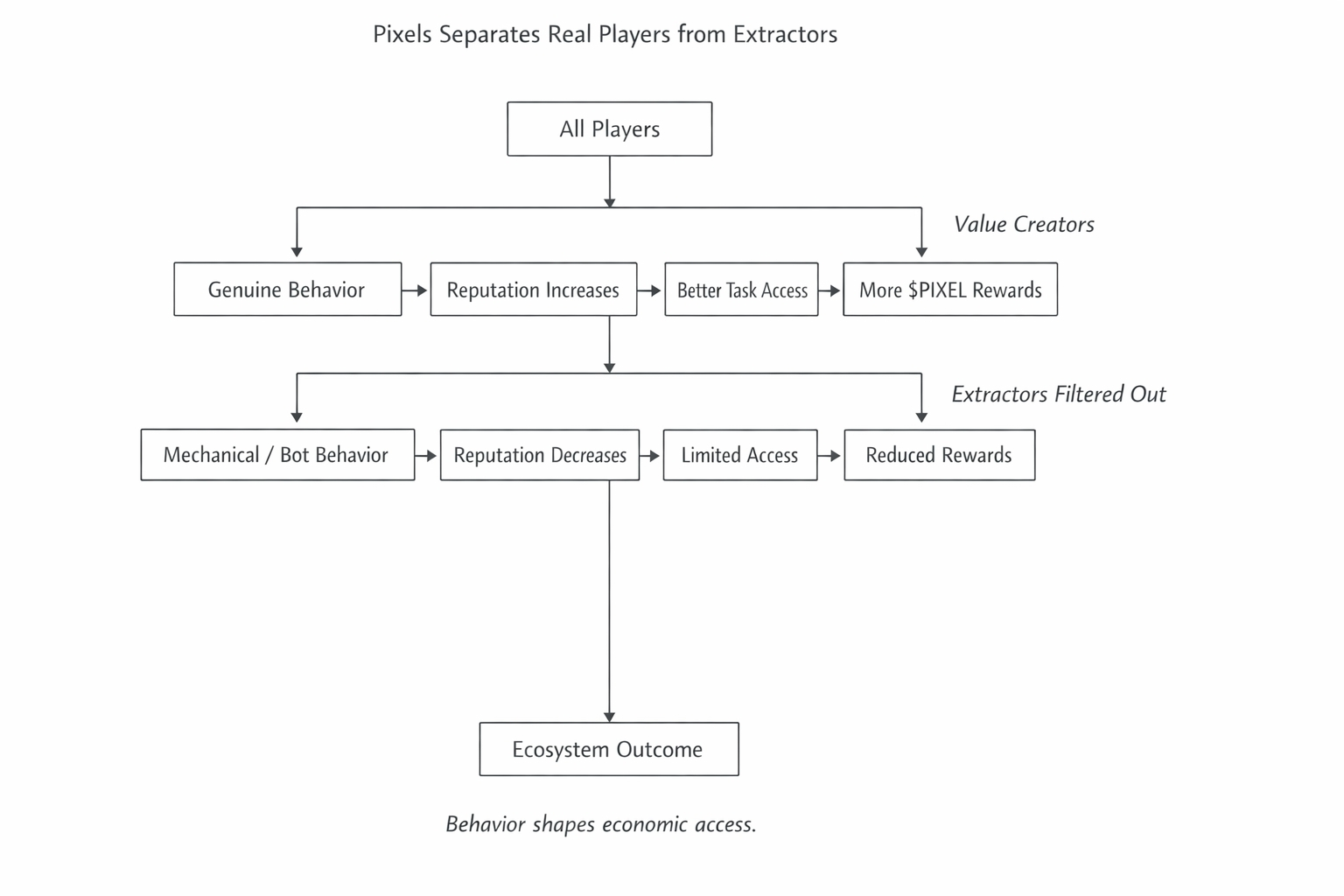
Reputation creates a natural sorting mechanism inside the Pixels economy. Players who engage genuinely over time accumulate reputation that improves their access to rewards. Players who engage mechanically or exploit the system see their reputation damaged and their reward access restricted. Over time — if the system works as designed — the economic center of gravity shifts toward genuine players and away from extractive ones.
That is not just good game design. That is a token economy defense mechanism.
The single biggest reason Web3 game economies collapse is not bad tokenomics on paper. It is that the reward surface gets captured by players whose only goal is extraction. They do not care about the game. They care about the token. And because most systems cannot tell the difference between them and genuine players, the extractors drain the economy while the genuine players leave because the experience has been hollowed out.
Pixels' reputation system is an attempt to make that distinction visible and consequential. Not perfectly. Not immediately. But structurally, over time, in a way that compounds.
The Stacked layer makes this more interesting still.
Stacked's AI game economist analyzes player cohorts to identify churn risk and reward sensitivity. But cohort analysis is only as good as the behavioral data feeding it. A reputation system that tracks genuine engagement signals over time produces richer, more reliable behavioral data than a system that only tracks raw output. The reputation layer and the Stacked intelligence layer are not separate features. They are feeding each other.
High reputation players are more valuable to the ecosystem not just because they engage genuinely but because their behavioral data is cleaner signal. Their patterns tell Stacked something real about what keeps genuine players inside the game. That signal then improves reward targeting for everyone.
I do not know if Pixels has fully solved the reputation problem. The documentation is honest about the fact that future updates will expand how reputation is calculated and what it gates. That suggests the current system is a first version, not a finished one.
But the intent behind it is the right intent. And in Web3 gaming, building the right intent into the architecture from the beginning is rarer than it should be.
Most games reward you for showing up.
Pixels is trying to reward you for showing up as a real person.
That sounds like a small distinction. I think it is load-bearing for everything else PIXEL is trying to build.