
Most games eventually settle.
Even the good ones.
Players figure out what works, optimize it, share it, and slowly the game becomes a known space. You stop discovering and start executing. The uncertainty fades, and with it, a lot of the excitement too.
Pixels doesn’t really settle in that way.
At least not for long.
There are moments where it feels like it might. A certain activity becomes popular, people cluster around it, and for a short while it looks like the economy has found its shape. You see it in crafting cycles, farming routes, even simple resource loops that suddenly start appearing everywhere at once.
It feels like a meta forming.
And then it shifts.
Not dramatically. Not in a way that’s immediately obvious. More like a slow redistribution of attention that you only really notice after things stop feeling efficient.
I remember logging in at one point thinking a particular loop was still “the thing to do.” It had worked fine before, nothing obviously changed in the system, so I just kept going. But the output didn’t match the effort anymore. It wasn’t broken, just… diluted. Like too many people had quietly arrived at the same conclusion I had.
That’s usually how it starts.
In Pixels, the moment something becomes widely understood, it stops behaving like an advantage.
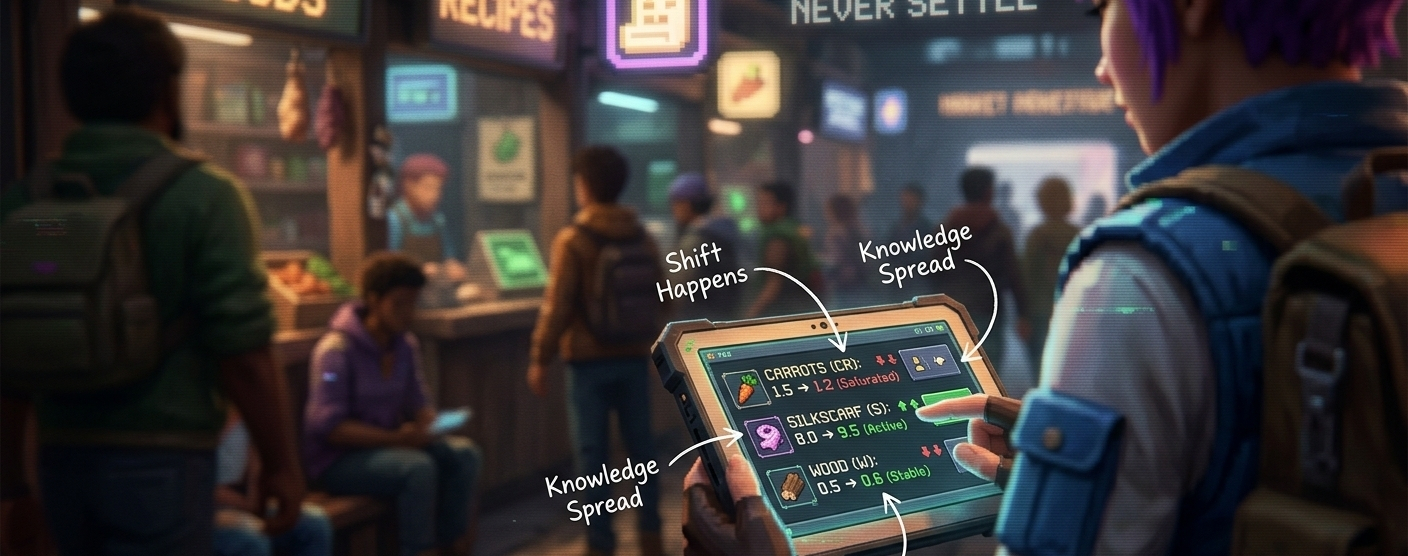
The economy is extremely sensitive to shared knowledge. Once information spreads—through Discord groups, posts, word of mouth—it doesn’t just inform players, it redirects them. And when enough players redirect at the same time, the shape of profitability changes underneath you.
What was efficient becomes crowded. What was quiet becomes competitive. And what was overlooked suddenly becomes interesting again.
So instead of a stable meta, you get movement.
Constant rotation.
It’s not that nothing works. It’s that nothing works for long enough to become permanent.
That creates a strange kind of rhythm in how the game feels. You’re never fully settled into a role. Even if you specialize in something, there’s always this underlying awareness that it might not stay optimal for long. Not because of a patch or explicit change, but because other players will eventually arrive at the same place.
And when they do, the advantage dissolves.
This is where Pixels feels different from traditional optimization-heavy games. In most systems, learning is cumulative. The more you understand, the more stable your position becomes. Knowledge compounds into control.
Here, knowledge has a shorter lifespan.
Not because it’s useless, but because it spreads too efficiently.
There’s a kind of paradox in that. Being correct about the economy doesn’t guarantee sustained benefit. Sometimes it just means you were early to a pattern that other people will also discover soon after.
And when they do, the pattern changes meaning.
You start seeing this most clearly in resource-heavy activities. Something feels underused, almost invisible for a while. A few players experiment with it, realize it’s decent, and then more people follow. Within a short window, it goes from “why is no one doing this” to “everyone is doing this.”
And that transition is where the shift happens.
Prices adjust. Competition tightens. Time investment increases. Suddenly the same activity that felt relaxed becomes something you have to actively compete in just to maintain results.
Nothing in the code changed. But the experience changes completely.
That’s the core loop of Pixels’ economy: discovery, adoption, saturation, abandonment. Then back again.
It doesn’t stay still long enough to become fully optimized, because optimization itself accelerates the next shift. The more efficiently players identify value, the faster they converge on it. And convergence is what breaks stability.
So instead of rewarding long-term mastery of a single system, the game quietly rewards awareness of movement.
Where players are going.
What they are abandoning.
What is starting to feel slightly too popular to be efficient anymore.
That’s a very different skill set from traditional “find the best strategy and repeat it” gameplay.
It’s closer to reading timing than solving systems.
And that’s probably why Pixels feels inconsistent to some players. If you’re expecting permanence, it feels like things keep slipping out of place. But if you adjust to the idea that the economy is always being reshaped by collective behavior, the inconsistency starts to look more like structure.
Just not a fixed one.
It’s a structure that moves with attention.
The interesting part is that this prevents the game from fully collapsing into a solved state, but it also prevents it from ever feeling fully solved. There’s always something slightly ahead of you or slightly behind you in terms of opportunity.
Rarely aligned perfectly.
And maybe that’s the real identity of Pixels.
Not a game you master once.
But a system you keep reinterpreting as the people inside it keep changing what it means to play efficiently.
