

Written by Yetta Sing(@yettasing)
In our industry, there’s a familiar playbook of self-introductions:“I was one of the earliest in this space.” “I come from a tech background.” “I’m a true believer in this vertical.” “I graduated from an Ivy.” These sound like simple credentials. But over time, they often evolve into something more personal: emotional anchors, even identity statements. What starts as context gradually becomes a source of self-worth, and eventually, a part of how someone sees who they are.
Similarly, when someone asks, "Weren't you a strong supporter of X? What changed?" it shouldn't feel like a moral accusation. But when your identity becomes fused with your past beliefs, such questions trigger shame rather than reflection. You find yourself defending not just your position, but your very sense of self.
In today's world, certain topics, like gender, politics, and religion, almost always create tension. Not because these subjects are impossible to discuss, but because they're deeply intertwined with personal identity. When a belief becomes part of "who I am," disagreement feels like a personal attack. The conversation becomes defensive, logic yields to emotion, and changing your view feels like erasing part of yourself.
Compare that to a technical debate, say, about a pretraining strategy or the performance of a LLM. These debates can be intense too, but they don’t hit as deeply. Why? Because they’re not anchored in identity. People argue, test ideas, and move on.
Ideas can be falsified, refined, replaced. Identity cannot.
This psychological distinction is especially critical in startups. Can founders respond to failure without seeing it as a blow to their self-worth? Can they pivot based on real feedback without spiraling into self-doubt? This resilience often separates founders who break through from those who don't.
A Resilient Core
After years of working closely with founders, we’ve noticed something important: the best founders rarely stand out because of one extraordinary talent or skill. What truly sets them apart is a strong and stable inner structure, something that reveals itself not in resumes or pedigrees, but in how they respond to uncertainty, conflict, and volatility.
We’ve identified four key traits that make up a founder’s resilient core:
Low Ego
High Agency
Natural Curiosity
Strong Execution
The founders we admire most have a rare balance: a clear sense of direction without being trapped by self-image; strong beliefs without rigidity; high self-respect without ego-driven defensiveness. It sounds idealized, but this mindset stems from a very real psychological structure: low ego. These are people who know who they are without needing to prove it all the time.
Defend Your Ideas, Not Your Identity
How to tell? In conversations, we look beyond experience, idea and vision to understand how founders define themselves. Having a technical background or being early to an industry isn't the issue, these are simply facts. The problem arises when these facts become identity anchors.
This is what we observe when ego takes the driver’s seat:
Do they frequently reference past roles, exits, or credentials to justify decisions today?
Do they often drop big names, schools, or backers to validate themselves?
Do they blame others or external factors instead of acknowledging personal accountability when explain failure?
Do they centralize authority? or allow team members to challenge them constructively?
Do they listen actively or constantly defend their stance during feedback?
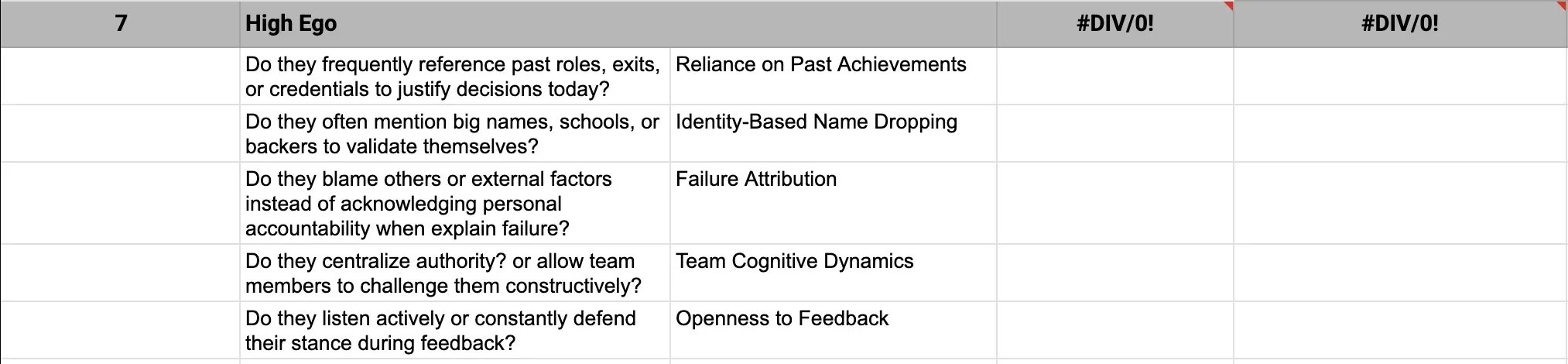
In crypto's radically transparent and brutally populist environment, ego is especially dangerous. We've seen founders build beautiful products and raise large rounds, yet struggle to rally a community. The issue isn't about product or marketing, it's that the founder becomes trapped in a self-image that prevents genuine openness, both internally and externally.
On the flip side, some founders come from humble backgrounds, still figuring out their product. But the community gives them time and trust. Because they feel invited into a shared journey, not preached to. These founders don’t posture, they engage.
What looks like a communication style difference is often a deeper divergence in how founders relate to identity itself.
Self-Labels Are Born from Deep-Seated Fear
Labels are meant to be tools for external communication, helping others quickly grasp your role, expertise, background, or value proposition. They’re part of a social signaling system, useful for categorization and narrative clarity. But for many, labels gradually morph into the scaffolding for their inner identity.
Behind this shift lies a deep, often unspoken fear: the fear of self-collapse.
In the past, identity was structured and deterministic. Who you were depended on where you came from, what you believed in, and what profession you held. These elements provided a stable sense of social order and selfhood. But today, as geography, career paths, and belief systems become decentralized, individuals are left with the daunting task of actively constructing who they are. And in that vacuum, labels offer an easy shortcut, a psychologically comforting illusion of certainty.
Just say, “I’m a tech geek,” “I’m a libertarian,” or “I went to Harvard,” and people will instantly ‘get’ you. The quick hits of recognition, approval, even admiration, act like dopamine, reinforcing our reliance on labels. Over time, these labels stop being tools and start becoming stand-ins for the self.
The more someone lacks inner order and a stable internal framework, the more they lean on labels as psychological crutches. They might keep repeating what sounds like statements of fact, like the ones I mentioned earlier, but these phrases aren’t really about sharing experience. They’re about maintaining a sense of self. These are anchors of existence.
They double down on identity, defend old positions, and reject cognitive updates, not because they truly believe in those views, but because if the label wobbles, the illusion of self crumbles. They’re not defending truth; they’re defending a self-portrait cobbled together from external validation.
As Dovey often says, “The hardest people to talk to aren’t the uneducated. It’s those who’ve been trained in the ‘right’ answers and now believe the world revolves around them.”
Real Freedom Begins Where Identity Ends
The best founders don’t cling to identity. It’s not that they lack identity, they’re just rooted in something deeper: A strong sense of inner order, shaped by insight, resilience, and adaptability. Their identity isn’t held up by labels like “Stanford grad” or “crypto native,” but by real-world capacity: the ability to see with clarity, maintain composure during chaos, and evolve their thinking as they grow.
In contrast, the more a person clings to a fixed identity, the more their thinking gets boxed in. When you fear contradicting your past self, you start filtering ideas through the lens of consistency rather than truth. That’s how people get trapped, justifying outdated views instead of solving real problems.
Growth begins when you acknowledge, "I am not defined by my past statements." A truly free thinker doesn't say, "I'm X, but I understand Y." They've moved beyond needing to be X. They can evolve without fear and adapt without shame.
When you free your self-worth from labels, you can finally think with clarity. You stop performing a role and start engaging with reality. In Buddhist terms, this is the beginning of non-self — not the cessation of existence, but liberation from identity-driven reactions.