
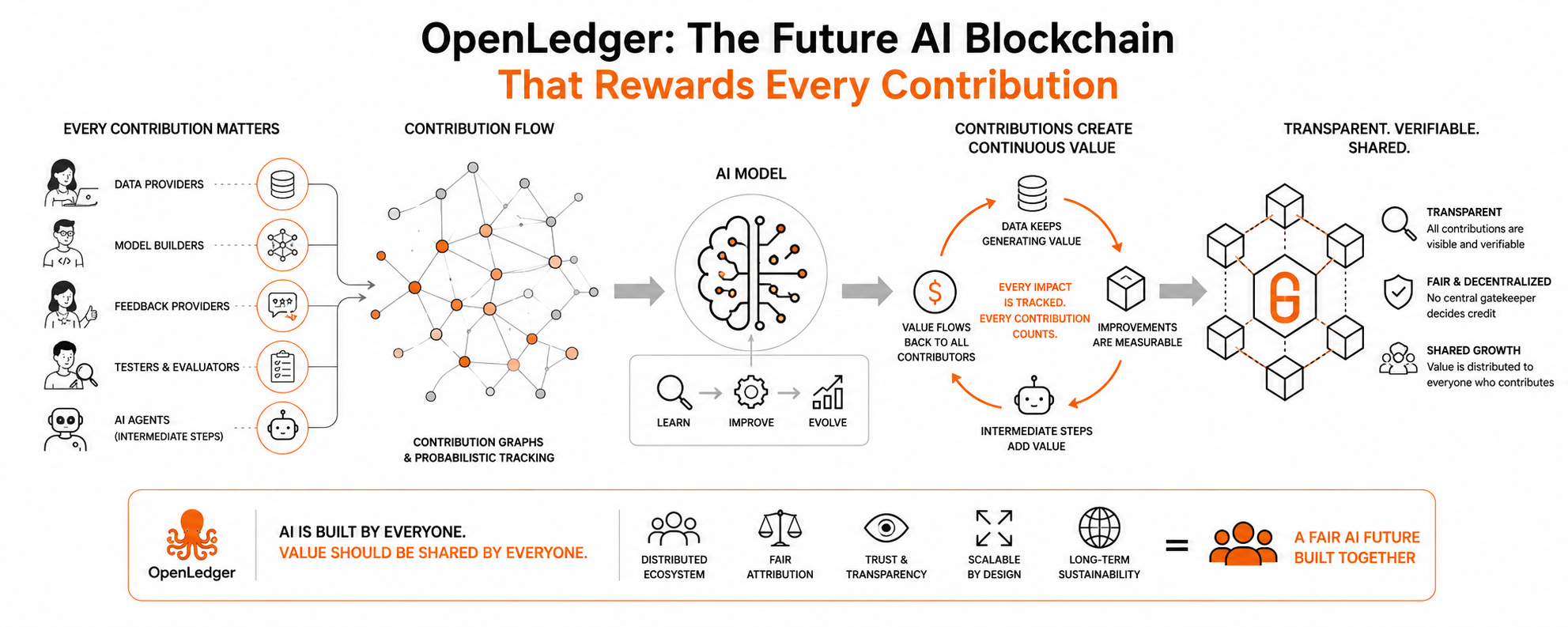
When I think about how AI systems actually work, it’s clear nothing really comes from one place. It’s always layers of human effort stacked together data, model design, fine-tuning, feedback, testing, all of it. And most of that work never really gets seen. You just get the final output, not the messy process behind it.
That’s where ideas like @OpenLedger start to make sense to me. I don’t see it as just another blockchain project it feels more like a rethink of how credit should work in AI. If your work helps improve a model, it shouldn’t just disappear into the background. It should actually count for something.
The tricky part is that AI doesn’t work in clean, separable steps. From what I’ve seen, you can’t really point to one dataset or one change and say, “that’s what made it better.” Everything blends together.$ALT
So instead of trying to trace exact cause and effect, it becomes more about estimating contribution. Things like contribution graphs or probabilistic tracking can give a rough idea of who influenced what over time. It won’t be perfect, but it can still be fair in a practical sense.
What I find interesting is how this changes how we think about data. Right now, data gets used to train models and then basically disappears into them. But in a system like this, if that data keeps influencing outputs, it could keep generating value instead of being “used once and done.”
The same goes for model builders. Improvements wouldn’t just be technical updates anymore they’d also show up as measurable contributions. If what you built makes the system better, that impact can actually be traced back to you in some way.
Even AI agents fit into this. A lot of their intermediate steps searching, reasoning, partial outputs usually get thrown away. But if those steps improve future results or get reused, they’re part of the value chain too.
Of course, measurement here is messy. Nothing in these systems is truly isolated, so attribution will always be a bit fuzzy. The goal probably isn’t perfect accuracy anyway it’s more about being consistently fair in a way that makes sense.$FIDA
Another shift I keep coming back to is trust. Instead of a central platform quietly deciding who gets credit, you’d have something more transparent, where contributions are visible and verifiable.
The challenge is scale. Anything too heavy or complicated usually doesn’t survive in real-world use, so adoption matters just as much as the idea itself.
Still, I like the direction. It moves away from a few big platforms capturing most of the value, toward something more distributed where more people actually share in what they help build.
And at a deeper level, it changes how you see AI not as a finished product sitting on a server, but as an ongoing process shaped by small contributions over time.
And that leaves me with the same question I keep coming back to if intelligence is built by everyone, why shouldn’t the value be shared by everyone too?