
I’ve been thinking about AI a lot lately, but not in the usual hype way people talk about it online. More in a practical sense—how it actually shows up in real work and real tools.
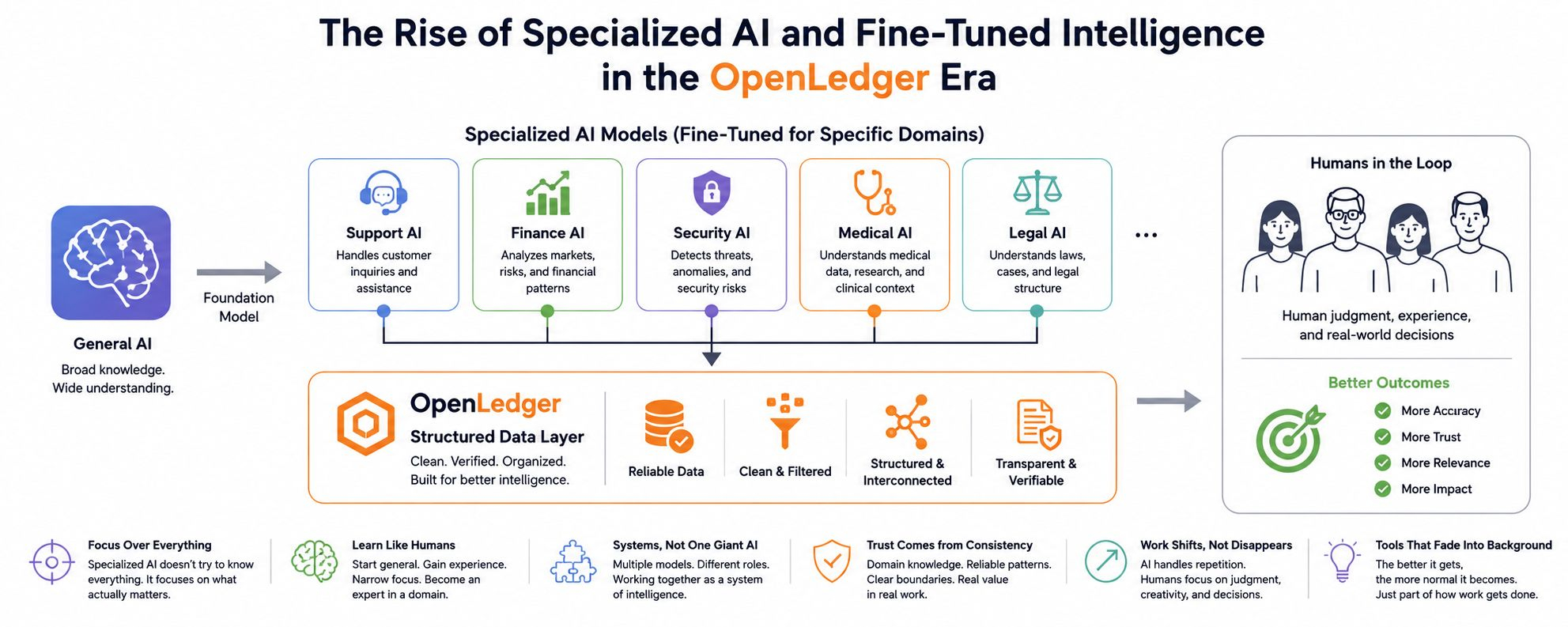
And honestly, the more I look at systems like @OpenLedger , the more it feels like we’re not heading toward one big all-knowing AI. It’s more like we’re moving toward a bunch of smaller, focused systems that each do their own job properly.
At one point, I also thought AI would become this single system that could do everything—write anything, explain anything, solve anything. And at first, it kind of feels like that’s true. These models are impressive. They answer quickly, switch topics easily, and usually sound confident.
But once you actually start using them for serious or technical work, you notice something. The answers are often well-written, but not always fully right in a deep sense. If you already know the topic, you can feel when something is slightly off—not completely wrong, just missing the real structure behind it.
That’s where specialized AI starts to make more sense.
When a model is trained or fine-tuned for a specific area, it behaves differently. It stops trying to be generally good at everything and starts focusing on being actually useful in one thing. The responses become more precise, more grounded, and more aligned with how that field really works.
This is also where something like @OpenLedger fits in. Because it’s not just about AI models—it’s about the data they learn from. If the data is messy, the AI learns messy patterns. If the data is structured and reliable, the AI becomes more useful.
So instead of random information from everywhere, you get systems that can rely on cleaner, more organized knowledge.
Fine-tuning is basically part of that process. You take a general model and train it further using focused data so it behaves more like an expert in a specific field. Over time, it picks up the language, logic, and thinking style of that domain.
It’s actually similar to how people specialize.
No one starts as an expert. People start broad, then slowly narrow their focus through practice and experience. Eventually, they stop thinking in general terms and start thinking in patterns specific to their field. AI is doing something similar, just without real-world experience.
And this is already changing how systems are built.
Instead of one big AI doing everything, we’re seeing multiple smaller models working together. One handles support, another handles data, another handles security, and so on. Each one has a clear role.
It doesn’t feel like one intelligence anymore. It feels more like a system of tools working together.
And that actually makes more sense in real life.
Trust is another big factor here. People don’t trust AI just because it sounds smart. They trust it when it consistently understands their domain.$OPEN
A doctor needs accuracy, not general explanations. A lawyer needs structure, not vague advice. A financial analyst needs reliable patterns, not guesses.
Specialized systems tend to perform better in those cases because they stay within clear boundaries.
But there’s a trade-off.
When something becomes too specialized, it can lose flexibility. A finance-focused model might miss political or social changes. A medical model might not see broader context. So you gain precision, but you lose range.
That’s why the future probably won’t be just general AI or just specialized AI. It will likely be both together. A general system for broad thinking, and specialized systems built on top for specific tasks especially when structured data systems like OpenLedger support them.
Another thing that stands out is that AI isn’t really replacing people in a direct way. It’s more like it’s changing what people spend time on. It handles repetitive tasks like sorting, summarizing, and scanning information but humans are still needed for judgment and real-world decisions.
So the work shifts instead of disappearing.
And the better AI gets, the less you notice it. It just becomes part of the background of how things work. You stop thinking about it as a separate tool.
That’s usually a sign something is becoming normal.
But even with all of this, one thing is still clear: AI doesn’t actually understand the world like humans do. It doesn’t have experience. It doesn’t know meaning. It just works with patterns.
And that difference still matters.
So when I look at everything together, I don’t see one giant intelligence taking over. I see something more realistic a network of smaller, specialized systems, supported by structured data platforms like OpenLedger, working alongside human thinking.
Not one system that does everything.
Just a lot of focused systems doing their own part—and doing it well enough to actually be useful.