
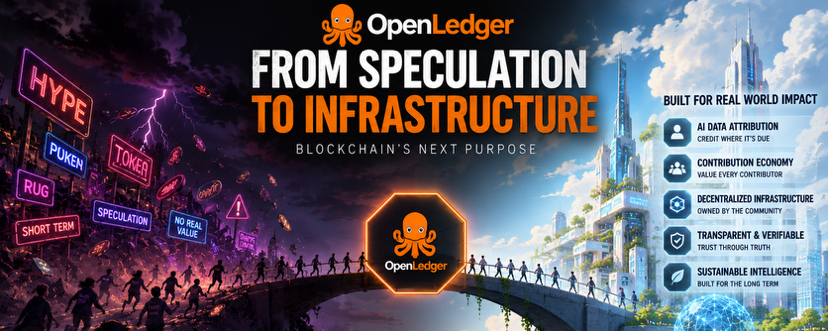
For a long time, I thought blockchain mostly survived on speculation.
New narratives.
New tokens.
New cycles of attention repeating over and over again.
Even when projects talked about infrastructure, it still felt like speculation was the real center of gravity underneath everything.
That’s probably why I never looked at blockchain as something truly foundational.
Just financially interesting.
But recently, after spending more time looking into @OpenLedger and the direction around attribution, AI coordination, and contribution visibility, I started realizing something that honestly changed the way I see the entire space.
Some blockchain systems are quietly evolving into infrastructure layers for AI itself.
And that feels very different from speculation.
Because the deeper AI moves into society, the less sustainable invisible systems probably become.
Invisible data ownership.
Invisible contribution.
Invisible influence.
Invisible economic extraction happening underneath models that increasingly shape how people work, think, and make decisions.
The uncomfortable part is that modern AI already depends on enormous amounts of coordination most people never see.
Human behavior trains systems.
Communities generate context.
Contributors create value.
Data continuously improves intelligence.
Yet almost all of that activity disappears once the output becomes polished enough.
That disconnect started feeling strange to me.
Especially when AI companies are beginning to resemble infrastructure providers rather than simple software products.
And infrastructure changes the stakes completely.
Because infrastructure quietly determines:
who participates,
who benefits,
who remains visible,
and who becomes economically invisible inside the system itself.
That’s the part of OpenLedger that shifted my perspective.
Not because the project promises some dramatic revolution overnight.
But because it approaches blockchain less like a speculative asset layer and more like a coordination layer for contribution and accountability.
The more I think about it, the more I realize speculation alone probably can’t sustain the next phase of AI economies.
Eventually these systems need:
traceability,
ownership,
verification,
attribution,
and some durable way to connect intelligence back to the humans helping create it.
Otherwise AI becomes increasingly detached from the people continuously feeding it value underneath.
And honestly, I think that detachment becomes dangerous at scale.
Because once AI integrates into finance, enterprise systems, autonomous agents, and digital governance, invisible infrastructure starts carrying real-world consequences.
At that point, blockchain stops looking like a market narrative.
It starts looking more like public infrastructure for trust.
Not trust in the idealistic sense people used to talk about years ago.
Trust as economic visibility.
Trust as attribution.
Trust as coordination between humans and systems too large for individuals to fully see on their own.
The strange thing is I didn’t expect AI to be the thing that made blockchain feel more real to me.
But now I’m starting to think the next important blockchain networks may not be the ones creating the most speculation.
They may be the ones quietly becoming necessary underneath the future intelligence economy itself.@OpenLedger #openledger $OPEN
