

 Blockchains were designed to eliminate human discretion. Once deployed, a smart contract does exactly what it is told no interpretation, no hesitation, no second thoughts. This rigidity is often presented as a strength, but as Web3 expands beyond closed crypto systems into real-world interaction, that same rigidity becomes a liability. The real world is messy. Data is delayed, disputed, incomplete, and sometimes deliberately misleading. The real challenge for Web3 is no longer execution. It is judgment.
This is the gap APRO Oracle is quietly stepping into.
APRO is not just another oracle that delivers data faster or cheaper. It is attempting something more fundamental: turning external data into something smart contracts can reasonably depend on rather than blindly consume. In other words, APRO is building the missing decision layer between off-chain reality and on-chain finality.
The Oracle Problem Is Not Data It’s Authority
Most oracle systems treat data as neutral input. A price is a price. An event happened or it didn’t. But in practice, real-world data rarely arrives cleanly. Different sources disagree. Timing matters. Context matters. Incentives distort behavior. When smart contracts consume data without understanding its reliability, they don’t become decentralized they become brittle.
APRO starts from a different assumption: external data should never be trusted by default. It should earn the right to influence capital.
This is why APRO does not frame itself as a simple data feed. It treats oracle infrastructure as an arbitration layer a place where data is evaluated, contested, delayed if necessary, or rejected outright before it is allowed to trigger irreversible on-chain actions.
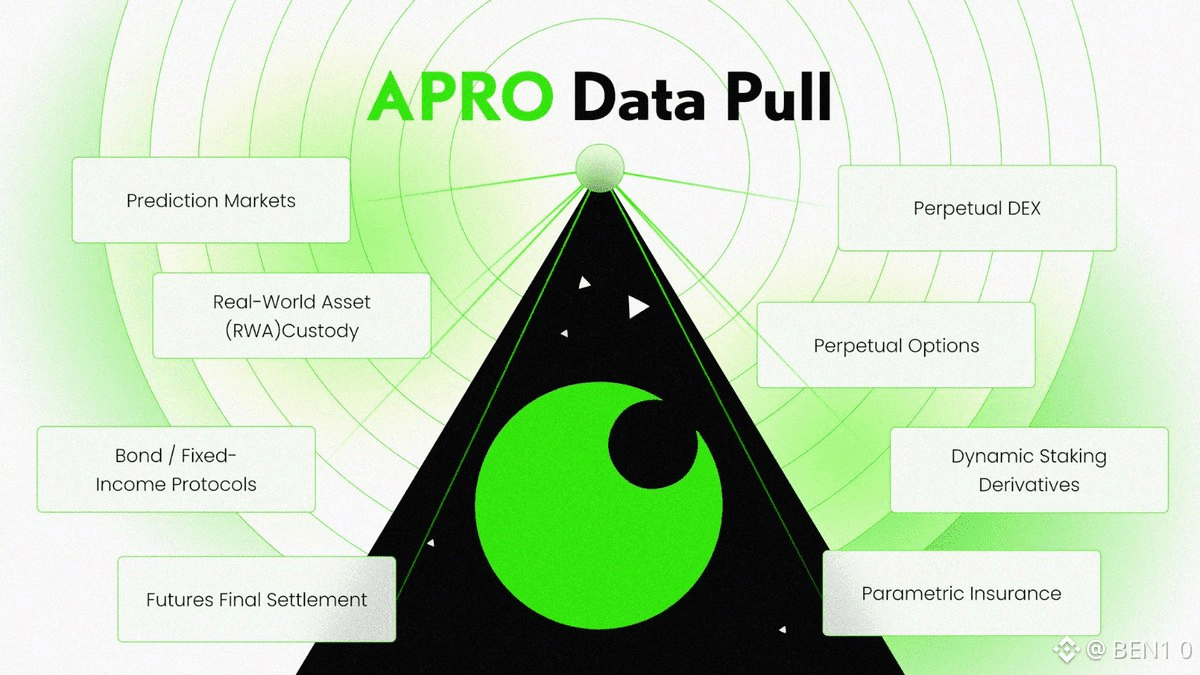
Through its dual push and pull architecture, APRO allows applications to decide whether they want continuous real-time feeds or situational data access. A high-frequency trading protocol may require constant updates. A liquidation engine during extreme volatility may prefer to wait for stronger confirmation. A governance contract may only need data once, but needs it to be extremely defensible.
This ability to delay action until confidence is high is what separates infrastructure built for speculation from infrastructure built for systemic resilience.
Verification Before Transmission, Not After Failure
APRO’s architecture intentionally keeps heavy analysis off-chain while anchoring final accountability on-chain. Data is gathered from multiple independent sources, but instead of simply aggregating it, APRO introduces AI-assisted anomaly detection at the verification stage.
This is not about replacing decentralization with algorithms. It is about recognizing that static rules fail against adaptive adversaries. AI in APRO’s design functions as a probabilistic filter flagging inconsistencies, detecting unusual deviations, and raising friction precisely where blind automation would be dangerous.
In practical terms, this means data does not automatically become “truth” just because it exists.
Why Randomness Matters More Than Most Protocols Admit
Randomness is often treated as a feature for games and NFTs. APRO treats it as a security primitive. Predictable randomness does not just break games it enables manipulation, extraction, and governance capture.
By integrating verifiable randomness into its core architecture, APRO ensures that validator selection, event resolution, and outcome generation cannot be gamed through timing or insider advantage. This reinforces a deeper idea: fairness is not cosmetic in Web3 it is structural.
Economic Accountability Instead of Reputational Trust
APRO’s token model is not designed to create attention; it is designed to create consequences.
Validators and data providers stake value not as a symbolic gesture, but as enforceable collateral. Incorrect data is not just “wrong” it is costly. Honest behavior is not assumed it is continuously incentivized. This transforms trust from a social expectation into an economic property.
This accountability is further expanded by governance. A central operator is not in charge of making decisions regarding data standards, verification thresholds, or network evolution. Participants who are financially impacted by the results receive them. This purposefully slows down governance. Capital-moving systems shouldn't make rash rule changes.
A Multi-Chain World Needs Shared Reality, Not Fragmented Truth
Web3 is not converging on one chain. It is fragmenting by design. But fragmented execution without shared data standards leads to systemic inconsistency. The same asset, event, or condition should not mean different things depending on the chain observing it.
APRO’s support for dozens of blockchain environments positions it as a shared reality layer rather than a chain-specific service. Instead of each ecosystem inventing its own oracle assumptions, APRO offers a consistent interface for interpreting the external world across chains. This reduces duplicated risk and aligns incentives across ecosystems that increasingly interact with one another.
Why APRO Feels Like Infrastructure, Not a Product
The most telling thing about APRO is not what it markets, but what it optimizes for. There is no promise of instant dominance. No claim of replacing every oracle overnight. Instead, there is a clear focus on reliability under stress the exact moments when oracle failures cause cascading damage.
APRO is being built for the phase of Web3 where failure is no longer acceptable. Where capital is institutional, assets are real, and errors are irreversible. In that world, data cannot be fast alone. It must be defensible.
The Long Game: Making Data Earn the Right to Move Capital
Ultimately, APRO is not trying to make blockchains smarter. It is trying to make them more cautious in the right ways.
By introducing verification, delay, rejection, and accountability into the data pipeline, APRO reframes how decentralized systems interact with reality. It teaches smart contracts that not all information deserves immediate action. Some data should be questioned. Some should wait. Some should never be allowed through.
That mindset marks a transition from experimental Web3 to infrastructural Web3.
If the next phase of blockchain adoption is about trust at scale, then APRO is not just supplying data.
It is defining when data deserves authority.
And that may turn out to be one of the most important shifts in decentralized infrastructure.