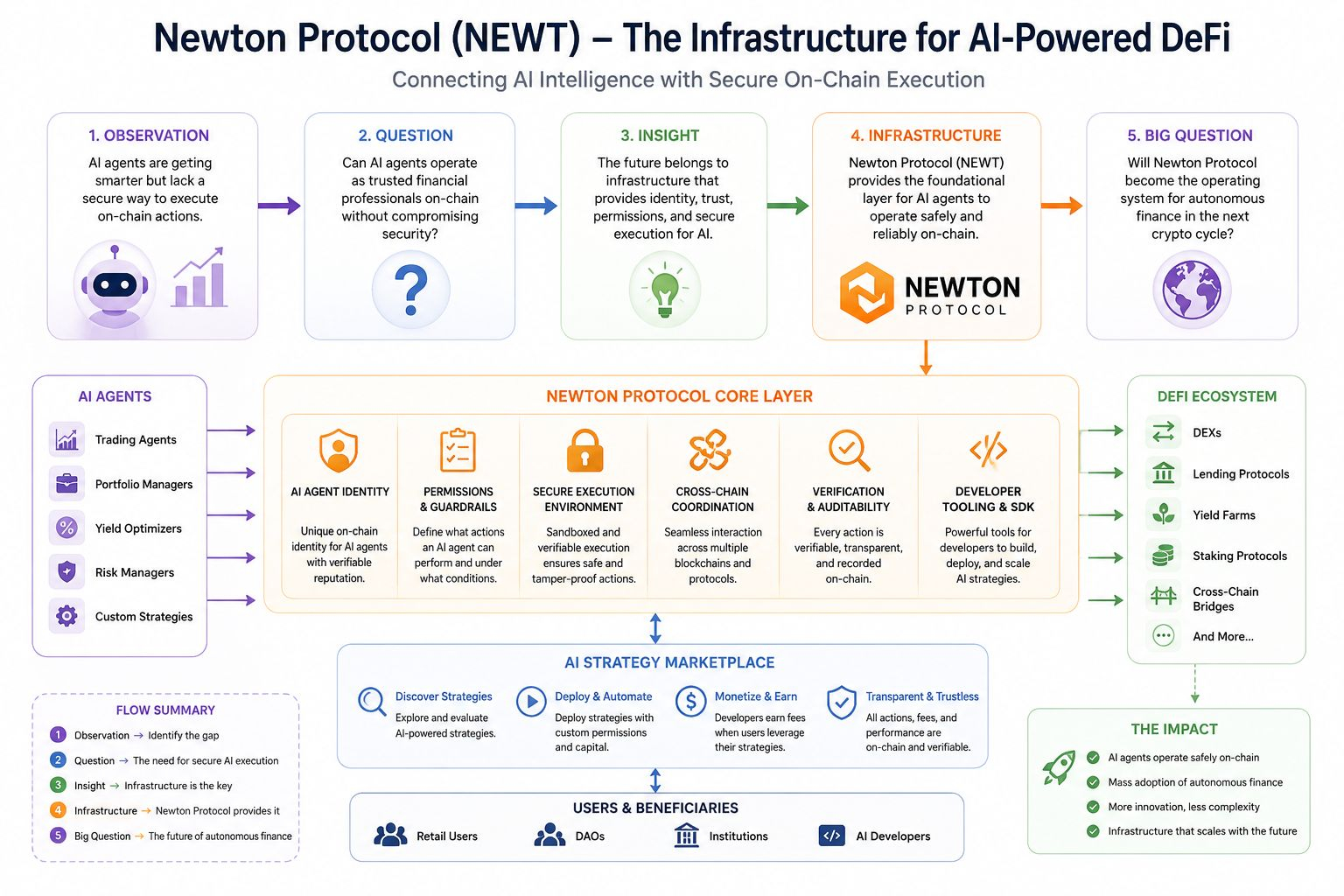
Artificial intelligence is entering a new phase. The conversation is no longer just about smarter chatbots or faster models. The real challenge is creating an internet where AI agents can operate independently, execute financial decisions, and interact with decentralized applications without sacrificing security or trust.
That shift raises an important observation.
We have built AI that can think. We have built blockchains that can verify. But we still haven't built an infrastructure that allows both to work together seamlessly.
This is where the conversation around Newton Protocol (NEWT) becomes interesting.
Every week, a new AI agent promises to automate trading, manage portfolios, analyze markets, or execute on-chain strategies.
The problem isn't intelligence.
It's execution.
An AI agent can identify the perfect trade, but how does it securely control assets? How does it prove that its actions follow predefined rules? How can users trust an autonomous system that operates across multiple chains and protocols?
Without trust, automation remains limited.
Without secure infrastructure, AI becomes another centralized service wearing a decentralized label.
What if AI agents could operate like programmable financial professionals instead of experimental bots?
Imagine giving an AI permission to manage liquidity, rebalance a portfolio, claim staking rewards, or participate in DeFi opportunities all without exposing your private keys or relying on centralized servers.
The challenge has never been about making AI smarter.
The challenge is creating the infrastructure that allows intelligence to execute safely on-chain.
That's the gap Newton Protocol is trying to address.
Throughout crypto's history, the biggest winners haven't always been the applications people interact with.
They've often been the invisible infrastructure beneath them.
Ethereum wasn't successful because of a single decentralized application.
It became valuable because thousands of applications could be built on top of it.
The same principle may apply to AI.
Instead of asking, "Which AI trading bot will win?"
Perhaps the better question is:
Which protocol becomes the foundation that every AI agent relies on?
If autonomous systems become common across crypto, they won't simply need intelligence.
They'll need identity.
Permissions.
Verification.
Secure execution.
Cross-chain coordination.
Developer tooling.
These aren't flashy features.
They're infrastructure.
And infrastructure tends to become more valuable as ecosystems grow.
Newton Protocol appears to be positioning itself as that foundational layer rather than another consumer-facing AI application.
Instead of competing with every AI agent, it aims to provide the rails those agents can use.
Think of it like this.
Roads rarely receive the same attention as the cars driving on them.
Yet without roads, transportation never scales.
Likewise, if AI agents become responsible for billions of dollars in on-chain activity, they'll require standardized infrastructure capable of enforcing permissions, verifying actions, securing execution, and enabling developers to build reliable autonomous applications.
That may ultimately prove more important than any single AI model.
The protocol's vision extends beyond automated trading.
It points toward a marketplace where developers can build, deploy, and monetize AI-powered strategies while users interact with autonomous systems through a secure, verifiable framework.
If successful, the protocol wouldn't simply host AI.
It would coordinate an entire ecosystem of intelligent on-chain services.
Crypto is entering an era where users increasingly want outcomes instead of complexity.
Few people enjoy manually bridging assets, comparing yields across protocols, adjusting positions every few hours, or constantly monitoring market conditions.
They simply want results.
AI can deliver those results.
But only if the underlying infrastructure makes autonomous execution trustworthy.
That's where the next wave of innovation may emerge not from another chatbot, but from protocols that allow AI to interact with decentralized finance safely and transparently.
Infrastructure often feels invisible.
Until everyone depends on it.
The next crypto cycle may not be defined by which blockchain processes the most transactions or which AI model generates the best predictions.
It may be defined by something much deeper.
Who builds the operating system for autonomous finance?
If Newton Protocol succeeds in becoming the trusted infrastructure layer connecting AI agents with decentralized applications, its significance could extend far beyond another AI token narrative.
Because history suggests that platforms enabling entire ecosystems often create more lasting value than the applications built on top of them.
The market is still searching for the protocol that bridges artificial intelligence with decentralized execution at scale.
Whether NEWT becomes that foundation remains to be seen.
But one thing is becoming increasingly clear:
The future of AI in crypto won't be won by intelligence alone.
It will be won by infrastructure.