
I have been looking into Newton Protocol for longer than I expected, mostly because I assumed I would understand it after a quick read through the documentation. Instead, I found myself reopening architecture diagrams, comparing rollup designs, and trying to separate what the project actually aims to build from the flood of AI-related narratives that seem to surround almost every blockchain project these days. Somewhere along the way, I realized Newton is asking a more interesting question than I initially gave it credit for. It is not trying to prove that artificial intelligence can make financial decisions. We already know that it can. The harder question is whether those decisions can be trusted once they begin controlling real economic value.
Artificial intelligence has become incredibly good at recognizing patterns, interpreting data, and producing decisions at a speed that no human team could realistically match. Blockchain, by contrast, has always been less interested in intelligence than in verification. It records history, enforces rules, and creates transparent systems where actions leave permanent evidence. The tension between these technologies is obvious. AI often behaves like a black box whose reasoning can be difficult to explain, while financial systems demand accountability whenever assets move. That friction kept resurfacing as I read about Newton because the protocol appears less concerned with making AI more capable than with creating an environment where autonomous systems can operate inside clearly defined boundaries.
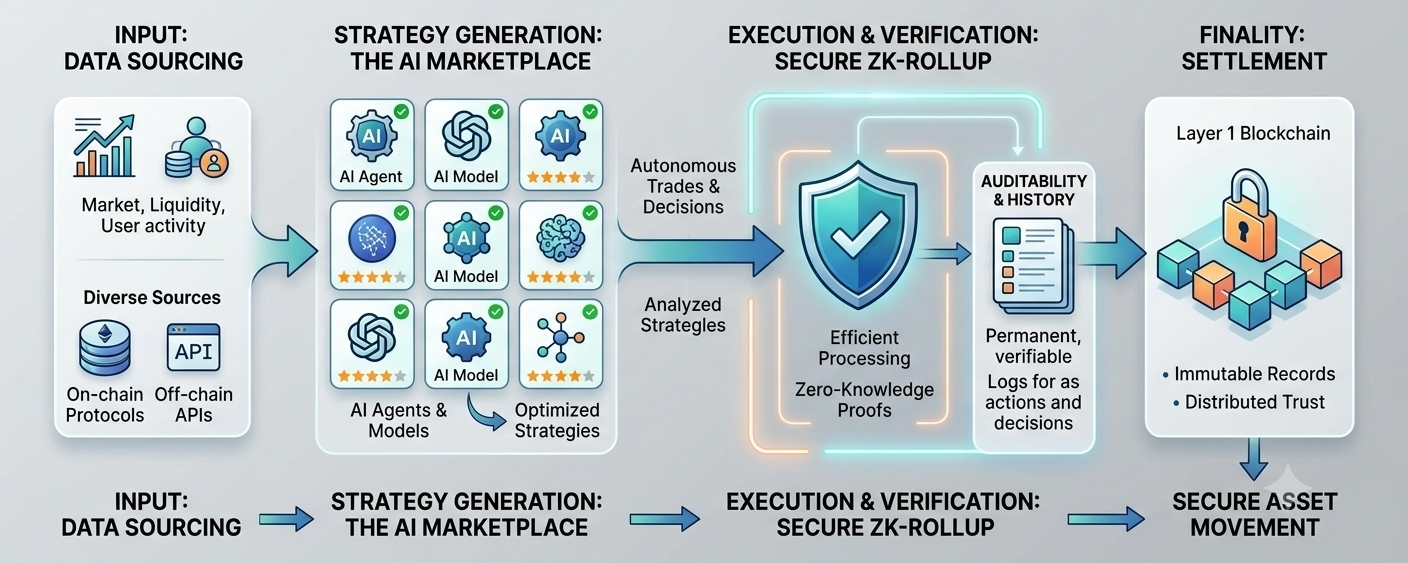
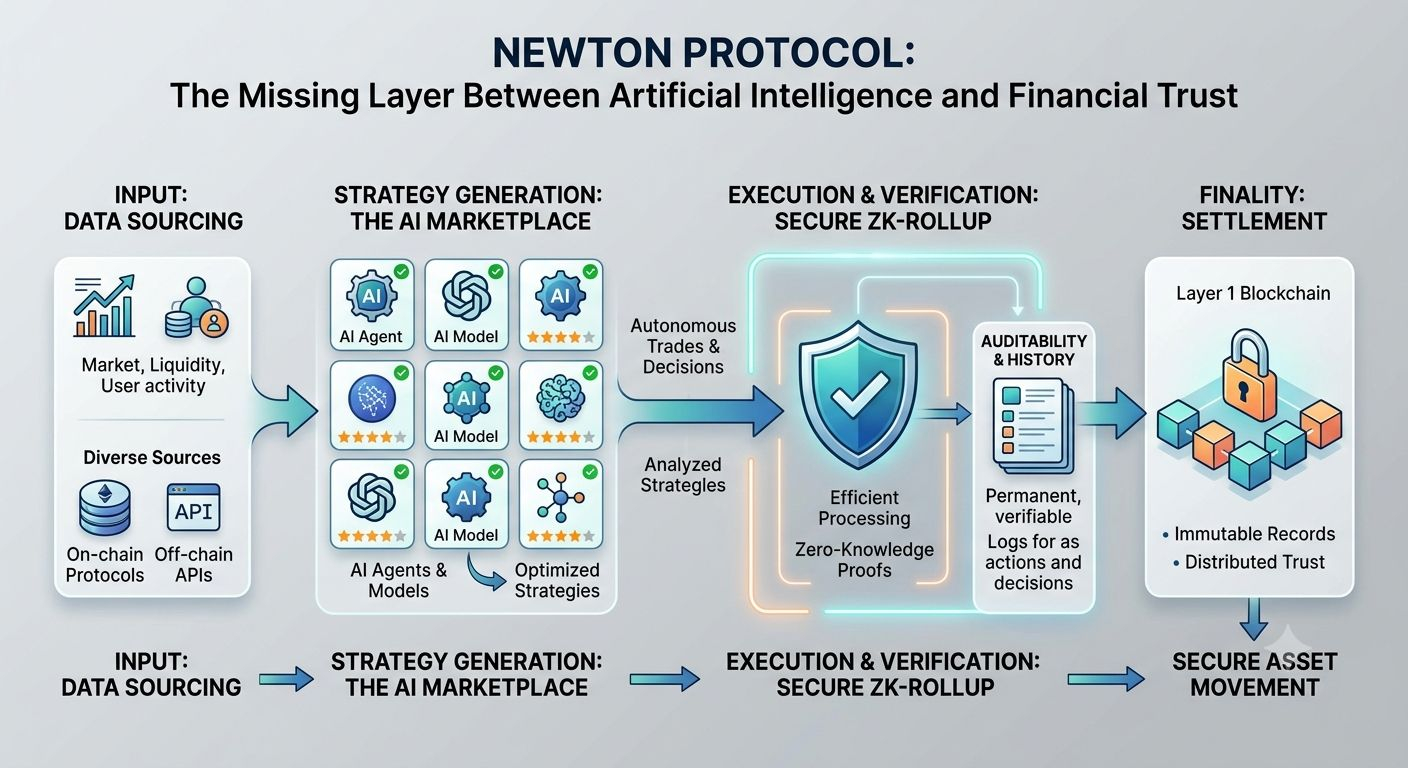
The technical foundation reflects that philosophy. Newton is building a secure rollup intended specifically for AI-driven strategies, automated trading, and autonomous financial execution. At first, I wondered why another specialized rollup would be necessary when Layer-2 ecosystems are already expanding so quickly. After thinking about it for a while, the idea became more convincing. AI workloads generate constant streams of computation that would be expensive and inefficient if every operation had to execute directly on a public blockchain. Newton separates intensive computation from blockchain verification, allowing AI agents to process complex tasks while recording important outcomes in a secure and transparent way. It feels less like forcing blockchain to become an AI computer and more like allowing each technology to focus on what it naturally does well.
What also caught my attention is the marketplace Newton hopes to create for AI developers. The current AI landscape is fragmented, with researchers building sophisticated models that often remain locked behind private APIs, proprietary software, or scattered open-source repositories. If autonomous financial agents become common, reputation will matter almost as much as performance. Developers will need ways to prove that their strategies consistently behave as expected without exposing every detail of their underlying models. Users will need more than marketing claims before trusting software with meaningful capital. Newton seems to envision a system where AI strategies develop transparent execution histories that allow trust to emerge gradually rather than relying entirely on promises.
I keep coming back to one idea that sits beneath all of this. We spend an enormous amount of time discussing whether AI is becoming intelligent enough, but surprisingly little time discussing whether our infrastructure is becoming trustworthy enough. Those are completely different problems. An autonomous agent capable of managing liquidity, rebalancing portfolios, or executing algorithmic trades is only useful if people believe its actions can be monitored, constrained, and audited. Financial history is full of examples where sophisticated models failed because confidence disappeared faster than the mathematics could respond. Better intelligence alone does not solve that problem.
Of course, none of this guarantees Newton's success. Infrastructure projects rarely succeed because of architecture alone. They need developers willing to build applications, users willing to trust new systems, liquidity that reinforces network effects, and enough flexibility to adapt as both blockchain technology and artificial intelligence continue evolving. AI itself changes at an astonishing pace, while infrastructure often requires years to mature. There is also the unavoidable reality of regulation. Autonomous financial systems introduce difficult questions about accountability, compliance, and responsibility that no blockchain protocol can fully answer on its own. Those uncertainties should probably make anyone cautious before assuming that technical elegance automatically translates into adoption.
Even with those doubts, I find Newton Protocol unusually compelling because it is focused on a problem that feels increasingly inevitable rather than temporarily fashionable. Artificial intelligence is steadily moving from assisting human decisions toward making independent ones, and decentralized finance is becoming more automated with every passing year. Eventually those trends collide in meaningful ways. When that happens, the conversation may shift away from whether AI is capable enough and toward whether the systems surrounding it deserve our confidence. Newton is attempting to build that missing layer of trust. Whether it becomes the standard for autonomous financial infrastructure remains impossible to predict, but the question it is trying to answer feels more relevant every month, and that alone makes it worth paying attention to.
