

I honestly thought it sounded a little heavy.
Crypto already has enough layers, enough dashboards, enough compliance language, enough people trying to make simple things feel institutional. My first reaction was probably the same reaction many DeFi users would have:
Why do we need another checkpoint?
Isn’t the whole point of DeFi that transactions move freely?
But the more I think about how DeFi actually works outside of theory, the more that reaction starts to feel incomplete.
Because the real problem is not that DeFi lacks monitoring.
DeFi has plenty of monitoring.
Dashboards. Alerts. Risk reports. Analytics tools. Wallet trackers. Exploit postmortems. Compliance screens. Incident threads. Telegram warnings after something has already gone wrong.
The issue is that most of this comes after the fact.
After funds move.
After the vault accepts the action.
After the strategy executes.
After the bad transaction is already part of history.
That is useful for analysis, but not always useful for protection.
In traditional finance, many actions are blocked before they happen. Not because the system is perfect, but because institutions cannot afford to explain every failure after settlement. A bank, fund, or regulated platform usually needs some version of pre-transaction permissioning, policy checks, identity rules, risk controls, and internal approval logic.
DeFi mostly flipped that around.
It made settlement fast, open, and final.
That is powerful.
But it also means that mistakes become expensive very quickly.
For normal users, the problem is simple: they do not read every smart contract, understand every vault policy, or manually evaluate every risk condition before signing. They rely on interfaces, trust signals, reputation, and sometimes hope. That is not a serious security model. It is human behavior pretending to be technical confidence.
For builders, the problem is different. They want open systems, but they also need guardrails if their products are going to touch serious capital. A DeFi vault that can only be understood by experts will not scale beyond experts. If a strategy has rules, restrictions, compliance requirements, or risk boundaries, those controls need to exist where the transaction actually happens, not buried in documentation.
For institutions, the gap is even sharper. Monitoring after settlement is not enough when legal responsibility exists before the trade. A fund cannot simply say, “We noticed the violation afterward.” Regulators, auditors, risk officers, and clients usually care about whether the system prevented the wrong action in the first place.
And regulators are not really asking DeFi to become traditional finance. At least not directly.
The deeper question is whether decentralized systems can prove that certain rules were enforced without turning everything into a closed database again.
That is where something like Newton Protocol becomes interesting to me.
Not as a hype story.
More like plumbing.
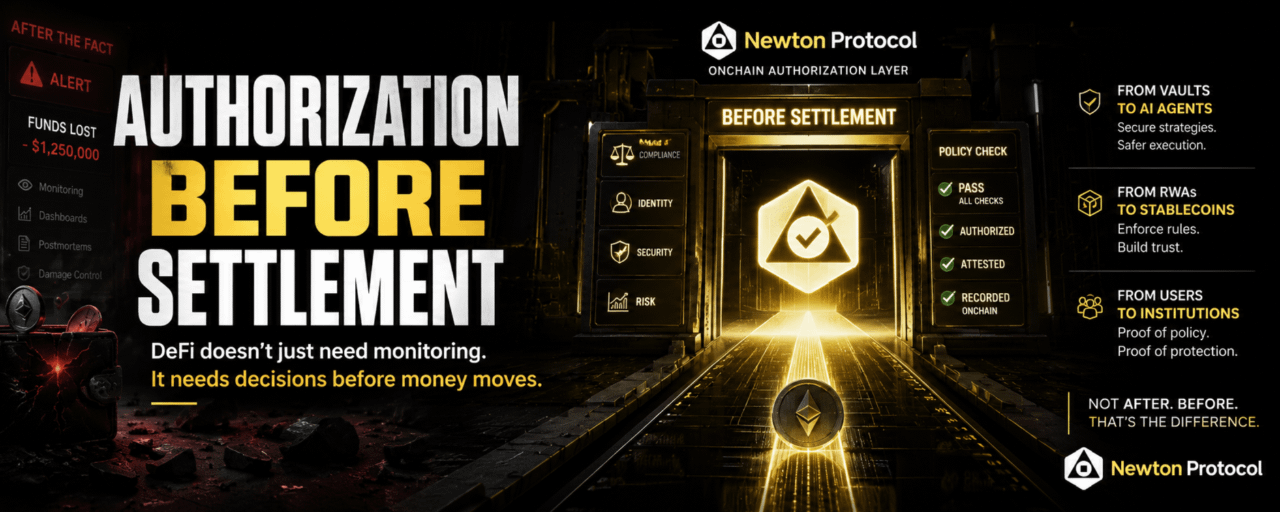
Newton’s idea is that DeFi transactions should be checked against active policies before settlement, with a signed pass/fail attestation recorded onchain. That sounds small until you think about what it changes. It moves the trust question from “what happened?” to “what was allowed to happen?”
That difference matters.
A post-settlement monitoring tool can tell you a vault took a risky action.
A pre-settlement authorization layer can potentially stop the action before it becomes a problem.
That does not make DeFi risk-free. Nothing does. Policies can be badly written. Identity systems can be flawed. Compliance logic can become too rigid. Extra checks can add cost, latency, and complexity. If users feel like authorization is just another gatekeeper wearing crypto clothes, they will resist it.
And they should.
DeFi does not need invisible control pretending to be safety.
But it may need enforceable rules that are transparent, programmable, and provable.
Especially if AI-driven strategies, automated trading systems, RWAs, stablecoins, and institutional vaults become normal parts of onchain finance. Once agents start moving funds, and once vaults start executing strategies automatically, monitoring alone starts to look late.
The machine does not need a report after the mistake.
It needs boundaries before action.
That is the real reason authorization before settlement matters.
It is not about making DeFi slower for no reason. It is about making higher-value DeFi usable by people and organizations that cannot operate on vibes, screenshots, and after-the-fact explanations.
Newton Protocol will likely work only if it stays boring in the right way: reliable, clear, affordable, and hard to game. It could fail if it becomes too complex, too permissioned, too expensive, or too dependent on policies nobody trusts.
But the direction feels serious.
Users need fewer surprises.
Builders need safer execution environments.
Institutions need proof before exposure.
Regulators need evidence that rules were not just written, but enforced.
And DeFi, if it wants to handle more than speculative capital, may need to accept a difficult truth:
final settlement is powerful.
But final settlement without prior authorization can turn every mistake into a permanent record.