
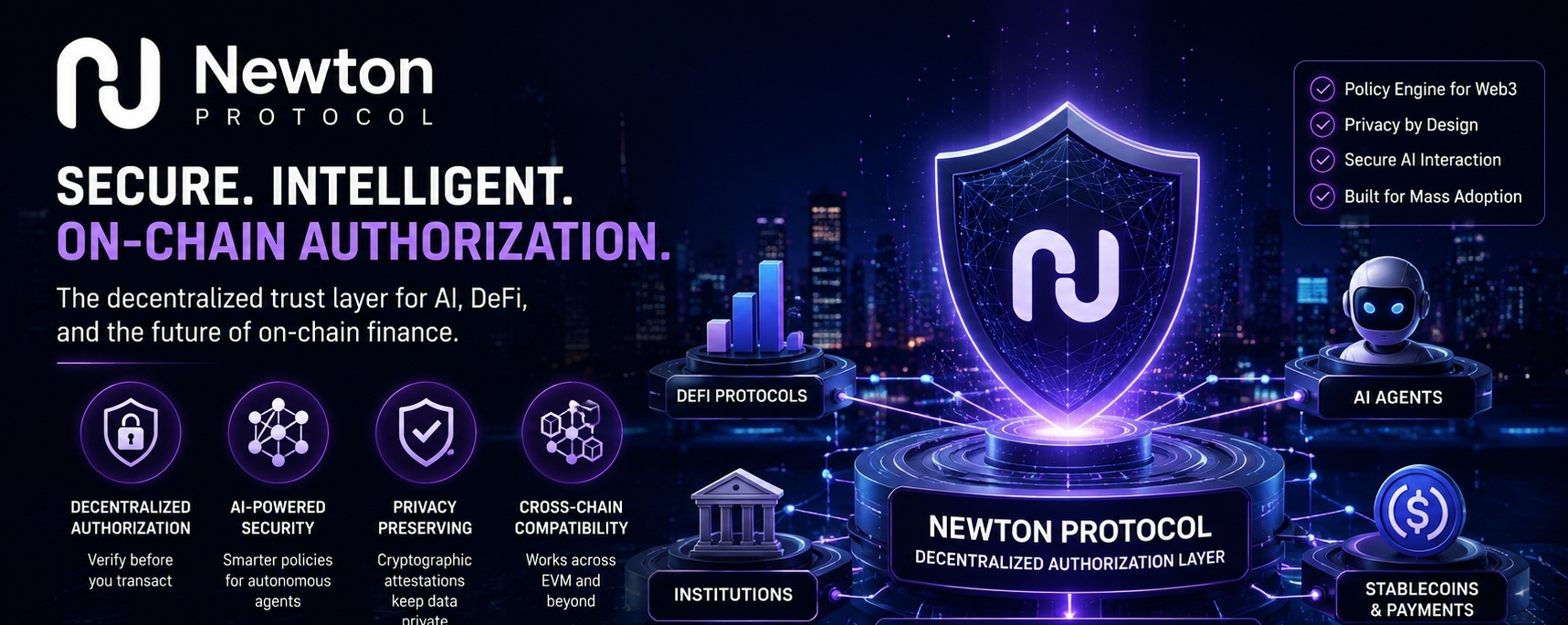
Newton Protocol caught my attention because it approaches a problem that has quietly become more important as crypto has evolved. Most blockchain projects compete to process transactions faster or cheaper, while Newton is focused on what happens before a transaction is ever approved. That difference may sound small at first, but it changes the entire conversation. As more value moves on-chain and AI systems begin interacting with decentralized applications, simply executing transactions is no longer enough. There has to be a reliable way to determine whether an action should be allowed in the first place, and that is exactly where Newton Protocol is positioning itself.
At its core, Newton Protocol is building a decentralized authorization layer that allows smart contracts to make decisions using information that exists beyond the blockchain itself. Traditional smart contracts only understand what is stored on-chain, which makes them predictable but also limited. They cannot naturally verify identity, spending policies, compliance requirements, or real-world conditions without depending on centralized services. Newton is designed to bridge that gap by allowing trusted policy decisions to be verified through a decentralized network before transactions are executed.
One of the aspects that makes the project interesting is its architecture. Instead of introducing another blockchain competing for liquidity and users, Newton works as infrastructure that other applications can integrate. Developers can define policies that determine how wallets, AI agents, vaults, or financial applications are allowed to operate. Those policies are evaluated by decentralized operators, who verify the required information and produce cryptographic attestations that smart contracts can trust without exposing sensitive user data on-chain.
Privacy plays an important role in the protocol's design. Rather than storing personal information publicly, Newton relies on cryptographic proofs and attestations so applications can confirm that predefined conditions have been satisfied without revealing unnecessary details. This approach creates a balance between transparency and privacy, something that has always been difficult for blockchain applications to achieve.
Artificial intelligence has become one of the biggest narratives in the digital asset industry, but many projects simply attach AI to their branding without explaining how it fits into blockchain infrastructure. Newton takes a more practical direction. Instead of building another AI model, it focuses on securing the actions performed by AI systems. If autonomous agents eventually manage portfolios, execute trades, or automate payments, they need clear permission structures instead of unrestricted access to digital assets. Newton provides the framework where those permissions can be defined, verified, and enforced before assets ever move.
The protocol is also designed to support institutional participation in decentralized finance. Large organizations often require transaction policies, regulatory checks, spending controls, and operational safeguards before interacting with blockchain networks. These requirements have traditionally been difficult to implement in decentralized environments. Newton introduces programmable authorization that allows institutions to apply those rules without abandoning the transparency and composability that make blockchain technology valuable.
Developers are another important part of the ecosystem. Newton provides tools that allow applications to integrate authorization logic without rebuilding complex security systems from scratch. Instead of every project creating its own permission framework, developers can rely on a common infrastructure that supports policy verification across different blockchain environments. This approach encourages consistency while reducing the technical complexity involved in building secure decentralized applications.
The NEWT token is designed to support the protocol rather than exist as an isolated asset. It is intended for staking, governance participation, protocol fees, and supporting the network's model ecosystem. Operators helping secure authorization requests are incentivized through the protocol, while developers creating useful models and policies can also participate in the broader ecosystem. This creates an economic structure where activity inside the network contributes directly to its long-term operation.
Another strength of Newton is its focus on interoperability. Modern blockchain activity is no longer limited to a single network. Assets, applications, and users constantly move across multiple ecosystems. Newton is designed to function across different environments, allowing authorization policies to remain consistent regardless of where applications are deployed. That flexibility becomes increasingly valuable as blockchain infrastructure continues expanding beyond individual chains.
Security remains one of the protocol's strongest themes. Every authorization request passes through decentralized verification instead of relying on a single authority. The combination of distributed operators, cryptographic attestations, and programmable policies creates multiple layers of protection that reduce the risks associated with centralized approval systems. As blockchain applications continue handling larger amounts of capital, these additional security mechanisms become increasingly significant.
What makes Newton Protocol stand out is not flashy marketing or promises of instant transformation. Its value comes from addressing a layer of blockchain infrastructure that has often been overlooked. Authorization, policy enforcement, privacy-preserving verification, and secure interaction between AI systems and decentralized finance are all becoming increasingly relevant as the industry matures. Rather than replacing existing applications, Newton is building technology that allows those applications to operate more safely, intelligently, and efficiently while preserving the decentralized principles that define the blockchain ecosystem.